
Chartered Accountant and Big 4 auditor, Karthik Venkat, was not in a good space when he came to us.
His first GMAT score was 560! And after 4 attempts, the highest he could score was 720. In his view, it was a low GMAT score for his target schools. But he wasn’t going back to the GMAT exam center ever again.
He had applied to 8 elite business schools in USA and Europe – 4 with the help of an admissions consultant and 4 on his own.
He was rejected by every single school. To add insult to injury, he didn’t get even a single interview invite from any of them.
He explains what he did in his second attempt that completely changed his fortunes.
Hint: It was neither profile improvement not a higher GMAT score. Both remained exactly the same in both attempts.
Read Karthik’s review of MBA Crystal Ball on LinkedIn.
MBA after Big 4 Audit for CA
by Karthik Venkat
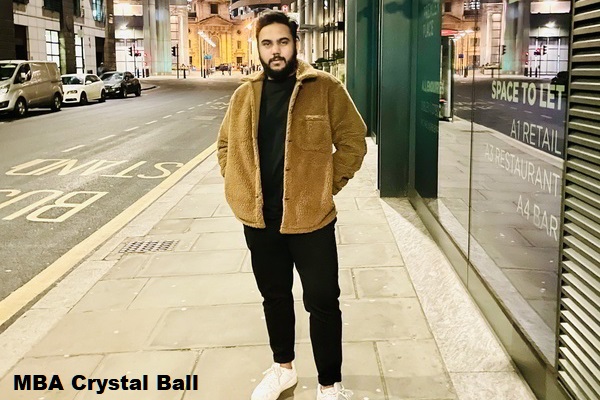
I come from a quintessential Indian middle-class family where education is highly valued. Growing up in the midst of financial difficulties, I learned the importance of money and developed a fascination with finance.
To lay the foundation for a career in finance, I pursued a Bachelor of Commerce (Hons) from Delhi University and later became a Chartered Accountant.
Throughout my life, I have been actively involved in sports, particularly cricket and badminton, and I continue to pursue these interests. Additionally, I enjoy playing poker and watching geopolitical videos. My friends would describe me as an optimistic, risk-taking, and approachable person.
Across my professional life, I have worked across all the Big Four firms with extensive experience as an auditor for 7+ years.
During this time, I led multicultural teams and served clients from diverse sectors such as automotive, real estate, telecommunications, and media & entertainment.
However, as I aspire to reach C-suite roles in the long term, I realized the need to broaden my perspective beyond finance and gain a deeper understanding of other business functions like marketing, operations, and strategy.
Through my research, I discovered that pursuing an MBA would provide me with the knowledge and skills necessary to transition into strategy consulting and eventually industry roles (Benefits of MBA after CA).
GMAT Preparation
My GMAT preparation journey was relatively smooth (well, not exactly). I scored a 460 on my first diagnostic mock and 560 on my first GMAT attempt.
I realised that the exam tests very different skills such as decision making, communication with clarity, and ability to comprehend complex information and structure it.
Once I got the hang of it, I was able to push my score to a 720 on the third attempt. While it was a good score, considering that I was coming from an over-representative pool, I gave another shot at the exam but got only a 710.
I understood that I may have reached a plateau, so didn’t waste too much time and effort for another retake.
My top concerns
Top concerns when considering B-school applications were as follows:
- How does my GMAT score compare to the averages of my target schools? Would I need to add +20 to my score or select schools based on this criterion, considering I come from an overrepresented pool?
- How do B-schools view articleship experiences? Are they considered valuable?
- On paper, my background in audit does not appear non-traditional. Could this decrease my chances?
Through conversations with Admissions Committee members, alumni, and effective essay drafting, I was able to address and alleviate these concerns.
First innings
Though there is plethora of information online, it is not very structured and millions of different opinions floating around.
As I didn’t know anyone who had applied to international B-schools or went through a similar path, I collaborated with an admissions consultant who’s quite popular.
I took a 4-school package that included essay and resume edits. I worked with the consultant for LBS, INSEAD, HEC and Cornell.
Using a similar methodology, I applied to 4 other schools on my own – Tuck, Ross, Fuqua and IESE.
Unfortunately (or fortunately!) I was rejected by all without even an interview.
I chose to view the setback as a chance for self-improvement. While I did not receive feedback from the schools, I dedicated substantial time to analyse each application critically.
Meanwhile, I switched my job and moved to London in a lateral move to gain more international exposure.
Second Innings
Once bitten twice shy, they say. But despite the disappointing results of my earlier applications, I did realise that analysis required a professional help. And going by my previous experience, I knew I couldn’t do that on my own.
So I reached out to MBA Crystal Ball (MCB) team. Having followed MCB for almost a year, I emailed Manish Gupta to get some assistance.
One aspect that I felt very different about MBA Crystal Ball was that Manish didn’t convince me to take up their services.
Secondly, he shared very honest feedback and delved into quite a few aspects of my profile and discussed, with clarity, about realistic chances as a reapplicant.
I admired their approach and sincerely believed that they can help me with the application process.
I had opted for MBA MAP + Essay editing services for 4 B-schools as I felt that I needed help not only with writing the essays but also with communicating my stories in an effective manner.
Eventually, I got paired with my mentor at MCB (godsend guy!). After the initial call with him, he shared a couple of documents.
1. Meet me document
Essentially this required filling up key details of me growing up – childhood, school, college, education etc. Also, it focused on writing key achievements/failures of professional life.
2. MBA MAP Questionnaire
It focused on rating oneself on soft and hard skills. Also, there were standard MBA essay questions (similar across b-schools) to be written in a few words.
So, even before we started working on the essays, we spent considerable time in going through all the stories and developing an applications strategy to present a holistic view.
Some key aspects we approached differently were:
School Selection
Based on my long-term goals and preferences, we filtered out four target schools: IESE, LBS, HEC, and INSEAD. These schools aligned with my aspirations of working in Europe, transitioning into consulting, and having strong brand recognition and alumni networks.
Attending MBA information sessions, virtual campus visits, and alumni meetings allowed me to gain a deeper understanding of the schools’ cultures and determine my fit.
Essays
Prior to starting each essay, we brainstormed content and key points, making it easier to articulate my thoughts.
My consultant provided a structured framework for each essay, including expected content and word limits for each section, which helped me fit my stories into the relevant structure. His reviews were invaluable, highlighting gaps or ambiguities in my responses and allowing me to strengthen my essays.
The outcome of my efforts was securing interviews at IESE, HEC, and INSEAD, although I did not receive an interview invitation from LBS.
Opting for the MBA interview package from MBA Crystal Ball, I received guidance from my MCB mentor, who knew my story inside out, and participated in two mock interviews.
These practice runs allowed me to refine my responses, manage timing, and emphasize the unique aspects of my profile.
My MBA interview experiences
My interview experiences were as follows:
IESE MBA Interview
The interview with an Adcom member was conversational, focusing on my strengths, weaknesses, and the changes in my profile since my previous application.
HEC Paris MBA Interview
I had two alumni interviews, one conducted over Zoom and the other in the alumni’s office.
HEC required a PowerPoint presentation on a chosen topic, and I had already prepared the content and slides with help from MCB.
The interviews primarily centred around my goals and the international aspects of my profile.
INSEAD MBA Interview
Once again, I had two alumni interviews, both conducted in person.
The first interview delved into my career choices, extensively discussing alternative plans and motivations for pursuing an MBA.
The second interview took place in a relaxed coffee shop setting and focused on my extracurricular activities, travel experiences, and life after INSEAD.
Ultimately, I received admission offers from HEC, IESE, and INSEAD. I have decided to attend INSEAD for the class of 2024 starting in December.
If the significance of that last sentence isn’t immediately obvious, I should highlight that I was a reapplicant to all 4 bschools in my second attempt, and 3 of them offered me admits.
This was beyond my expectations!
Here’s what I learnt
From this journey, I have learned several valuable lessons:
- Always maintain self-belief, even during challenging times such as GMAT preparation or the application process. Perseverance is key.
- Develop a clear understanding of why you want to pursue an MBA and why a particular school aligns with your goals. It is crucial to envision the kind of life you want beyond these milestones.
- Begin by jotting down relevant content from different aspects of your life and then focus on structuring it effectively. Present your stories in a compelling manner in your essays.
- Spend some time to choose the right MBA admissions consultant. I found mine during my second innings. Hope you can find yours in the first!
I am excited to embark on the next chapter of my life at INSEAD, where I will further develop my skills and expand my horizons.
Also read:
– MBA reapplicant success stories
– MBA after IIT after multiple rejections
– From waitlist to scholarship: MBA Consultancy experience
– MBA after CA: From India or abroad
– MBA vs CA
– MBA in Germany for Chartered Accountant, after 30
– MBA for CA with experience in family business
– CA rejected by ISB, admitted in second attempt
– How an Indian CA got scholarships from top business schools in USA
