
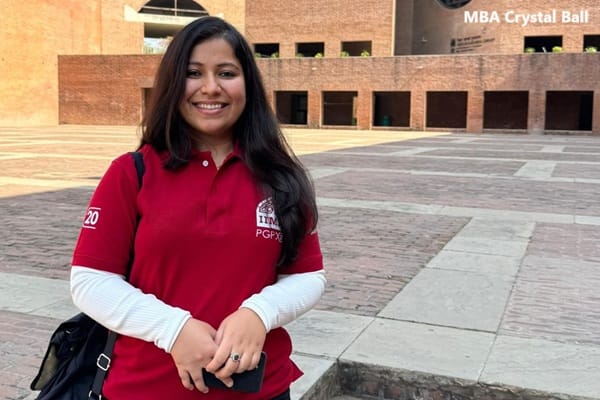
Roma Mishra, an IT professional, applied to the top 3 IIM one year MBA programs – IIM Ahmedabad (IIMA PGPX), IIM Bangalore (IIMB EPGP), IIMC MBAEx) – after a career break, and with a modest GMAT score of 710. She got into two of them, with one (IIMA) offering her scholarship. Check out her journey.
This is the transcript of our our video Q&A with Roma. Watch the original video here: How I got into IIM-A and IIM-C: 1-year MBA for Executives
How I got into IIM-A & IIM-C after career break
IIM One Year MBA | MBA Crystal Ball Review
by Roma Mishra
MG: Welcome Roma!
Roma: Hi Manish, thank you for having me here.
MG: Could you give us a brief background about your academic qualifications, what you did growing up?
Roma: I grew up in Bombay. I did my BTech in computer science engineering from BIT Mesra. As I come from a family of scientists and engineers, so that choice just came very naturally to me.
Personally, I have always made sure that my academics and co-curriculars go hand in hand, rather, I’ve been much more into co-curricular activities.
So, even before college, I was into singing and painting, taking part in various state level competitions. I received scholarships for the same for graduation and that carried forward during my college years and my work life as well.
MG: Very interesting! It always helps to have that balance. Where did you head after you completed your undergrad? Tell us a little about your professional career?
Roma: I got placed in Oracle India as a software developer and I worked there for about 7-7 ½ years. My work here was a very good learning experience both technically and also domain-wise.
I was lucky that my product came from a hospitality-tech domain, so I got to know a lot about the industry as we used to solve a lot of real-time client issues. So yes, I got a good exposure.
MG: Can you elaborate on which areas you were involved in? Considering that people move around especially in the tech industry, what made you stick on for so long?
Roma: I was on the code development side; I was a backend software developer. Actually, the kind of work I did is what made me stick around.
I would always look for opportunities for learning and I got that in my company itself. So, I didn’t find any solid reason as such to switch at that time.
MG: Then, what prompted you to look at an MBA at a relatively later stage in your professional journey?
Roma: To be honest, MBA was in the cards So while I was working as a software developer, I knew my next step would be an MBA as I would switch to something that would diversify my profile.
As I come from a very purely technical background, even the learning was very linear for me. But I wanted a shift in my role and function and move to business roles.
I wanted to do that through formal education, so that’s what prompted me to think about an MBA. I had started considering it 5 years into my career, but it materialized much later.
MG: You also had a bit of a career break. So, tell us about that? How did you navigate that?
Roma: After gaining around 7 ½ years of experience, I had a career break. So, what happened between me and my company was amicable, and I was compensated for it. Though it was shocking at first, it’s also about perspective right!
I thought of looking at it as an opportunity rather than a loss.
I needed personal time for myself. I thought this transition had come at a perfect time, so I decided to take some personal time-off and then go for an MBA.
MG: How did you go about identifying the types of schools you were interested in – in terms of location, like within India or abroad and how did you navigate that entire decision-making process?
Roma: It was very simple for me. I knew I wanted to be in this country and even in future, I have plans to start a venture of my own and I thought I want to do it in this geographical space.
I spoke to a lot of alums from several schools and realized that an MBA is actually a very localized degree in terms of geography. So that’s how I thought this is where I need to be. It was a very simple decision and I applied only to colleges in India for MBA.
MG: So, from a decision-making perspective, did you find motivation outside, for example, people in your network who might have done it or was it internal? How did you crystallize your sort of schools and the decision for MBA?
Roma: Both actually! The decision for an MBA was internalized – it was purely the thought that if I want to work in these domains, I have go step-by-step and get the education first. That was my thought process.
But then, when I spoke to the alums of these schools in the country, I realized that they provide much more than just education and through networking, I crystallized the choices that I made as to which schools I need to apply in India.
MG: Sure, that makes sense. Then why did you decide to work with a consultant because you already had your network, you could maybe leverage alums? How did you go about deciding the right team to work with?
Roma: There are two things here.
Firstly, I had a short time; my immediate application was for EPGP in IIM Bangalore which was just around 20 days away.
And very luckily, I had a colleague and a dear friend who was an IIMA alum and I spoke to him about my situation and how I should go about it.
There is a plethora of information out there on the internet on how to navigate your business application and I spent a day on it. It was way too overwhelming for me and I wanted to do this process right.
Secondly, I’m already on a career break and I don’t want to take any chances here. So, I knew that I needed professional help.
I spoke to my alum friend and you were his mentor and he directly connected me with you.
I took my decision in 2 minutes that I need to connect with you and yeah, that was my process.
[Read Roma’s friend’s story here: INSEAD offered ₹16 lakh in scholarship. Should I drop out of IIM Ahmedabad?) ]
MG: Tell us how your experience was working with MBA Crystal Ball. Which consultant did you work with? Any ‘Aha’ moments maybe? Or anything that stuck out while you were going through the process?
Roma: My mentor was Avinash and I’m so grateful to him. I think coming here was the best decision that I took. The process really resonated with me.
So you start with a Meet-me document and then we start preparing the drafts.
If I were to summarize, it was a very beautiful self-discovery journey is what I would say.
The process, and with every draft that you prepare, the probe questions would ask me to go forward with the next draft, which would lead me to retrospect for long, long hours. That’s what I did in my profession, and that’s what I think was very beautiful. The best thing was that it wasn’t just about the goal.
So when we would start, it wasn’t like, ‘Okay, you have so many words to fill in an essay, you need to write this, this, this. Let’s start with it.‘ That’s not how we went about it.
Instead slowly, he started to get to know me and we went through my entire professional and personal journey.
We picked out stories and the richness of the application was brought into my essays is what I would say and we grew into it vertically than just putting a number of stories into one essay. We went really into the depth of one story and that was brought out very beautifully in the application.
MG: Perfect! So, tell us which colleges you applied to? Where did you interview? Especially, any kind of interview moments that still stay with you?
Roma: I applied to IIM A/B/C. I lie in the mean cohort group in terms of age and experience, so it was again a simple decision.
Before starting my application, I was a little under-confident because I thought I had a very generic linear profile.
This was one area where I thought maybe it is not so good and the other one was the career break and every interview went around that.
So you could only prepare so much, but after every interview, I felt okay, this is something new. All my interview questions were around the career break and I really liked my interviews.
MG: What were the results? Where did you make it? What scholarships did you get?
Roma: So, my first interview was IIM Bangalore’s. I didn’t make it there. My second was with IIM Calcutta where I got wait-listed. But that (admit) got confirmed just two weeks back.
IIM Ahmedabad was my final interview. I gave it my all in the interview and I got in there with an entry scholarship of 25%.
MG: That’s awesome! And I understand that you’re doing this interview from your campus.
Roma: Yes, I’m sitting in my dorm as we speak.
MG: That must be an amazing feeling! Can you share any tips or advice for others who might be facing similar concerns around taking a career break? How did you approach discussing your break during interviews?
Roma: Okay! So I would say that I am in a good position to share because my career break was long. It went on for about 1 year 9 months or so. Firstly, it’s not a taboo, it’s absolutely okay to take career breaks.
Secondly, what’s important is being clear about your reasons – whether it’s for personal growth, self-discovery, uncertainty about your current career path or health-related issues. The reason you have needs to be solid. For that you need to be honest to yourself.
Thirdly, I would say that please surround yourself with a trusted group of people who are accepting, with whom you can share and who keep giving you reality checks from time to time because it won’t be easy when you see your peers working at that time. But again, you’d have that motivation that whatever you’re doing, is all okay.
MG: Okay, just going deeper on this point, because this can be very useful for future applicants, when you were probed, was there a lot of grilling like counter questions about the break? How did that experience go, especially during the interviews?
Roma: So, the most recent that I can recall was IIM Ahmedabad’s interview. The first question itself started with ‘Okay, so you took a career break’. It was a 25-minute-long discussion over that. And I would say it was not grilling. They were just trying to know you better.
So okay, I decided to travel. They wanted to know – what skills did you gain out of it? How is it going to help you in your MBA admits, MBA journey, how you contribute to the cohort?
You cannot just take a break and be idle.
They would ask you a lot of questions around what skills you gained, what your learning experience was. You need to be very honest about it and how that resonates with and how you link that with your MBA decision.
MG: So almost all the interviews were around it. Do you think you had prepared all of it beforehand or were there any surprises while you were addressing or facing these questions?
Roma: There were surprises you see, but you will be able to navigate through them if your intent is solid, if you know why you’re doing an MBA. This is a very cliched question – Why an MBA?
But it is very important why you are here even after 7-8 years professional experience, why you’re doing it at this stage and what you did in your break and how that is going to help you. For me, I came from a hospitality-tech industry and I travelled for a year.
One of the aha moments for them was this – happened in the Bangalore interview – that I travelled solo internationally for many days. I didn’t point that before but I’d like to point it here.
I thought this is a very normal thing to do – traveling solo. But Avinash said no – this is not normal.
This is absolutely a point of self-discovery, so this Aha moment was brought out in my application and the same question was asked in the Bangalore interview as well.
So I travelled solo and coming back to the hospitality industry that I came from, I also explored that while I was travelling. The products in restaurants – I observed, I went through those, I spoke to a lot of people regarding those products in different geographies internationally. So that is also an experience that I gained through my travel.
The interviewers will try to question you a lot on how this will help you in your MBA and I was able to do that properly because again my intent was clear why am I going to do an MBA and I think I utilized my career break quite well.
MG: Interviewers are also known for asking questions on current affairs, industry, so what kind of preparation, if any, did you do on that front and how did it come up during the interviews?
Roma: So at IIM Bangalore, they asked me questions around my industry. They didn’t ask me about political or current affairs but they asked me around my industry which was software and IT.
But they didn’t ask me any at IIM Ahmedabad. There you have a separate format as well. There it’s an extempore. I got a political topic in extempore. I took another chit and even the second topic was a political topic for me.
MG: Any sort of special tips that you have on both, how to prepare for the industry-specific ones and for this extemporary or this political affairs kind of areas?
Roma: For industry-related knowledge, that comes from experience. So I didn’t do any special reading or research or anything like that. I was already in customer (consumer) facing industry. So for that, I worked through my experience and I didn’t do any industry-related prep.
I did go through extempore topics for IIM Ahmedabad on GMAT club but that didn’t help because this year, I mean it, every topic is new. So my agenda for interviews was very different.
So regarding my professional side, I had already done the work during my essays. I had already retrospected, I’ve already had my story straight. So my preparation was majorly around just structuring my answers well in the interviews.
With every answer that I’d say, I needed to make sure that my skills were being brought up. So structuring my answers well was very important for my interviews. The things that you don’t know – I mean extempore – it’s just a hit or miss. If you’re lucky, you might get something that you know of.
My extempore went terribly in IIM Ahmedabad’s interview.
It’s a different experience because I didn’t even know what the topic meant. I had to ask the professor as I was not aware of what that law is.
They tried to help me a bit and it was a 10-15 minute extempore where I couldn’t sense what the topic is, what standing for or against this means. But the questions that they would ask me were intense.
I would try to respond to them to the best of my ability as they’re not testing your knowledge of the topic, but they’re testing your critical thinking ability.
MG: Maybe, also the poise that you did not get anxious, I’m sure you carried yourself well with confidence at that point?
Roma: Oh yes! After that terrible extempore, I took one deep breath and then I said okay, let’s start with the next part.
Also, you need to be honest with your interviewers.
They are very experienced. So towards the end of interview, I admitted that I was not aware of that topic and then rest is history as we see!
MG: Great Roma! Thanks so much for sharing your journey. I’m sure it’ll inspire many future applicants. All the best with your endeavours! We’ll closely track your professional journey.
Roma: Thank you so much Manish. I hope I was of help.
MG: It was very useful!
We hope you found this interview helpful. Watch our other applicant success stories’ videos.
At MBA Crystal Ball we’ve helped many applicants get into the elite business schools, often with scholarships Reach out to us at info@mbacrystalball.com if you’re looking for professional help with your applications.
– How I got into IIM-A PGPX & IIM-B EPGP with scholarships
– Executive MBA from IIM (Ahmedabad, Bangalore, Calcutta)
– Why regular full-time MBA and not Executive MBA
– Best Executive MBA Programs in the world
– How to get into IIMA PGPX after being rejected: MBA after 35
