
When most Indians consider a government job as the final destination (for the stability and respect it offers), some who are already enjoying a comfy sarkari naukri have bigger plans.
From a small town in Punjab to the hallowed halls of Berkeley Haas, Anshul has managed what most MBA aspirants from modest, middle class backgrounds can only dream of. A large part of his success lies in his ability to take rejections in his stride, accept his mistakes and seek help.
How I got $80,000 in scholarship after 8 rejections
My journey from a government job in Punjab to Berkeley Haas
by Anshul Aggarwal
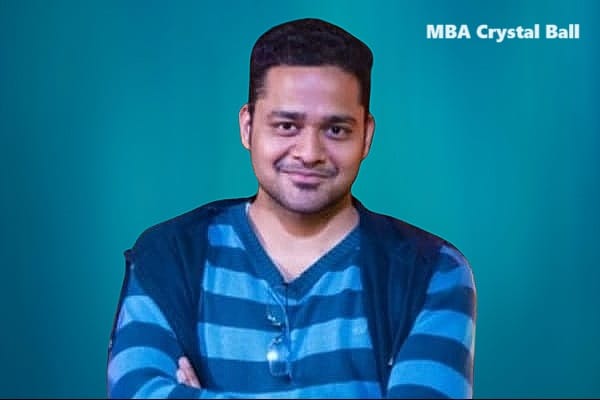
Hello, this is Anshul. I come from a small town named Kotkapura, situated in the south-western part of Punjab.
Born and brought up in a middle-class family, where my grandfather and mother were high-school teachers, I was always encouraged to be academically strong. I’ve always remained academically diligent and have stood among top 5 of my class.
Nevertheless, this middle-class upbringing and the academic diligence always made me think that excelling in academics was the way to achieve success in life.
In hindsight, I believe, I could not be more wrong, and I could have shaped myself as a better human-being, had I also focused on shaping my co-curricular interests, developing interest in sports, and tried to gain some interpersonal skills.
Nevertheless, committing to achieving academic excellence rooted in me the values of perseverance and self-improvement. To date, I have always tried to pick up on best of the personality traits that people around me have.
It takes a village to raise a child – I believe I’ve picked up a bit of something from everyone I‘ve stayed close.
I picked up basketball, guitar, and dramatics in my high-school, but the non-medical and engineering journey took up most of my time and I could never pursue these until the days of my bachelors’ degree.
Searching for an impactful career
Towards the end of my final year of bachelors’, I co-founded a non-profit that helped rural communities in developing their sanitation infrastructure through crowd-funding.
The work was satisfying and working with masses improved my interpersonal skills. However, it did not have any clear career and financial progression.
Thus, post my bachelors’ at NIT Jalandhar in Civil Engineering, I decided to stick to my core career fields and chose to pursue structural engineering jobs.
This was the only plausible career option in civil engineering that provided me the opportunity to pursue my analytical skills in a professional setup without having to experience any on-site construction related chaos.
Hello, government job!
As a structural engineer, the work was satisfying. However, considering the contemporary careers prospects of the field, especially in India, I realized I needed a master’s degree in structural engineering.
Or I could try my luck with public services, which is one of the sought after career path in civil engineering.
I tried both – pursued my M.Tech in Structural Engineering and prepared for competitive exams such as IES, State Engineering services etc.
I cleared the Punjab Public service commission exam in 2018, and joined my present service with the government of Punjab.
At present, I am a Sub Divisional Officer working with the State government of Punjab and manage the government’s in-house strategy wing (policy formation) for the state’s water resource management.
The best part of this public service is the opportunity to impact the society at its core, sitting in a strategic position in the decision making hierarchy.
The opportunity to work directly with the public, administration, legislators, academicians, experts, corporates, and NGOs is something that not many other professions can provide to one in their 20s or early 30s.
Although, managing work (both strategy and execution) within such diverse group of professionals is one of the biggest challenge of such roles, one really gets to develop their skills in negotiation and conflict resolution.
Why MBA after government job
While my career with the government had a steep learning curve and ensured societal respect and financial security, it had its own challenges. I’ve always liked tackling new challenges and keep life at a pace.
However, the government roles usually mean stagnancy, both in terms of finances and career prospects. One cannot really switch to any other role/company easily after spending a good span of career in the government.
I decided to explore other career options to keep myself relevant and to maintain mobility in my career.
MBA was one such golden ticket that could allow me to restart my career, while also taking in account the skills learnt in my previous experiences.
I had no one in particular, in my family or in close circle, who took such decisions and pursued such degrees, especially after leaving coveted public roles.
My aspirations from an MBA were quite simple: a mobile and switchable career, high financial output, exposure and network across industries, and an insight about entrepreneurial skills for any future endeavors.
Didn’t expect GMAT to give me such a tough time
My first attempt at GMAT was a casual attempt without any preparation and I scored 650. With a prep of approx. a month from online sources, I easily scored 680. However, I was stuck at this score for quite a while.
While I was scoring 720-740 in Manhattan mocks, I could never really cross 680 in real exam conditions.
I did not want to settle for a lower tier B-school and trade my coveted government job with it. I decided to only give it up for a good admit.
While I applied to many tier-1 and tier-2 schools in USA and Canada, I got in at one of the tier-2 programs in Canada.
COVID protocols made it mandatory to attend this school online, sitting from home. I did not want my MBA to go this way, and I left that admit.
The following year, I took one more shot at the GMAT and scored 700. It was still not enough for a top 10 or top 20 B-school.
Given my diverse professional profile and good academic background, GMAT was one factor that I believe was weighing my profile down. I then tried to take GRE and luckily scored 326.
Rejected and dejected, I needed a good mentor
By this time, I had already received rejects in all my applications in top-20 schools.
I started questioning my profile and could not really decipher the issues with it that were leading me to straight away rejects.
I needed help!
However, I had no one (friends or family) who was in such top schools, or pursuing a good MBA abroad. Discussing with alums from these top schools helped but wasn’t enough.
I had already tried applying to schools myself, but was exhausted from all the rejects that I was getting.
That when I decided to take help from admissions’ consultant.
My preference was to engage a global consultant; however the prices were too hefty to even think about such a decision. And even if I could afford them, I doubt they’d be able to understand my profile and career journey.
I decided to explore Indian consultants – they were still charging heavy amounts. Moreover, I found that these consultants had managed profiles where the candidates had a clear career path in the corporate sector. My trajectory was nothing like that.
I discussed my concerns with many of these consultants and the candidates who took their service – I felt none of those consultants could really understand my profile and would be able to help me justify it in the essays.
Through some friends and candidates’ blogs, I then stumbled upon MBA Crystal Ball (MCB), which I found falling in a sweet spot of all four concerns –
- not too costly
- extensive experience
- global outlook
- ability to manage my profile
Review of MBA Crystal Ball admissions consulting
Manish Gupta, my mentor at MCB, was quite thorough with his approach. While I was quite confused with my own approach, he was very patient in managing my queries and helping me find out my answers.
What I really wanted from a consultant was hand-holding and not spoon-feeding. I wanted to apply to these schools myself, with my own genuine stories.
I was already treading in the right direction but had lost faith in my profile and approach due to rejects.
Manish helped me with exactly what I needed at this point. He provided me a structure to help me think in the right direction.
Brainstorming sessions with Manish were the best part of this engagement. I not only became confident in my aspirations and essay responses, but also found clarity about my own profile.
I applied to these schools myself, wrote each of the answers myself, and used my own genuine stories. Manish helped me shape those stories well so that they communicate the very essence of my profile to the adcoms.
I applied to 6 schools. Manish helped me apply to Stanford. Stanford application was the base that I then used to apply to all the other schools.
Although essay questions are different in each application, each of my applications communicated the same intent and stories that Manish and I figured out.
I applied to Stanford, Haas, INSEAD, Cambridge, Ivey, and Yale. I got interview invites from Haas and Ivey. Stanford, Cambridge, and Yale were straight away rejects – and I know why.
From my 2.5 years of applying to these schools, I had understood the nitty-gritty of this process, and believe that the major reason behind these rejects was my previous applications to these schools.
If I were a fresh applicant, I believe, I would have gotten interview invites from the remaining schools as well.
I was clear about my criteria for choosing the schools. I wanted a global top tier MBA that can provide me a mobility in career, helps me justify my public sector experience, and has resources that can lead me to a consulting career (preferably public sector consulting) in short term and an entrepreneurship mindset in the long term.
After attending events and discussing with several alums and students of these schools, I shortlisted 10 schools: Stanford, Haas, Duke, Ivey, INSEAD, Cambridge, Oxford, Yale, HEC and Rotman.
Through my discussions with Manish, we dropped some schools and segregated the rest further into 1st and 2nd round applications. Our criteria was based on my reapplicant status, school relevance, and some other factors.
How I prepared for the interviews
For my interviews, I again took help from Manish and did 2 mock interviews with him. As we had already prepared my profile, I did not face many issues while thinking of content for my interview questions.
Through a simple search on GMAT club for interview transcripts, I built a database of probable questions. Manish helped me improve it by providing some more questions that were relevant to my case.
This was the easy part. Knowing what questions to expect, and knowing how to answer them are at opposite ends of the difficulty spectrum.
I knew the content I was going to discuss in my interviews. Manish helped me articulate it and helped me improve some issues with my speech/accent.
My interview with Berkeley Haas went quite well. When it comes to bschool culture, Haas is known to be quite generous and helping in its conduct. These traits showed up in its interview as well.
My interviewer was a Haas alumna, working in the tech industry on the west coast. She has a background in finance and tech.
She was very cordial and helped me get comfortable during our casual discussion in the initial 10 minutes of the interview. The questions that she asked were straight out of the list that Manish and I prepared. It was a blind interview- she had not read my application but had my resume with her.
Although she asked these questions in a format per se, the interview was more of a discussion.
From what I understand, Haas had already judged me from my application. The interview was more of a sanity check. It was kept to understand whether Haas and I would be a good match or not.
The result blew my mind!
I got an admit from only Haas, that too with a scholarship of 80,000 USD. That’s around ₹66 lakhs in Indian Rupees.
In hindsight, with an RoI like that, my concerns about spending on a good admissions consultant were completely unfounded.
I believe, the major factor behind my application results (the rejections to be specific), was my reapplicant status.
I had improved my profile drastically after working with Manish and knew that going back as a reapplicant was the only issue left to be resolved in my application.
I received interview invites and admit from Haas only because this was the only school that I had not applied to in previous years.
The biggest differentiator in my profile is my varied experience (non-profit, corporate, and public sector).
Things would’ve been very different if…
In hindsight, I believe I could have gotten an admit had I stayed true to my profile. I wasn’t writing content in a manner that the adcoms could really connect to.
I have attended umpteen number of admissions events and each adcom suggested that the candidates stay true to their profile and not say what they think adcoms want to hear.
This was the biggest and the only flaw in my application strategy. Manish helped me remove it. Had I written what I wanted to tell and not what I think they would like to hear, I would have gotten in much earlier.
This application journey was quite stressful and spanned a couple of years. In the end it was quite rewarding. It did provide me an admit but really shaped me as a person. Through exploring to write true answers and aspirations, I learnt a great deal about myself.
MBA applications in general are quite a long haul and can be stressful at times. What I really suggest is knowing your true answers to questions like why MBA before even starting on this journey.
MBA applications are not difficult but structured. I highly recommend following this basic structure and not just apply, just for the sake of it.
For Government professionals, especially in India, this journey adds another layer of emotional stress. For one, you do not have many people around you in your peer professional group that take such decisions. Thus, It would become quite normal for you to keep evaluating on daily basis your decision to leave such coveted and secure jobs for a masters.
Also, the close friends and family are generally not onboard with such decisions. Further, the grade-A government roles are majorly management roles.
However, because of a drastic difference in work culture of public and private organisations, government-service people can face difficulty in articulating their experiences in terms that the schools or other industries would understand.
Learning about as many industries as you can, talking to people from diverse backgrounds is the one way out you can improve on your understanding of your own profile in the general management context.
Moreover, even the schools admit only a small chunk of applicants from such backgrounds. Rightly so, because such people have general management skills and not a particular skill that can be transferred to their post-MBA role in a particular industry.
So, appealing to your true core, finding/creating your own category, and presenting that in the application is the only plausible way that a profile of a government professional becomes appealing.
Send us an email if you’d like to work with MBA Crystal Ball admission consultants for your MBA applications: info@mbacrystalball.com
Read these related stories:
– Top MBA after government job in the Indian railways
– How I got a masters degree in USA after public sector job
– I got into IIM after PSU job: PO in Bank shares success story
– Balancing Work, Life, GMAT prep & MBA
