
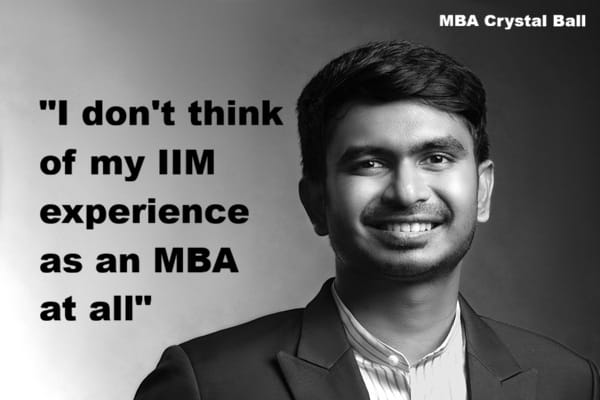
Ameya has had quite an eventful career journey. He has been in touch with us since 2017 and took a very planned, methodical approach that started with our MBA Profile Builder and landed him in places like INSEAD and BCG. Let’s find out how he did that.
How MBA profile building helped me get into INSEAD
From IIM to INSEAD to BCG
by Ameya Talanki
MG: Ameya, for starters, could you give us a sense of your qualifications and tell us a little about yourself?
Ameya: I was part of the first batch of the Integrated Programme in Management at IIM Indore. This was a five-year integrated program that combined liberal arts in the first 3 years. You could pick and choose the subjects you wanted to study.
There was a good combination of the core management subjects like statistics, economics, but also a good amount of social sciences, a decent amount of performing arts and some amount of language as well.
So that was the first 3 years, and then the last 2 years we got integrated into the same postgraduate program classroom setting, and the curriculum was exactly the same. I joined the program in 2011 and graduated in 2016 from campus.
I got into Tata Sky as part of their management training program. I was selected for sales. It was a one-year program where you do different rotations and eventually end up in the function you were selected for. I joined sales and ended up in sales.
Towards the end of my management training program, I came across an interesting program at Maersk, which was a changed approach to their leadership program. Maersk has always had a very strong leadership program called the Maersk Line Graduate Program.
Access Free Frameworks →
They decided to tweak it and take a slightly different approach. They called it ‘Go With Maersk’. It was a program in collaboration with UC Berkeley and Stanford. We were 70 graduates from across the world.
I came across the program, found it exciting, and felt that Tata Sky had challenges in terms of future prospects as entertainment was moving toward Netflix and online streaming. I also wanted a more global career, so I thought this program gave me access to what I was looking for.
I applied and eventually got selected. We were two from India as part of the program – 70 globally. The program structure included four learning modules over two years and two job rotations within India. I did rotations in customer experience and operations, and I was lucky to do a third rotation in e-commerce as Maersk was trying to enter that space.
Every six months, we had training modules across the world – Shanghai, Berkeley/Stanford, Kenya, and Copenhagen, which is the Maersk headquarters. After two years, you expatriate to a different geography, which is how I ended up in Southeast Asia.
I came to Cambodia, led a P&L for Maersk Cambodia, and eventually led the P&L for the entire Mekong region – Vietnam, Cambodia, Myanmar, and Laos.
After that is when I ended up at INSEAD.
My transformative IIM Indore journey
MG: That’s quite an eventful journey. Before we move on, could you talk a little about the integrated program – how one gets into it and how your experience was overall? Did you feel it was at par with the regular program?
Ameya: The process is fairly similar to the CAT. You have an aptitude test with different sections, and based on the score, you get an interview. After the interview, scores are combined and then you eventually get selected into the program.
I was part of the first batch, so IIM Indore was also learning, developing and growing in the program itself alongside us. But honestly, it was a great experience. The kind of manager and leader I am today is largely because the program gave me a very different approach to problem-solving, people management and career growth.
There were doubts initially about the program’s success. But funnily enough, when we joined the PGP, 7 of the top 10 rankers were from the IPM batch. Academically, we performed very well.
The program has evolved significantly since then. Career outcomes were hazy initially because recruiters didn’t fully understand what to expect from IPM graduates. The form that the program has taken today is very different.
Today, many ambitious students joining the program leave after 3 years to go to an IIM Ahmedabad, an IIIM Bangalore or an IIM Calcutta.
That’s the kind of direction that the program will head into eventually where getting a PGP from IIM Indore may not necessarily be the ambition that someone goes into the program with.
The undergraduate section is extremely exciting and makes you a very well-rounded leader when you get into the corporate world.
MG: What do they call the undergraduate program?
Ameya: I think it’s a Bachelor of Arts in Management Studies, as IIMs can now grant degrees after three years.
The turning point: What made me pursue a global MBA
MG: Moving ahead – you already had your MBA and a rockstar career. Why did you start thinking of a second MBA, and why did you approach us for the Profile Builder?
Ameya:
Honestly, when I look back at my experience at IIM Indore, I don’t really think of it as an MBA at all.
An MBA should help you develop a network that you can lean on, and you being able to learn from the classroom setting itself, not just from the academic content that the MBA delivers.
Since we had no work experience before getting into the last two years of the program, I see it more as an MiM program than an MBA. That wasn’t so clear when I graduated, because in India, the context of an MBA is – you finish your undergrad, you go into an IIM and that’s an MBA!
When I got into Maersk and interacted with peers across the globe, I started to realize that there are aspects to my leadership style and my way of thinking that need a significant amount of evolution.
I felt the only way I can actually get that is by taking a step back at some point in time from my career – taking that 1-2 year break to go back to school with a very clear idea of what I want from that MBA program.
That’s when I reached out to you in 2017. When I joined Maersk in 2017, I started meeting people from across the world, started seeing how they think and build networks and everything that comes with it.
I got in touch with you guys at MBA Crystal Ball because of a couple of things: one was I’d always seen posts of Sameer and you on LinkedIn and I always thought the way you approached helping students to find their dream school or get into their dream MBA program was something that I quite resonated with.
You guys are quite honest and quite realistic; you don’t sugarcoat things. You are very clear and I needed that awakening call.
“Am I in the right direction? Am I not? Should I be reconsidering things, etc.?” I think that was important for me.
And two – the profile builder itself as a package was quite unique. I hadn’t seen any other consultant at that time offering something like this. And I thought I’m very early on in this journey. I genuinely do not know how to frame my story or what I should be doing.
I wanted to approach this in a manner where I look at you guys as sort of guidance for me to build on from there. And if I really want to do an MBA and if I’m so committed to it, then I might as well just take a very targeted approach to it.
Getting help early on to understand what it would take for me to get there was quite important. I think these two were the primary driving factors to look at the profile builder.
How expert feedback changed my approach
MG: It might be a little back in history but do you remember how the profile builder may have helped you? How did it eventually influence the way you articulated your applications later on?
Ameya: So to be very honest, from my IIM Indore times, I always thought of myself as a good orator and someone who communicates well. But there’s very limited space in an essay for you to communicate your story. This is not a speech, right?
And how on earth are you going to communicate all of your life experiences and your journey in as many as 200-300 words and still make sure that whoever is reading it gets the emotion of what you’re trying to communicate through it.
Going through the profile builder was an awakening on that front for me and interacting with you as well made it very clear to me that “Hey dude, you have to up your game in terms of how you are presenting your story”.
The content might be there, you might have had the experiences, but you also have to learn to articulate it. And in this process, you also have to be very clear in your head as to what you want to communicate. It gave me a good understanding – to the extent of clarity I need in life.
It cannot be as vague as saying, “I want to do a second MBA because IIM Indore is so and so. And, this is my career journey – I grew up in Bangalore, I went to IIM, and this is what it is”. But what is it that makes me unique in an MBA classroom? What is it that I bring to the table?
I think it forced me to take a step back and say that I’m genuinely not prepared, and I need to reflect on this. I need to first 100% convince myself that I want to do it and why. And the answer needs to be convincing to me. Then I need to find a way to articulate it in the best manner.
So I think that was one huge learning, and the second was you guys being realistic about setting my expectations in terms of what I can expect from schools and stuff like that. I think both of those were very good to have early on.
Otherwise, it’s this nice bubble that you’re building around yourself, and suddenly it bursts and you have no clue about how to deal with it.
So I think for me, those two were the biggest takeaways and I really appreciate you guys for that.
Why INSEAD: My MBA decision-making journey
MG: Tell us what kind of scores did you apply with, and why did you eventually zero in on the MBA at INSEAD? How was that decision-making process?
Ameya: Right after the profile builder, I forced myself to think about why I really want the 2nd MBA – let’s not call it a 2nd MBA. But why do I want another learning journey; what do I want from it in terms of professional outcomes, personal growth and development outcomes?
And when I reflected on it, I realized that my best growth in terms of career, also as a person, an individual and a human being – had happened at Maersk. I attributed that largely to the diversity that the program had. Because the Maersk program was 70 of us from 50+ countries around the world.
Everyone thought differently and would give me feedback about how I was, what I did right or wrong or could do better.
I saw them, was inspired in different ways and realized that diversity was very important in an MBA program.
And second, because Maersk had allowed me to spend some time at Berkeley, I also knew what the American approach to an MBA program was. And when I combined the two, I felt the American approach is not going to work for me.
I really wanted a very inclusive, holistic, open environment where people come in, learn about the world and grow while learning from each other. We do not have one nationality that dominates the classroom.
That’s when it became very clear to me that INSEAD is the school that I wanted to go to, plus coupled with the fact that it’s a one-year program. I didn’t want to invest two years of my life in a classroom setting again. So INSEAD was the program for me.
I came to this conclusion towards the end of 2019 when I moved to Cambodia and when COVID started becoming a thing. That timing seemed to be fairly good for me then, anyway I was working from home and had a little bit of time on hand.
I thought I’ll prepare for the GMAT – it was mostly self-prep, never took any classroom sessions per se. I was supposed to take the GMAT in the March of 2020. This was during COVID lockdowns and countries were closing things.
And Cambodia did not have a physical GMAT center. So I had booked flight tickets to go to Thailand and Vietnam to take my GMAT. But eventually I couldn’t go because the borders were shut.
Then when the GMAT became online, the first online version did not allow you to take notes. So you had to actually use the inbuilt screen to do your math. I tried it but I felt this was not going to work for me. I’m a very pen and paper kind of a person.
So then in a span of 2-3 weeks, I actually switched to the GRE because the online version of the GRE at that time was allowing you one sheet of paper that you could write on and erase. I felt this works for me.
So I took the GRE and ended up scoring a 326.
Not a great score but my quant score was great. I had a 168 on my quant, my verbal was 158 which I had expected because I had never prepped for a GRE verbal. The GRE verbal section is very different from the GMAT verbal section.
I laid this out very openly in my INSEAD application. I said, “These were the challenges I faced.”
I think INSEAD was very comfortable with that because they said, “If we look at your GPA from IIM Indore, the scores you got in the subjects that are relevant to us and also your quant scores in the GRE, we think it’s still a fairly good score you have.” That was the eventful part of it.
I eventually applied to INSEAD in 2020; I got in and was supposed to start in January 2021. But I deferred my program by a year because of COVID and because I did not want to have a subpar learning experience.
The INSEAD advantage: learning, recruiting and career shift
MG: How was the experience at INSEAD in general? Walk us through how the consulting recruiting works specifically.
Ameya: The INSEAD experience is amazing. When people say INSEAD is the best year of your life, I think they genuinely mean it. It’s a great program and a great school, in terms of classroom learning. If I look back, the classroom experience at INSEAD is easily 5–10x that of IIM.
What you can learn from your classmates, the way the professors approach communicating something to you, is very different. I have very fond memories of my classroom experience. Three years on, I still remember the exact moments of some classrooms and what that learning moment for me was.
In terms of consulting recruiting, INSEAD is very structured. I think if you want to get into consulting, INSEAD is probably the place to go to. I was part of the D-Class which gets to do an internship.
I never wanted to get into consulting; this was never my career.
I still feel that I’m a builder at heart. I wanted to go into an early-stage startup and build. But 2022, when I was graduating, was not the best year in terms of VC funding and startups.
So I thought why not give consulting internships a try? I had nothing to lose and in any case, consulting was not my final goal, so I felt I might as well give it a shot.
The way consulting recruiting works at INSEAD is – you have fixed timelines. If you were applying for internships, within two months, you have your interviews, so it’s very quick. You go in in January and by March, you already have your interviews and by the end of March or early April, you have an offer in hand already. So that is for the summer internships.
And eventually for full-time recruiting, again it’s very structured. All three MBBs – McKinsey, BCG, and Bain – have a very structured process for INSEAD. Everything is time-bound and happens in the span of about 30 days. You submit an application, get interviewed, get an offer and you choose to go to one of them.
So for me, I was clear BCG was the firm. One of the things INSEAD helps you with is, because the class has so many consultants, you get to see, in some way or form, what the culture of the different firms is like.
I resonated a lot with the BCG-ers in my class and I wanted to give BCG a shot, so I applied. I don’t think I was the best prepared for the interviews but it worked out.
I think Maersk gave me good business acumen that helped me quite a bit during my interviews with BCG. For my batch, BCG actually said that if you sign the summer offer, the full-time offer is also yours. So the summer internship was not really an evaluator for me, which was great.
I went in and had a lot of fun during my summer internship. I did a project in energy – an area I had never worked in before and I ended up liking the team and what consulting had to offer. I said, “Okay, I might as well go back, spend a couple of years and see how that goes.”
Anyway, I think it was a skill set that I realized I was lacking. Maersk gave me great operating exposure. Give me a P&L today and I don’t think I’d ever worry about running it. But if you had asked me to build a strategy back then, I don’t think I would have been able to. I obviously have a lot more confidence in that direction now.
Inside INSEAD’s consulting ecosystem
MG: Doubling down on the recruiting itself – so from a prep perspective, give us a little more of an insider’s look into how the prep works for the interviews. What kind of support do you get? What kind of systems are in place? Just a little more flavor on that.
Ameya: Yeah. So, you have your normal case books and a buddy system to case with. Even the MBB firms actually allocate a buddy for you to case with or try casing with. So there’s a very good ecosystem at INSEAD.
Not just that – INSEAD also does structured workshops, like level 1, level 2, level 3 workshops, on how you should approach case interviews, what your style should be, also the nuances of the different firms, how one interview is different from another.
INSEAD gives you exposure to all of that; they prep you well enough to say, “Okay, I know this process now and I’m confident that whatever comes to me won’t be a surprise.” So I think that helps a lot.
Also, it’s very rigorous – you have to give it time and get a lot of practice. Of course, it depends on what background you come from. Some people may not require as much preparation, while others might need a lot more.
Early on, you practice with your classmates who are BCGers, McKinsey-ers, and Bainies. You then understand what your benchmark is – where you stand versus them. Then you can start working your way upwards.
You go back and do a case with them let’s say a month or two later, and you get feedback from them: “Hey, do you think this is good enough for me to make it into the firm?” And that becomes a nice bar to set for yourself along the way.
MG: I think this is a very common concern that many people going to INSEAD have – that they hire only people coming from MBBs. In your experience, let’s say out of 100 people that MBBs hire, what percentage are returning candidates? Just as a ballpark, I would say it’s somewhere around 50-50, right?
Ameya: Right. About 50% of the folks who go into MBBs are returning folks, and the remaining 50% are completely new. I think people have this misconception, but there is actually a very sizable chunk of non-MBB folks who end up at MBB.
Inside BCG: The post-MBA consulting journey
MG: It’s been a couple of years since you joined BCG – how has the experience been? Any standout moments you’d like to share?
Ameya: Yeah, I think my BCG experience has had a lot of ups and downs. I joined the Vietnam office as my starting point and then eventually transferred to the Malaysia office. I’ve always travelled for work and even to date, I have not done a local project in the country I’ve been based in.
So I’ve got exposure to Vietnam, Malaysia, Singapore, Australia, the Philippines, and now Indonesia. From a geography-split perspective, I’ve done projects across all these markets.
From an industry-split perspective, I’ve worked in energy, industrial goods and financial services. And from a topic standpoint, I’ve done strategy, transformation and cost takeouts.
I’ve also done builds, which is very interesting. In Southeast Asia, BCG also does build projects – for example, working with a startup to actually build a product with them, launch it, go to market, and help the startup bring in revenue through that product.
So I’ve done the gamut of topics, I’ve done the gamut of industries and I’ve done the gamut of places.
MG: Amazing. So, as a closing note, is there anything that people outside consulting may not be aware of, or any suggestions you may have for those looking for a career in consulting?
Ameya: Sure. I think a couple of things. People tend to believe that getting into consulting is already a win – that is win number 1. But I think the journey doesn’t end there. You have to find the right projects you want to be staffed on, and you have to put in the effort to actually stand out as a consultant.
Especially after an MBA, people tend to underestimate this. You’re competing against homegrown consultants who have already developed the consulting toolkit and you’re trying to compete with them.
So I think people underestimate the push that is needed to actually be successful in consulting.
Keep that in mind when you join, and have the energy to push for that first 1-1.5 years so that you create your image in the firm and people start to recognize you.
Post that, I think it’s relatively smooth sailing. You’ve built a rapport within the firm around what kind of person you are, your working style, and what your spike is in the consulting context. Once partners know your spike, you get staffed on cases where that spike is quite important to succeed.
So I’d say: find your spike, make sure people can see it, and then double down on it. That would be my final advice.
MG: Perfect. Thanks so much Ameya for sharing these. I’m sure all consulting future aspirants would benefit a lot from it and all the best for your consulting and future career!
At MBA Crystal Ball, our experienced consultants have helped thousands of candidates get into the top business schools, with scholarships. Drop us a line at info@mbacrystalball.com if you need help with your applications.

Hi I’m an LSR grad in Data Sciences currently working at Blackrock would be interested to know more abt MBA study courses with u on offer
Thxs in advance for a prompt response
Regards n thxs
Khyati hari
91.6396961013
Top 20MBA?
Rank of ESSEC.
With 4yrs experience in mc Kinsey as research analyst in talent acquisition and 645 GMAT focus should I join ESSEC?
How is consulting pipeline?