
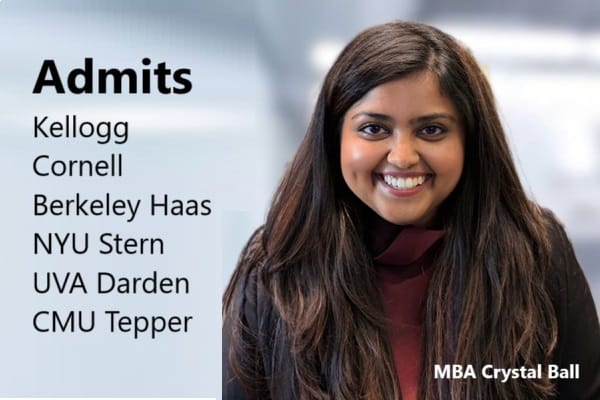
Apoorva Bhushan’s resume does not include the typical brands (such IIT, BITS, McKinsey, Goldman Sachs, Google et al) that many associate with top school admits. So how did she manage to get into so many elite business schools that offered a cumulative scholarship of $250,000?
We interviewed her on our YouTube channel. Here’s the transcript. If you prefer watching the original video, here’s the link: Non-IITian bags 6 admits with $250,000 in MBA scholarships
How I got 6 top MBA admits with $250,000 in scholarship
My Round 2 MBA application strategy
by Apoorva Bhushan
MG: Hello Apoorva and welcome! I think for our viewers, it would be great if you could tell us a little about your early life – what kind of extracurriculars were you involved in?
Apoorva: I think I was someone who was very bright academically since the beginning. I was the school topper during middle school and high school and I think because of how I had been brought up, I had a fair degree of exposure to extracurriculars. During school, I was involved in a lot of art competitions, public speaking, quizzes, spell bee competitions, etc.
Eventually, I don’t think I put in a lot of brain into what I want to do during undergrad. I just picked up engineering because like my dad was from IIT, it’s just something that came up naturally, so, ultimately, I pursued my engineering in electronics and communication at NSIT.
During college as well, I was fairly involved in a lot of extracurricular activities. I was the vice-president at the Finance and Economic Society at our college. I led the business conclave of our college as well which had a team of 100 plus and we organized several events like case study competitions, mock stock market simulations, etc.
I was also involved in the Relations and Student Affairs Society of our college, so that was basically around covering college events and managing the official YouTube channel of the college.
I loved poetry, so I was also a part of the Poetry Society of NSIT and I also had a brief stint at social impact with an NGO where I was involved in visiting different orphanages and organizing certain art workshops.
MG: Excellent! So pretty much your plate full! Tell us how you transitioned into the professional world? How was that experience?
Apoorva: Right, another thing that I was really obsessed about in my undergrad was case study competitions. So I think I did around 10 plus over 3 years through these case study competitions.
I was really exposed to the world of data. I loved the number crunching that was involved and that is when I decided that I would basically settle for business analyst/data analysis kind of profiles during placement.
That’s how I ultimately came to American Express. That was an on-campus placement that I secured and it was essentially a product analyst/business analyst role. I was honestly not very sure how the work would look like but as fate would have it, I was placed in a central product team within American Express.
So, for the first 2 years of my work experience, I was in core product analytics and post my promotion, for the next 2 years, my role evolved in the sense that I was involved in managing platform health and more around data architecture and establishing data pipelines.
So, I think my role was really interesting in two aspects: first that the team was very central to American Express which meant that I got a lot of opportunity to have cross-functional collaboration with themes such as risk marketing, compliance, underwriting, etc. So, that gave me a lot of exposure very early in my career.
I think the second interesting aspect was when I joined the team, the team was fairly small and there was rapid expansion. I could see firsthand, the problems that evolved with that rapid expansion, as there was a lot of evolution of product strategies.
That really helped me shape my career journey, so I think overall it was a very fulfilling work experience at AMEX.
MG: Like we discussed, you did not relent your extracurricular, but continued on those as well. Tell us how you were able to manage it and what were the things you were doing?
Apoorva: I think extracurriculars has always been like a big part of my life and I continued that at American Express so I was involved in the Mentor Mentee program of our team.
So we basically built profiles of mentors and mentees and paired them up together because we realized the importance of mentorship in early stages of your career. That program was a huge hit and impacted almost 100 plus colleagues.
I was involved in a lot of diversity related initiatives – be it Pride Month celebrations or Black History Month celebrations.
Something that was very close to my heart was also on the social front – so I was involved in the Good Citizenship Wing which is like the corporate social responsibility wing of American Express.
I was involved in a lot of initiatives like Silent Auction. Then there was a Daan Utsav where we essentially donated around 20,000 kgs of grains to NGOs. Then there were NGO visits where I was again involved in art workshops and there was also a blood donation drive.
These were all events that were very close to my heart and I thoroughly enjoyed my time. I was also involved in certain leadership and development-related initiatives so I launched a newsletter around different leadership attributes.
MG: When and how did you start thinking of an MBA? What was your journey up until the point you started your applications including GMAT and all that thought process?
Apoorva: As I mentioned, I was a very academic-oriented student, so right from my 3rd or 4th year of college, I knew that I wanted to pursue a second degree, so it was more about what and when for me.
So, in the fourth year itself, I started researching the various options which aligned with my interest. I looked up courses such as Masters in data science, Masters in Business analytics, Masters in Engineering Management, as well as MBA.
This one unlike undergrad needed to be a very thoughtful process, that’s why I wanted to spend some time in the industry getting to know what I wanted to do. Over the years, in American Express I think I was very lucky and I’m very grateful that I could have a lot of mentors not just based out of India but also people based out of US.
Again, my maternal uncle who’s based out of US and has been there for almost 20 years acted like a mentor while discussing various career options. By that time, I got grasp of what I really wanted to do and an MBA totally aligned with those goals. I wanted international exposure and I really wanted to push myself beyond my comfort zone, so that’s when the entire MBA picture came in.
I started with my GMAT prep in late 2022. I’m going to be honest I underestimated the exam. When you do a quick Google search, you basically come across that you’ll be able to get done with the GMAT in 3 months.
That’s what I thought that it’ll be a easy ride and I’ll be able to apply across R1 and R2 but that did not happen. Ultimately, my final GMAT score which was a 760 came in at the end of August which also meant that I could not apply to a lot of schools in round 1. That’s a bit about my GMAT journey.
MG: The point that you just mentioned about thinking about Masters versus MBA, what helped you decide between one versus the other because that’s a common sort of dilemma that many professionals face in their journey?
Apoorva: There were a couple of aspects that I factored in when I researched through the courses of different Master’s programs. A lot of it was based out of hard skills. I felt like I already possessed most of those as part of my work experience or I could learn those on my own so that was one aspect.
The second aspect was that by the time I had clarity on what I wanted to do in the long term, I already had three years of work experience, so I was already above the average age for most of these courses.
The third aspect was that during conversation with mentors in the US and especially my maternal uncle who helped me see the longer-term picture, it was clear that an MBA provides a greater network for pivoting across industries and functions, so that’s how the choice eventually came in.
MG: What were your top concerns while going through the application process?
Apoorva: Definitely I had a couple of concerns. So first as I mentioned, my GMAT score got delayed and that meant that I couldn’t apply to bschools, especially the M7s in round 1. Going into the process, I knew that I didn’t want to reapply as I had heard a lot of horror stories about reapplications.
And having given multiple GMAT attempts, I just didn’t want to go through that entire application process again. So that’s why I would say I was not very selective when it came to schools because I had only R2 to apply.
Again, I really wanted to go this year and since I had to handle so many applications within those 2-2.5 months, that was definitely one of the top concerns. The second concern was that essentially since I came from a tech background, it’s very important for Indians from tech background to differentiate themselves.
The third concern which came up during brainstorming was the fact that even though I had a breadth of extracurriculars, it lacked depth. So that was also something that kept on roaming in my mind.
I think those were my top three concerns.
MG: As you were looking for partners on this journey, how did you discover MBA Crystal Ball? How did you go about choosing an admission consultant? What was your experience working with us?
Apoorva: I connected to a lot of my college undergrad seniors or even other folks who had gone through this entire process before and the one thing they suggested was to have initial calls with multiple consultants as per your budget and then you basically do a vibe check to decide who you feel comfortable with, so that’s how I went about with it.
I shortlisted 8-9 consultants whose fees were within my budget and then I had that initial brainstorming session with them and I was trying to assess the comfort level and that really matched with MBA Crystal Ball. I could feel that comfort that I can share all of my personal stories, so that was there.
I think the second aspect why I went with MCB was the fact that I felt during the conversation there was no selling ploy that was really employed which I felt with some of the other consultants. Also, I remember having our first conversation and you essentially scared me a little because you did not paint that rosy picture.
A lot of people feel the GMAT is a very big part of the entire process but the truth is the applications are equally important. I think, that reality check was important to get myself back into that gear of grinding for the next 2 2 2 to 2.5 months for the applications, so that’s why I went with MCB.
Once I started the process of applications with MCB, there were a lot of moments where I found evidence that my decision was actually correct, for instance, our brainstorming sessions were essentially untimed.
I remember some of our conversations going beyond 2 hours, so that really helped me felt heard and I felt like an ample amount of effort was being put into the applications from your end as well.
Another aspect was there was a lot of creative liberty that was provided and I feel like creativity is a big part of my personality. By the end, when essays really shaped up, I could feel that they really reflected me.
For instance, we started the essays with a poem, so I think overall, you also made me fall in love with the entire application procedure. I remember when I wrote my GSB specifically, I was almost in tears because it was so emotional and so personal. These are the things that really worked for me.
MG: Awesome! I think you had a pretty good run, right? Tell us about your interview invites. How many did you get? How was the experience, especially, was there any standout experience?
Apoorva: I was reading on GMAT blogs and on GMAT club and contrary to most of the experiences shared by others, I found that there was a direct correlation between how my interview went and what the ultimate result was.
In terms of interview invites, I received interview invites from all the colleges (9-10) I applied to except Wharton. So, I was really elated in terms of the interview invites.
So far as preparation goes, I signed up with MCB for my interview prep and I think one or two mocks are more than enough for any candidate because most of the MBA interviews are pretty straightforward.
They essentially ask the same questions like why MBA, what are your short-term/ long-term goals. You must have a set of 8 to 10 professional stories which were essentially prepared for all the behavioral questions that come as part of the interview.
In terms of standout experiences, I think Kellogg was definitely one of the standout experiences because during the interview, you can totally gauge that the person really likes you and I think that’s what happened in Kellogg.
Another standout experience, on the other end of the spectrum, was Stanford because it was absolutely terrible for me. It was by a Stanford Alum and ran up to 1.5 hours and there were almost 20 plus behavioral questions that he asked, so by the end of the interview, I had run out of professional stories to be honest!
MG: Which programs did you get in? I think you also had your fair share of rejections, right? How did you take that in your stride?
Apoorva: I got admits from Kellogg, NYU Stern, Berkeley Haas, Darden, Cornell and CMU Tepper with some offering good scholarships as well. I received a reject from Stanford and I was waitlisted at MIT, Booth, Fuqua and Ross.
By the time, Kellogg decision had come, I was pretty happy with going for Kellogg, so I didn’t really pursue the waitlist at any of these colleges. In fact, I withdrew my application from Ross and Fuqua, so didn’t really see what happened there. Ultimately there was a reject from Booth and interestingly I’m still waitlisted at MIT.
I genuinely wanted to go either to Booth, MIT or Kellogg and since Kellogg offered scholarship, so I was really elated about that. So, that was about my journey.
MG: As a closing note, if you were to sum up your experience journey into some key takeaways, for someone with your background or for Indians in general, what would you say about the GMAT in general and about applications?
Apoorva: Regarding the GMAT, I think one of the biggest mistakes someone can do is to underestimate the exam. Firstly, I would suggest keeping at least 8-9 months for the test prep and not just the bare minimum 3 months because you don’t know whether you’ll want retakes or not.
Secondly, in terms of the GMAT, I think what really worked for me in my last attempt was absolute consistency. I remember doing a quant mock every day for 21 days straight, so that’s the kind of consistency the exam really demands towards the end of your prep, so I’d really emphasize on that.
The third is the fact that especially coming from an engineering background, a lot of us have gone through the JEE prep and we are very hard bent on some ways through which we solve quant questions.
I realized pretty late into the entire preparation journey that unlearning is a very big part of GMAT preparation as well so I had to unlearn some of the ways I used to solve questions and learn newer and more efficient techniques.
Regarding applications, I would recommend being more selective in your school selection rather than applying to 9-10 schools. That will not just save you a lot of effort but also a lot of money as well because each of these applications would cost around $200 $250. Ideally, you should be done with your GMAT early and then distribute your applications between round 1 and round 2.
Another thing I felt when I sat down to write my essays was that some of the professional stories had been long back, in my first year of corporate experience, so I had to really scratch for PPTs or Excel sheets to remind myself what had really happened.
So, I would suggest that if someone is thinking of an MBA or Masters, it would be helpful if you have a diary where you just document your personal and professional experiences – not just for MBA interviews but any interviews in general.
Another aspect would be just talk to as many people as possible. I feel that paying it forward is a big part of US B-schools in general and you would be surprised how much people are willing to help you. Just a normal LinkedIn drop really helps.
Some of the people whom I interacted with have now become my mentors. I think they’re going to be part of my journey going forward as well, so it is really important to cultivate these relationships while you are in this process, so that would be my two cents.
MG: Very useful information, Apoorva! Thanks for sharing all that! All the best with your Kellogg journey!
Apoorva: Thank you, Manish!
We hope you found this interview helpful. At MBA Crystal Ball, we’ve helped many applicants get into the elite business schools, often with scholarships. Reach out to us at info@mbacrystalball.com if you’re looking for professional help with your applications. Good luck!
– MBA abroad after 30: I got into 2 top European B-Schools
– NYU Stern School of Business with $60,000 scholarship in Round 3
