
What can a professional singer do to compete with the engineers and finance professionals for a seat in a top MBA program? That was the top question troubling Mandira Karmakar.
Among the thousands of emails we get each year from hopeful MBA applicants, Mandira’s message came as a breath of fresh air. The architect-turned-singer had a profile that did not seem like a typical MBA applicants.
After a few years in a ‘regular’ job, she decided to follow her passion and took the plunge into the music industry. She toured the world and built a large fan following on social media.
She explains why she chose an international MBA after a career in the media and entertainment field, which included 1,500 live performances and a national reality show.
Update: After completing her MBA, Mandira joined Tesla as a Global Supply Chain Manager in the San Francisco Bay Area. Yet another example of the life-transforming power of a good MBA.
MBA after B.Arch and a thriving Music Career
Transitioning from Blueprints to Beats to Business
by Mandira Karmakar
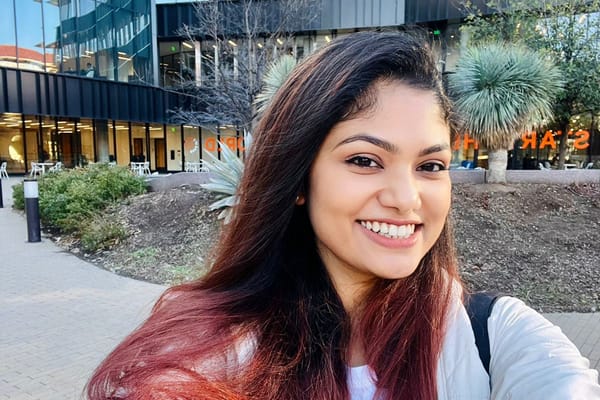
Experimental and risk-taker are the two words that my friends use to describe me.
Born in a Bengali family, art, culture and education has always been an important practice.
While I was a diligent student, my parents made sure that I had a holistic growth by enrolling me in Hindustani classical music, Odissi dance and drawing classes, very early in my life. Among these, I was more inclined towards music.
Access Free Frameworks →
Back in 2005, the first episode of Indian Idol was the first major influence that planted the thought of being a part of such reality shows in future.
I prominently remember filling up the slam books with my career aspiration as “playback singer” and was the one who would prepare the class for any music performances in school.
Growing up in a national thermal power project in Odissa with limited access to good trainers and opportunities didn’t stop me from learning and performing at multiple district level and state level competitions.
Balancing both academics and extracurriculars, I consistently ranked among the top 5 in the class, serving as the school captain, as well as focusing on my all-rounded development.
This experience taught me that art plays a crucial role in shaping technical career paths, and it has convinced me that everyone should incorporate some form of art into their lives.
Professional Background
I am an architect and professional singer, actively working in the Indian music industry. I earned my undergraduate degree in Architecture from the National Institute of Technology Rourkela. During those five years, I nurtured my musical talent by performing at various platforms while maintaining a strong academic record.
Torn between my profession and passion, I chose to start as a consultant, managing cross-functional teams for Indian and international multi-million-dollar projects. This role, though demanding, allowed me to network with senior professionals and enhance my communication skills.
It also opened doors to connect with senior musicians in Mumbai, leading to offers from movies and web series. After securing a top-10 spot in a national music reality show, I took a leap and pursued my creative entrepreneurial journey.
This journey has brought me recognition, with over 1,500 live shows across India and the US and a social media following of 100K+. Performing in front of 50+ cameras on a reality show judged by celebrities like Mika Singh, Udit Narayan and Akriti Kakar was a once-in-a-lifetime experience.
However, I’ve also faced exploitative contracts and gender disparities, which I aim to address in my career.
My desire for an MBA comes from both positive and negative experiences in the music industry. I aspire to enhance my brand and establish a global music record label.
Initially, I plan to take up strategy/consulting roles in tech and media companies to build the experience and connections needed for my long-term goals.
McCombs felt like the perfect fit for my MBA, offering the ideal combination of ROI, collaborative culture, top-notch professors, and Austin’s vibrant live music scene. Conversations with alumni and current students confirmed my decision.
My struggles with test prep
I started my GRE preparation in the month of January. During the first few days, I researched a lot on YouTube, learning of different study materials they used and their experiences. While candidates use various materials, here are the ones I would strongly suggest:
- Magoosh flashcards (for vocabulary)
- Magoosh subscription for both Quant, verbal and AWA
- GregMat (This has really helped me for my verbal. The way of teaching is very logical and interestingly uses a mathematical way to solve verbal questions. This costs only $5-$7 per month.)
- Official Guides and the separate Quant and Verbal question banks by ETS are very important to understand the type and difficulty level
- Manhattan Guides- I definitely practiced the quant from these but for verbal, the text completion and sentence equivalence questions have irrelevant vocabulary. The RC section is good.
- Word Power Made Easy by Norman Lewis- I treated this like a story book and read 5 pages per day. This book is optional but is very effective in grasping vocabulary the fastest way.
- Argument/Issue pool by ETS- available on their website
- Important tip- Follow an error log, revise the vocabulary words regularly, dedicate at least 3-4 hours on a daily basis and do not skip AWA during practice. I’d highly recommend to go through this YT channel by Talha Omer and understand the logic behind GRE scoring
I took the GRE three times, and here’s a reality check on retakes: They show your willingness to improve and are not viewed negatively, contrary to what we might think. I attended multiple info sessions with admissions committees and students to confirm this.
My initial GRE score wasn’t impressive, likely due to nerves. But knowing that retakes were normal helped me approach my next attempts with a positive mindset, and I improved my score.
My advice to aspiring students: Don’t be ashamed or skeptical about retakes. As long as you’re putting in the effort and aiming to showcase your best side, you’re on the right track.
Once you have your score, the next question is which universities to target. I heard from many who were aware of my GRE score, that I wouldn’t make it to a top-20 school without a GRE score of at least 325 or a GMAT score of over 720. Some even viewed my non-traditional career path negatively.
My tip: Believe in yourself, set realistic goals, and don’t lower your standards based on others’ opinions. While your GRE/GMAT score is important, it’s just one factor. Admissions committees also consider your professional trajectory, personality, and overall career potential when evaluating your application.
Why admissions consultant?
While I had sorted out all the good universities that I wanted to be a part of, I wanted to discuss about my career goals with experienced professionals with history of dealing with diverse candidates.
Since I have friends who have their MBAs from the top business schools in US and Europe, I first reached out to them.
I soon realised that their perspectives are subjective, limited to their own experience and some of the times, they were just based on our past interactions in college.
A consultant, with an experience of dealing with probably 1000 different professionals with diverse experiences, would have a better vision and experience than a student who’s focussing just on his own application.
Given my unconventional background as an international student, I felt the need to take advice from someone who could be unbiased and realistic; a third-party guidance. When it comes to choosing the right consultant, it was a difficult scenario for me.
To be honest, while there’s a huge number of educational consultants in the industry, it is extremely difficult to find the ones who are genuinely willing to help and are worth the huge amount.
I spoke to multiple consultants and asked for their portfolios to understand the professional backgrounds they have dealt with. I even enrolled with a Delhi-based consultant who seemed to have great reviews and was relatively cheaper.
To my surprise, I found them using ChatGPT for my MBA essay content and had a very bad response rate.
Moreover, they delegated work to another consultant who constantly demoralized me. Within a couple of weeks, I terminated their session and started putting in a good amount of research again.
After multiple discussions with my friends with an international MBA, I heard highly of Manish Gupta at MBA Crystal Ball (MCB) and reached out to him.
All my conversations with him were pretty positive, realistic and non-judgemental, which fulfilled the criteria I had in my mind.
However, given my bad experience with the previous consultant, I was still skeptical and hence, the package amount felt like a huge investment at first. But it eventually turned out to be one of my best decisions.
I had signed up for 3 MBA applications packages which included Brainstorming call + Review and editing of Essays for the school + Recommendation review for the school + CV review for one and then just review for the other two.
MBA Crystal Ball gave me professional AND emotional support
Before talking about any professional aspect, I would say that MCB has given extreme emotional support throughout this journey, something that an applicant really needs during these 5-6 months.
I approached them in early August and we had good amount of time to draft the essay for Round 1.
However, I would suggest not to delay this process thinking that there are still 2-3 months for the deadline. There are multiple things that come up so the sooner, the better!
Sometimes, it might also allow you room for a new work experience before you put in the application. In my case, I was suggested to retake my GRE and this early reaching out allowed me enough time to redo and improve my profile.
Additionally, it is also recommended to reach out to multiple different students from your target universities and attend the school webinars/ virtual meetups, to know more about the school culture and your fit.
These are among the small but important things that are not explicitly mentioned anywhere and I learnt them from MCB. Hence, reaching out to them early is highly recommended!
In the process, the first step was a “Meet me” document which had certain questions about my life, career, hobbies and goals, for the consultant to have a basic idea of my background.
The brainstorming call was an hour-long informative session where my consultant, Manish Gupta and I discussed about my professional trajectory and future vision.
Here, I’ve been very candid and transparent with Manish which I feel made it a lot easier for both of us to navigate through the essays later.
Manish Gupta has been an incredible listener and a very positive person throughout my journey. In terms of my deliverables, he made sure that we followed a timeline and would push me if I delayed it for any reason. Not only his content quality is superior, but he’s very creative in terms of presenting it.
My aha moment was specially during my Fuqua’s essay which demanded 25 random things. Rephrasing normal experiences to look eye-catchy and quirky is a skill which Manish surely possesses.
It made me realize that no matter how much you achieve, the power lies in story telling!
Navigating through this journey alone is definitely taxing but Manish made it quite easy. I don’t think I would have been able to look into some dimensions and research if I would not have approached him.
His “why, how and what” compelled me to find answers for my goals, which I would not have done otherwise. It gave me confidence and clarity. Even before my interview rounds, Manish went out of the way to review my video mocks, which is a lot of assistance along with the other reviews.
The amount of encouragement and motivation I have received from Manish has really helped me perform better and I’m sure, managing so many things along with work would have been very difficult.
What I learnt
This journey has taught me the value of patience and perseverance. I planned my MBA at the end of 2022 and have been working towards it since then.
Balancing my live shows, performing across India and the US, while preparing for the GRE and applications, required focus and discipline.
After getting my scores, submitting essays, and completing interviews, I eagerly awaited my results. Unfortunately, after Round 1, I was waitlisted at McCombs.
While I had other schools lined up for Round 2, McCombs was my top choice, so I kept pushing to turn the waitlist into an acceptance.
In February, during a music tour in San Francisco, I decided to visit McCombs to better understand my fit. I attended a demo class, had coffee chats with students and the admissions team, and fell in love with the university.
With renewed determination, I submitted additional letters of recommendation to strengthen my case.
A few weeks later, I received my acceptance letter from McCombs — one of the best moments of my life. My hard work and persistence had paid off.
But the story wasn’t over yet, and then the unexpected happened.
My F1 visa got rejected!
After getting the admit news, I quickly booked my visa appointment and attended the interview at the Chennai consulate.
However, despite holding two prior visas, my F1 visa application was rejected!
I was devastated, and my dream of studying at McCombs seemed to slip away again.
Undeterred, I kept searching for visa slots and consulted with former visa officers to strengthen my case. In late July, I secured another appointment, and my dad accompanied me to the consulate.
With my heart pounding, I walked out of the center, overjoyed, exclaiming, “My visa got approved, Papa!”
This journey has been an emotional roller coaster, teaching me that no matter how tough life gets, perseverance is key. My family, friends, and mentors, including Manish Gupta, were my constant support throughout.
For non-traditional applicants like me: In India, we’re so used to seeing engineers and doctors around that choosing a different path can make us doubt our place.
But remember, that’s what sets you apart. As a non-traditional candidate, you bring a unique perspective and experiences that others may not have.
The journey may be easier for some and more challenging for others, but there’s always light at the end of the tunnel if you’re patient enough to reach it. So, push through the anxiety and setbacks and believe in yourself! — keep going, you’ve got this!
Best of luck on your journey!
Connect with MCB for supercharging your MBA applications: info@mbacrystalball.com
Also read,
– Why second MBA abroad after entertainment and media job
– Chicago Booth Executive MBA admit for Indian Architect
– MBA admission with non-traditional profile and unorthodox background
– How an Indian musician got into INSEAD and Cambridge with scholarship as a reapplicant
