
European business schools offer an interesting combination of high quality education and cultural immersion to international students.
Engineer-turned-equity researcher, Rounak Ray, was among those who found the European model of business education attractive.
There was one crucial challenge between him and his dream schools – his GMAT scores. He took the classic GMAT and also the Focus edition. But neither helped.
Top European MBA admits despite low GMAT scores
How I got into IE & ESSEC (with scholarship)
by Rounak Ray
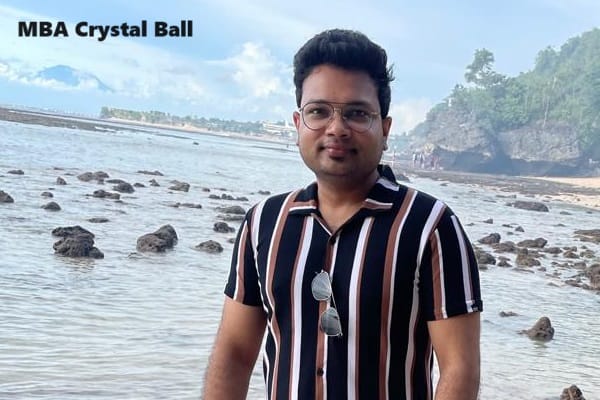
I am generally a quiet and reserved person until I become comfortable with someone, and my friends would describe me similarly.
Despite my reserved nature, I have actively pursued various extracurricular activities, including swimming, which I began at an early age and excelled in through various competitions.
Later, I ventured into professional cricket, and despite a busy work schedule, I regularly play as a batsman-wicketkeeper in our corporate cricket team and tournaments.
Although I pursued engineering during my undergraduate studies, my family’s emphasis on financial discipline and investments in equity markets sparked my interest in finance.
Additionally, not getting into an IIT contributed to my waning interest in engineering. During my undergraduate years, I independently built a foundation in financial accounting, learned about financial analysis and valuations, and even enrolled in a graduate-level micro/macroeconomics class.
Eventually, I discovered the CRISIL Certified Analyst Program, where CRISIL and IIM Calcutta select 35 students nationwide for a two-year work-cum-study program.
This program involves an aptitude test similar to the CAT, designed by CRISIL and IIM Calcutta, followed by group discussions and personal interviews.
In this program, candidates study a two-year Post Graduate Certificate in Finance (a mix of campus and distance learning) from IIM Calcutta while simultaneously working at CRISIL, receiving training in various areas of finance like equity research, fixed income research, and derivatives.
Even though I had already secured a job, I believed this program was the perfect opportunity to enter the world of finance, so I took the exam.
My strong quantitative background helped me excel in the test, but I was bombarded with finance-related questions during my interview.
Eventually, I convinced the interviewers of my strong interest in finance and secured a place in the program.
Upon joining CRISIL, many aspects were new to me as it was a significant leap from engineering to hardcore finance.
I was surrounded by chartered accountants and graduates from top commerce and management schools.
However, a combination of teachings from world-class professors at IIM Calcutta, support from my superb colleagues at CRISIL, and my own efforts trained me well enough to secure a client-facing role within one year of joining.
I tracked global sectors like Technology, Media, and Telecommunications. After a rollercoaster journey of three years at CRISIL, I decided to switch to front-end equity research and joined Haitong International Securities Group, where I tracked the India IT, Technology, and Media sectors.
Transitioning to front-end research was equally challenging and daunting, as the workload increased significantly. However, it was intellectually stimulating and interesting.
Along with covering companies under my purview, I also worked on IPOs and QIPs.
Eventually, I moved to Elara Capital, where I tracked India Internet, Media & Entertainment, QSR, and Alcobev sectors.
At Elara Capital, our team was voted No. 1 in the AsiaMoney Polls for two consecutive years.
After building a solid career in front-end finance, I wanted to move into the tech-finance domain.
During this phase, I felt that my degree in pure finance was insufficient and decided to pursue a full-time MBA.
I believed that combining my engineering background, IIM Calcutta learnings, equity research career, and a global MBA would enable me to build a thriving career in this domain. With nearly six years of work experience, a top global MBA was the only option for me.
By the time I decided to pursue an MBA, round 1 deadlines were fast approaching, leaving me with only the option to apply for round 2, which was also not far away.
The GMAT was a significant hurdle as I was out of touch with the material and had very little time to study due to long working hours.
However, I revised all the concepts within a few weeks and took the GMAT Classic, scoring 680.
I felt the score was too low and decided to take a second shot at the GMAT, this time the Focus Edition, within a month.
Despite consistently scoring 655-665 in official mocks, I scored a disappointing 625 on test day.
Though I was unhappy with the score, I decided to proceed with my applications due to my demanding work schedule.
The next challenge was deciding whether to apply independently or seek help from a consultant. Making my application competitive among a plethora of equally or more qualified applicants required expert guidance.
I had been following Manish and Sameer on LinkedIn for a long time and was impressed with their straightforward and honest approach.
I wanted a consultant who would be realistic and honest with me, not one who would pump me up into doing something irrational.
This made my decision simple, and I chose MBA Crystal Ball, opting for the three-school package.
I aimed to apply to the top European MBA programs. However, MCB was very clear that my lack of international experience would be a significant hurdle for INSEAD and LBS.
Additionally, my average GMAT score and low undergraduate GPA were considerable drawbacks.
My primary strengths were my post-MBA role experience, being an alumnus of IIM Calcutta, and my front-end equity research background.
After thorough discussions with MCB and numerous alumni from top business schools, I decided to target Oxford Saïd Business School, HEC Paris, and IE Business School.
I was very clear about one thing – I did not want to attend a finance-heavy school since I already had significant experience in finance, which I could leverage later.
Had I applied independently, I might have applied to numerous schools, which would have complicated the process.
MCB helped me focus on a select few top schools where I had a strong chance of admission and which aligned with my future ambitions.
Working with Ravi Agarwal, my MBA consultant and an INSEAD alumnus, was wonderful.
The best part was that I wrote the essays myself after intensive brainstorming sessions, followed by numerous iterations with Ravi.
This strategy kept me deeply engaged in the process and helped me understand every nuance, such as why I was including certain details and not others.
Ravi’s guidance was invaluable as he helped structure the essays and highlight key areas critical for securing an interview call.
The final product was excellent, and I felt that despite my average GMAT score, I had a good chance of getting into top schools.
After receiving interview calls, I opted for the interview package with MCB, which thoroughly prepared me to ace the interviews.
The interviews were conducted by the admissions committees, and I was thoroughly grilled about my motivation for pursuing an MBA, given that I was already in a post-MBA role. I was also questioned about my low undergraduate GPA.
However, these concerns had already been addressed during the mock interviews with MCB, so I was well-prepared to tackle them during the actual interviews.
Even after two weeks post-interview, I didn’t receive the final results.
Meanwhile, IE contacted my current manager to inquire about me, raising my hopes.
Ultimately, after a long wait of one month, I was elated to have converted IE Business School and ESSEC Business School.
Additionally, I received an EUR 8,000 scholarship from ESSEC Business School. After thorough consultations with Manish, Ravi, and numerous alumni, I ultimately chose IE Business School due to its strong reputation in technology and entrepreneurship, which aligned with my future goals.
I strongly believe that my thoroughly structured essays, which highlighted my achievements, helped me stand out among the numerous Indian applicants with higher GMAT scores and stronger GPAs.
The entire process was emotionally daunting, as drafting the application, preparing for the GMAT, researching schools, writing essays, and securing recommendations required immense patience, time, and effort.
It was also financially draining. There were times when I was losing hope, especially as I waited for communication from the schools. However, the joy of receiving an admission offer made it all worthwhile.
My advice to applicants is to be clear about why you want to pursue an MBA. The answer should not be just to gain a brand or a good job, as this approach does not work well outside of India.
You should clearly understand how the MBA will serve as a catalyst for your future career goals and choose schools accordingly.
Send us an email if you’re looking for some assistance with your MBA plans: info@mbacrystalball.com
