
When you read a title like that, it brings up some questions:
-
Is it easier for women MBA applicants to get into top MBA programs?
-
Do Indian female software engineers have it easier than IT/software male engineers?
-
What can women MBA applicants from India do to differentiate themselves?
This is a common perception among Indian applicants, influenced primarily by the MBA class profile data published by business schools. Admission officers of top MBA programs also encourage women applicants to apply.
What isn’t obvious is the fact that bschools do not drop the bar just to make it easy for women to get in. As admission consultants who help many female candidates get in, we can also vouch for this. Women MBA applicants have to fight equally hard to get into the elite programs.
Linking this back to the earlier point, if you ignore all the other factors and just focus on the gender distribution in the MBA class, it may seem that female software professionals would be preferred over males in a similar role.
Admission decisions have to consider not just balancing the gender stats, but also ensuring there’s enough diversity in the class. And there are more similarities than differences between IT candidates – regardless of their gender.
(Read Second careers for software professionals after MBA and Career change options after MBA for software engineers)
You don’t have to make this a gender-specific topic. Sure, you could make the MBA application woman-centric, if you think that’s what defines your journey.
But don’t miss out the wood for the trees. Focus on why adcoms would want you to be part of their class regardless of your gender.
Differentiation in MBA applications is a whole new topic in itself, so we’ll save it for another day.
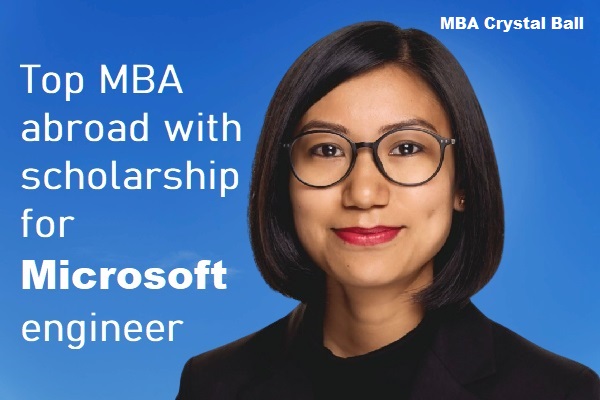
On that last point, Chandrakala Angom, a software engineer at Microsoft, did a pretty good job. Among other things, her Manipur roots helped Chandrakala stand out from the crowded applicant pool of tech/IT candidates.
Her story is special for us, because we can now share it with MBA applicants from the Northeast Indian states who ask us to share success stories that they can relate to.
Indian Female Software Engineer | MBA Success Story
How Toastmasters and my Manipuri roots helped me differentiate myself
by Chandrakala Angom
I have always been a dreamer, a quality that has stayed with me since my childhood.
However, my definition of success has evolved over the years. During my school days, success meant excelling in academics, which is something my friends would attest to. I was considered a serious student who took their studies seriously.
Apart from academics, I also enjoyed participating in literary extracurricular activities such as speeches and creative writing.
Nowadays, success for me revolves around making a positive impact on the people and society around me through the organizations I am part of.
At work, my colleagues often described me as approachable and accountable, which were the two most frequently used words in my 5-year anniversary card.
In addition to my work, I was actively involved in the Toastmasters community, which is a platform for improving public speaking and leadership skills.
I joined it to improve my public speaking skills but what kept me motivated was the inspiring stories of the people I met and the leadership experience
I gained through taking on executive roles. I’ve also been working closely with a student-led NGO called MitSna, which works on empowering the youths of Manipur through its various programs in the field of education and career.
The drive to continuously improve myself and to give back to the society in the ways I can motivated me to engage in these extracurricular activities despite my hectic work schedule.
Life in Manipur and challenges outside
Life in the capital city of Manipur differs greatly from other major cities in India. Located in the lesser-known northeastern part of the country,
I’ve often had fascinating conversations with friends from other states about the customs and culture of my own state.
Unfortunately, people from the northeast often face discrimination when they leave the region, particularly in the NCR.
This leads northeastern people to stick together and limits their exposure to multicultural environments outside of the region.
Personally, I have been fortunate enough to avoid experiencing racism, and have been able to develop close relationships with friends from other regions whom I met during my time in college and work.
My pre-MBA career graph
I worked as a software engineer in the tech industry. One of the best parts of my job was being able to witness the applications I created working flawlessly and bringing value to my organization.
As I progressed in my career, I realized that being a software engineer was not just about the technology, but it was also about understanding the customer’s perspective, leading a team, and seeing the big picture.
I wanted to develop my business acumen and learn about core business processes such as operations management, management accounting, and organizational behaviour.
I also wanted to gain a deeper understanding of how organizations form strategies and improve my leadership skills in a global business environment. These were the driving factors that motivated me to pursue an MBA.
In 2019, I made the decision to pursue an MBA and set my sights on US colleges, which typically require a GMAT score of over 730. My target score was 740, and I scored a 700 on my first attempt.
Unfortunately, the outbreak of the pandemic in 2020 and my new project at work made it difficult to focus on my GMAT prep in my second and third attempts.
The pandemic did make me take a step back and look at my priorities and be mindful about where I wanted to study and work after my MBA.
I then decided to study in Europe/UK to explore a bit of culture, art, and life along with and after my MBA. In my fourth attempt, I scored a 720 which was above the GMAT score of my new target schools.
As an Indian candidate with a tech background, I was aware that my profile was fairly common among applicants. So I was concerned about being part of an overpopulated pool.
Additionally, I had relatively limited international experience, having been based solely in Hyderabad, although I did collaborate with product owners in the US.
However, I believed that my overall work experience and extracurricular activities provided enough unique qualities to set me apart from other applicants.
Hiring an admission consultant
During my research phase for colleges, I spoke to an HEC alumna who shared her positive experience of working with a consultant.
She mentioned how the consultant helped her in the intensive introspection phase by providing guidance and acting as a sounding board.
This idea resonated with me, and I decided to seek the help of a consultant as well.
The alumna strongly recommended MBA Crystal Ball (MCB), which is how I ultimately chose to work with MCB.
I worked with my mentor at MCB, who provided me with detailed feedback during each brainstorming session. This enabled me to discover stories that effectively illustrated my defining qualities and experiences.
Their constructive criticism of my ideas and approach to the essay questions was incredibly valuable and played a crucial role in the development of my successful HEC Paris application.
Choosing the right business schools
Initially, I had a list of five target schools, which included HEC, LBS, Oxford, Cambridge, and INSEAD based on rankings.
I was specifically looking for a program that would allow me adequate time and opportunities to explore and evaluate various career paths, which is why the one-year programs of Oxford, Cambridge, and INSEAD were my secondary choices.
Between HEC and LBS, I was more drawn to HEC due to the breadth of options available during the customization phase, which included electives, MBA exchange, and certificate programs.
Additionally, the program’s duration was ideal, neither too long nor too short. While these features were also present in the LBS MBA program, I was also interested in living in Europe, which made HEC a more appealing option for me.
As HEC operates on a rolling admission cycle, I was informed of my selection before I applied to other colleges. Therefore, I ended up applying only to HEC.
I had two interviews, both by HEC alumni and they lasted 45-60 minutes. In both the interviews, I had to give 10-minute presentation on a topic of my choice.
My first interviewer was a founder of a non-profit organization in the education sector and the second one in Operations and Business development in the automobile sector.
The interview questions were mainly around my fit to the culture of the college and my ability to defend my presentation.
I wanted to be as prepared as I could be, hence I decided to take up the interview prep package with MCB.
Admission results
Within two weeks, I got a phone call from HEC Paris with my result.
I was overjoyed as HEC was my first choice. The scholarship result came shortly afterwards.
I got a scholarship from the school which covered a considerable amount of my tuition fees.
My experience at HEC has been great so far. After having two terms of core business subjects, I’m now in my term 3.
Some of the highlights are the outdoor leadership seminar, career exploration program and the workshop on ‘receiving and giving feedback’ which gave me valuable insights about myself and my leadership styles in general.
Some admissions advice
For Indian candidates considering HEC, or for any European business school, my advice would be to be prepared to network and apply for job opportunities independently.
While the career service team provides us with valuable workshops and guidance in our career search, it is our responsibility to apply for jobs.
Occasionally, companies reach out to us through the shared platform with the school. While some companies do come to campus for presentations, very few conduct interviews on site.
In my MBA application, I emphasized my diverse background within the Indian community by sharing my roots in Manipur, my aspirations for the region, and how obtaining an MBA would aid in achieving my long-term goals.
This probably helped me stand out from other Indian candidates who had a tech background.
Why there aren’t many international MBA applicants from Northeast India
While the northeast region has a strong connection to nature with sustainability practices ingrained in the lifestyle, there is a high rate of unemployment and there are gaps in many sectors, including education leaving the students in the region at a competitive disadvantage.
Furthermore, five out of the eight north-eastern states have a higher percentage of the population below the poverty line than the country as a whole.
As a result, for the majority of school students in the region, the focus is on finding a means of income after completing a certain level of education, and hence going abroad for higher studies remains a distant aspiration.
While it’s encouraging to see a recent surge in entrepreneurship in the region, there is still a long way to go to catch up with the big cities in India. I believe that responsible start-ups can play a huge role in boosting the growth of the country.
Tips for MBA applicants
The MBA application process required deep introspection and reflection, not only on my professional journey but also my personal growth.
HEC’s application, in particular, had many short essay questions, which made it challenging to convey my thoughts succinctly. I underwent numerous iterations to arrive at my final answers.
And I’m glad that I took the help of MCB which enabled me to present myself in the best possible way.
For aspiring MBA candidates, I recommend starting the process as early as possible.
While the GMAT may seem like the most significant obstacle, identifying your desired career path, geographical location, and researching suitable schools is equally vital.
Our unique values and experiences set us apart, so it is crucial to identify these distinctive elements for ourselves.
Wishing you all the best!
While we have published many stories of software professionals making it big on the international MBA canvas, we’d also love to see more applicants from the Northeastern states of India.
If you’re from Arunachal Pradesh, Assam, Manipur, Meghalaya, Mizoram, Nagaland or Tripura, we’d love to talk and explore ways to collaborate.
Also read:
– Insider shares everything about HEC Paris
– MBA in USA vs Canada vs Europe vs Asia: Which is the best country for MBA abroad?
– MBA admission with non-traditional profile and unorthodox background
– INSEAD Diversity Scholarship for Indian Female Applicant
– MBA Scholarship for Indian mother with Bank PO experience
– MBA Scholarships for women
– Top MBA programs for women with highest percentage of female students

Such an inspiring story. As someone who was born and brought up in a small town in Meghalaya (one you wouldnt find on a map even with a microscope) and has an Ivy League MBA from the US, Chandrakala’s story resonated with me on several counts. There are several reasons why we don’t see many international MBA applicants from Northeast India and I have attempted to point out some of the debilitating challenges a candidate from the Northeast has to overcome compared to a counterpart from mainland India. This is not to belittle the achievements of candidates from other small towns in mainland India and say they have it easy but an attempt to answer the pertinent question: “Why dont aspirants from the Northeast have good representation in international Bschools or even the best bschools in the country?”. If they call it a rat race, imagine taking a position 50 meters behind the starting line.
1. For one, the geographical location puts candidates at an immediate disadvantage. Coaching centers have tried and failed to set up facilities there, crippled as they were by connectivity issues and low turnouts. There is also a genuine lack of awareness among students and parents in the region about higher education (I myself did not know there was any such thing such as a IIT or a IIM before I was seventeen!)
2. Even in the absence of coaching facilities, the school curriculum is below par, archaic and is designed keeping in mind the interest of the lowest common denominator (Imagine not having probability and organic chemistry in your syllabus!). With the exception of Kendriya Vidyalaya, there are no CBSE or ICSE schools and students are left with no choice but to enroll in state board schools. There are little to no options for aspirants looking to push the envelope. As a result, folks who are able to secure a seat at a NIT or BITS or St. Xavier’s spend the first 2 years of their academic life simply playing catch-up with the rest of the crowd. In most cases, it is almost too late to make up for lost time.
3. There is a dearth of role models. Growing up, our definition of success was limited to people who were able to secure a govt college seat outside of the region and then land an IT job in Bangalore/Hyderabad/Mumbai, which for a regular candidate is mere table stakes.
4. Due to unrest in the region, parents are dissuaded from letting their children engage in extracurricular activities outside of school work. This often leads to gaps in personality development and such candidates bring very little to the table apart from their scholastic achievements in school. Within an already over-represented competitive pool, it becomes even more difficult to stand out from the rest of the crowd.
5. Lack of industry penetration in the region means parents have few career options, and therefore a lower disposable income and as a result there is no safety net for candidates who aspire to do a master’s degree or go abroad for studies. A graduate degree is considered more than good enough and is a ticket to live a good life elsewhere.
6. For a large majority of students who come to study or work in mainland India for the first time, the experience is not too dissimilar from a first visit to a foreign country. They are perennially caught in the headlights as they make try and make sense of the new environment around them , which in most cases is largely unwelcoming and even hostile.
Immensely proud of Chandrakala for bucking the trend and can only hope that she inspires more comers.
@Abhijit, great points and thanks for sharing.
Let’s do our bit on #3 as much as we can by sharing this story far and wide 🙂