
When you pitch product company experience versus service company experience, which is better from an MBA admissions perspective? Will one give you an edge over the other?
It’s been our experience that not all roles in the larger technology industry are created equal.
In a services firm (think the likes of Cognizant, TCS, Infosys, IBM, Deloitte et al) your work would typically encompass a software solution/product but to the extent of implementing/adapting it to your client’s needs.
In a product firm on the other hand, you have the chance to witness a much larger part of the product development lifecycle. This may include working with a Product Manager to understand customer requirements, and with an internal operations team to find out how they’d like to use a software to improve the supply chain efficiency.
In a services setup, the meatier roles are those that involve consulting, not restricted to software solutions. These roles are many times also referred to as Business Analysts.
In product firms, there are roles such as SDE, Product Analyst and the likes, which work closely with product teams that are considered valuable.
Of course, eventually it depends on the quality of your output, scale and achievements. But if you can, it’s always important to guide your career in a well thought-through manner rather than letting it run its own course.
And the other factor is that you may not have a choice either. Once you’ve chose a track (service or product company), you’re likely to continue growing within it.
Very few, like Vineet Jain, are able to manage the shift from a services company to a product company. He did that early in his career, and the decision helped him gather a more diverse set of experience and skills.
Service company to Product company to International MBA
MBA in USA with scholarship
by Vineet Jain
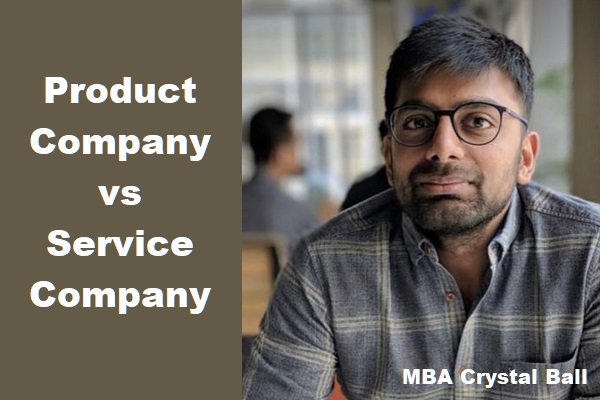
I had a typical middle-class upbringing in a small town. My childhood was defined by an interest in academics, a bit of sports and other hobbies that went along with it.
Given that the most attractive yet safe career at the time was engineering, I went to an engineering college, mildly famous in Northern India, called PEC, Chandigarh.
In hindsight, what worked for me in terms of career development at college was the business and economics courses that I took there. It is not common in most engineering colleges to offer these courses, but I feel lucky that I was exposed to how enterprises and economics work.
After graduation, I got hired by Deloitte – a services company. I worked in technical consulting with them, where I had a great experience with excellent professionals and meaningful work building IT systems for enterprises.
While in Bangalore, I had the opportunity to meet people in business through my brother, and this introduced me to the gritty and nuanced world of business, which I found more interesting than the sophistication of engineering.
When the right opportunity came along, I transitioned to operations in a product company, where I witnessed firsthand how systems can help businesses succeed.
From then on, I kept moving within the organization, when staying in one place for too long became too comfortable.
In hindsight, changing from a service company to a product company was a good decision. The flexible, employee-friendly policies of the latter offered many opportunities for role changes internally, within the company.
I saw many great leaders with MBA and/or engineering backgrounds, and I realized that building a successful business requires a strong work ethic and creativity.
However, I also realized that I needed to rekindle my own creativity if I wanted to stay in a corporate career for the long term. This led me to decide to take an academic break and MBA appeared as a great option.
When it comes to GMAT preparation, regardless of how you achieve it — through multiple attempts, intensive coaching, or innate talent — what matters is the final GMAT score. My advice is to aim to achieve the score early on. I got a 720.
While planning my MBA applications, my concern was how to sound palatable to American admission committees.
While I had a fairly average background — which isn’t necessarily bad — with the slight exception of my pre-MBA management career. Honestly, not having management experience before an MBA shouldn’t deter anyone, as most graduates start at the bottom of the management ranks after business school.
Hiring a consultant
Before starting my MBA application process, I spoke to a few consultants. Ultimately, I chose to work with MBA Crystal Ball (MCB). Ankur Gigras, my consultant (read why he turned down Harvard Business School), is not only a fantastic person, but also a tech executive with a wealth of experience. After just one conversation with him, I was convinced that he was the right choice for me.
Throughout the application process, Ankur provided great support, and working with him also gave me access to executive-level thinking, which was a bonus. I initially signed up for the full MBA application package and later added the interview package when I received an interview invite.
I applied to 7 business schools, based on the classic framework of reach, safety, and aspiration criterion, in addition to preference for West coast-esque tech-heavy schools.
Most top B-schools will have great regional presence and some, like top 3, would have national/global presence, but the quality of education is largely comparable.
After submitting my applications, I got an MBA interview invite from the University of Washington. I prepared to the extent I felt ready, but my interviewer was very accommodating and made the interview feel very conversational.
I applied to an ambitious set of programs. I had only one interview invite and one convert, but no regrets as it suited my goals perfectly.
And yes, I also got the best scholarship possible – $54,000!
But my advice is not to worry about scholarships. You can pay off your loan, if you take on one, in 2-3 years post MBA. Go for the school that fits you best, and not over index on the financial aid.
It is the connections that matter the most, people who you know or can get access to, and where they work.
Seattle, while underrated, is one of the best tech hubs in the world and great fit for most people who want to pursue tech careers. Any top business school will give you more platforms than you think it would, for most professional goals.
My MBA classroom experience
The program is truly amazing. It offers great professors, supportive peers, and is located in an exceptional city. Personally, I wouldn’t change a thing about it.
During my time in the program, I was fortunate enough to intern with ServiceNow, a large SaaS company, as a product manager – exactly what I was aiming for.
For those who may not be familiar with the US recruiting process, it is VERY self-driven.
My advice would be to speak with alumni from the program you enroll in, in order to understand what works best.
When it comes to application advice, this might sound a bit controversial, but we all have very similar offerings as Indian engineers or commerce graduates.
Just put in your best effort, but choose schools where statistics are comparable to your profile and things will work out.
In my case, I am happy to have invested my time in obtaining an MBA degree from the University of Washington and have no complaints.
As an MBA applicant, don’t worry about how your service or product company background will impact your admission chances. And you definitely don’t need to try desperately to move to the other side.
We work with a mix of both (applicants with product and services background), and have seen positive results with both – as long as you approach the application process in a logical manner.
Connect with us if you’d like us to help you with your applications:
info [at] mbacrystalball [dot] com
