
Don’t ever take a fence down until you know why it was put up.
Smart words from Robert Frost! In today’s world this fence has become quite invisible. Even the best of us can fall prey to fraudsters and scammers lurking about on its other side, just waiting for you to let your guard down.
In the online world, among the list of vulnerable victims to online scams are international students, fleeced off their hopes of a bright education experience.
So what makes them so vulnerable and what are the typical scams that are targeted towards international students? How can they protect themselves against the perpetrators?
What makes International Students vulnerable to scams and frauds?
Their vulnerability arises from the fact that most have little to no experience about life in the host country. Usually the only sources of information for foreign students are school official contacts or current students. Life outside and dealings with outsiders are limited. This makes them quite often unable to protect themselves.
The other reason is their age and inexperience. Typically international students are fresh out of school with minimum interaction, financial or otherwise, with the real world.
All these, coupled with the fact that most internationals tiptoe through everyday life, wary of violating immigration laws, make them targets of scammers who use intimidation tactics to cheat them off their money, or worse
Access Free Frameworks →
Common scams targeting International Students
While the nature of these scams is getting diverse and creative, there are 4 typical categories of international student scams:
- Visa related scams
- Housing scams
- Scholarship & Admission scams
- College degree scams
Let’s look at each one in more detail.
Visa related scams
Immigration is a crucial topic among international students. The legal status of ones’ immigration determines the result of the entire international experience.
Besides keeping up with course work and research, every student is bogged with questions that tie their immigration status to their future security and validity in the host country. Without a legal status, no one can be allowed to continue residing, let alone accomplish anything.
Here are some of the questions that we can safely bet every international student has wondered at some point in time. “What is my immigration status when I graduate? How long is the visa valid? Am I breaking any immigration laws by taking on employment while being a full-time student? Is my I20 valid as long as my student visa?”
The questions don’t end with graduation though. Even with a job, visa transitions from student to employment can raise enough queries to keep ones’ head busy for months. “What if I overstay my OPT and don’t find a job? What happens if I travel with a valid OPT but expired student visa? Is a job offer enough to help me reenter the country on an OPT?”
Imagine now, a scam that maliciously targets such a sensitive topic. The Yale website (along with several other university pages) have talked about how scammers victimise students by fraudulently extorting money in the name of immigration. They often call pretending to be police or immigration officers questioning some vague lax in their status and use intimidation and threats of deportation to scare them.
For instance, they may claim to say that the visa fee was not filled and unless it is done immediately, the visa will be revoked.
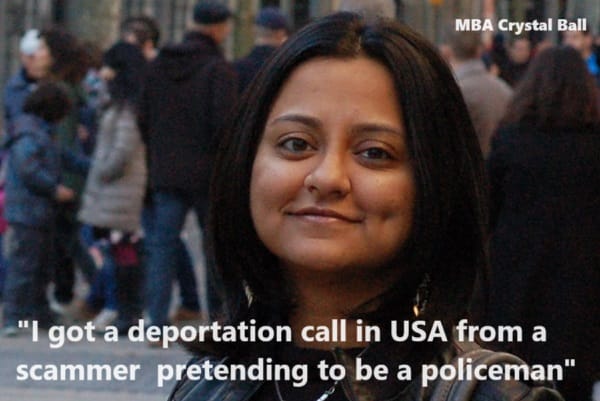
In one case, our very own MBA Crystal Ball author, Rakhi (pictured above), was attempted to be scammed by someone pretending to be a policeman while she was employed at a corporation in USA. She was told her I-94 Card (arrival/departure form at the port of entry/exit in the US) was not stamped and that she would be deported. Fortunately, she sought legal help from her employers immediately and they informed her that it was a well known scam, aimed at extorting money by scaring her with deportation.
Another fraud involves someone calling pretending to be a Visa Officer, claiming that your visa fee payment didn’t go through. Unless aware, students may fall prey to their fears and follow instructions to pay money or provide personal information like bank or social security details.
The important fact to remember, in such cases, is that NO immigration officer or cop is ever going to circumvent the legal process of correspondence to call and ask for money.
No official body will ever ask you to pay money in gift cards or cryptocurrency even, a common mode of transaction among scammers.
And NO immigration issue will ever require you to pay a fine immediately without prior notice.
What would you do?
Understand your immigration rights. No matter who calls you, threatening you with deportation, if you are aware of your legal status, scammers can be easily dissuaded.
If faced with such a predicament, immediately hang up and contact your university International Student Adviser at the International Student Office.
If you feel your safety threatened, please contact the local campus police and lodge a complaint.
Never pay any visa fee as a result of a request by someone calling as a Visa Officer. No Visa Officer is ever going to contact the applicant. All correspondence is maintained over email from official sources.
No payment will again be asked for to be paid immediately. Such an urgency is a sure sign that something’s fishy.
And here are some information about visas for you:
– F1 to H1B Visa process
– F1 Visa Interview Questions and Answers
– Optional Practical Training OPT on F1 Visa in USA
– CPT vs OPT: Differences for international students in USA
– What circumstances can lead to your Student Visa being cancelled and how can you get it reinstated?
Housing Scams
Again, quite common given that students have very little idea about the country and location they are destined to. However, most still want to ensure proper accommodation upon arrival.
As a result, if you are not circumspect, you may end up answering fraudulent property advertisements designed to fleece money by faking non-existent or already occupied properties.
They may charge the students a security deposit and in some cases book multiple tenants to the same property, with the “home owner” in the wind and incommunicado.
Recourse to avoid such scams is to book university housing or consult current students for recommendations. Clearly stay away from rental offers that appear too good to be true, with houses that seem to offer all amenities with less than the average rent in the neighbourhood.
Also, it is also always a good idea to stick to accommodations on or near the campus. Farther you venture, the less scrutiny will the property be under from campus security. One can always explore more upon spending a few months at their host university, for better rents and more amiable accommodations.
Scholarship or Admission Scams
Luring students with the promise of sure scholarship/admission is yet another harsh way to get cheated. The promise is that students will definitely get an admission offer or scholarship as long as they are willing to pay some token amount up front. This payment is disguised as application or deposit money, which is never seen again.
The clue to such scams is that no one will charge you money to give you money in the form of scholarship. Also, no school will ever promise an admission offer in exchange for money. That is like buying your seat in college which is quite illegal.
Even beyond graduation, students have been known to be approached by fraudulent job offers promising immediate H1B (work visa) and green card processing as long as the international student pays up a “job security” amount. Smell the dirt and move on please, is what we would advise.
College Degree Scam
A college degree scam works in quite a sinister way. It offers a degree/diploma in a short amount of time for minimal work. The result is a degree that is worth nothing and the student is left with a whole lot of debt. This has become even more prevalent in the age of online education.
There is also a scam where false advertising about a fake university or its accreditation is provided, luring students to apply and secure an admission offer. Result? Students losing money to a black hole.
It is important to understand where to apply, how recognised the program and the school is and whether the school is properly accredited by a national accreditation agency.
So, watch out for overly generous admission promises or guarantees of degree for little to no work involved. Ensure that the school has a proper physical address and that it is genuinely accredited.
Look for red flags like a lack of the proper school website extension like .edu (in the US), .ac.in (India), .ac.uk (UK), .ch (Switzerland), .de (Germany), etc. Beware of .com schools.
Read Study Abroad Scams
Red flags of International Student scams
First off, no one will ever guarantee you admission or scholarship in exchange for money. No one will ever offer you anything that seems too good to be true.
Beware of any phone calls or emails where someone pretending to be a police officer or any government agency calls to ask for personal information.
Getting hold of international student social security number, for instance, is a prime method of identity theft.
How can international students protect themselves against scams?
Always consult trusted agents of universities like the office of international students, professors, or current students to ensure reliability of information.
Always protect your information and never share sensitive data. Keep a copy of your passport, visa, employment/opt card, social security card, etc. elsewhere.
Having all documents in one place can lead to unimaginable trouble if lost or stolen. Protect soft copies of such documents by locking the files and keeping their access well hidden.
Always report suspicious and threatening calls or emails to the police or university authorities. Hang up or don’t respond and record all such correspondence for further action, if needed.
As international students in a foreign land, and without the protection of family, your safety becomes your sole responsibility. And in a positive perspective, it is also a learning experience. So, stay safe and learn all you can.
Sources: 1, 2, 3, 4
