
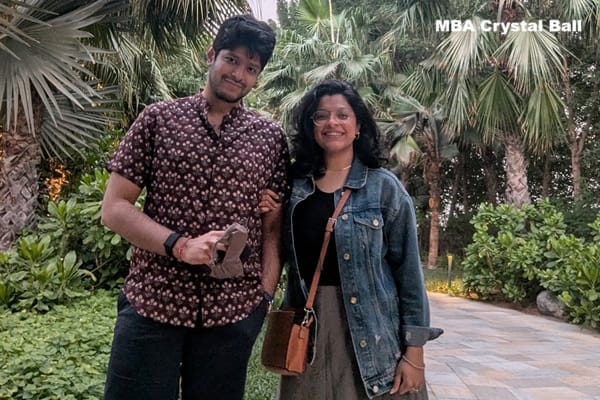
Pursuing an MBA is challenging enough, but doing it as a married couple takes it to another level. Meet Shruthi and Gautam, a dynamic duo navigating global careers, GMAT struggles, and top B-school admits together. While Shruthi is completing her MBA at IESE Business School in Barcelona, Gautam recently secured admits from London Business School and IESE with a GMAT score of 625.
From supply chain leadership at Reckitt to career pivots, mindset shifts, and strategic application decisions, their story is a powerful example of how ambition, partnership, and smart planning can unlock global MBA dreams. In this candid conversation, they share insights on GMAT prep, applications, interviews, and making bold choices as a couple.
Global MBA after marriage
How I got into London Business School and IESE
Q&A with Gautam and Shruthi
MG: Welcome, Gautam and Shruthi. Tell us a little about yourself and your qualifications, Gautam, to begin with.
Gautam: I’ve been based in Dubai for the past 28 years and I did my Bachelor of Science in Mechanical Engineering at the American University of Sharjah.
So I’m a mechanical engineer by trade. I’ve been working in Reckitt for the past 8 years.
Some of my key interests are sustainability as well as diversity, inclusion, and generally helping people in terms of giving them exposure and boosting knowledge. So these are some of my passions.
From theory to practice: Building a global career in supply chain
MG: If you could expand on your work with Reckitt, what kind of work did you do, how was the experience like?
Access Free Frameworks →
Gautam: I joined Reckitt as an intern through my college, essentially. So it was a program where I was in supply chain and I was given rotational roles within supply chain.
And as of recently, I was managing Africa, Middle East, and Pakistan in rolling out advanced tools for demand forecasting. I was also involved in solving top supply issues from our key factories around the world.
So my job in Reckitt involves solving these issues and having strong connections and network to the factory to ensure our supply is met for all these markets that I mentioned.
Just to add as well, because you mentioned the experience, I think it’s been a great experience in terms of exposure from being at the American University of Sharjah, where I was working on theoretical calculations and theoretical knowledge and moving on to practical applications.
I was dealing with actual numbers and risks that could affect the markets. So one day, if you go to a store and see we’re out of stock on a certain product, we are directly linked to that.
We’re affecting people directly, so for me, it was a major change and a great experience.
I was also fortunate enough to have a lot of exposure to work closely with VPs manufacturing and supply directors. I learned how their leadership skills work, what their thought process is. So I think it was a great experience from that angle.
I also had the chance to travel to South Africa, Bahrain, Saudi – some of our key markets, so I could be on the ground to realize what the consumer wants and how our supply chain network works. That helped me boost my knowledge and my network in the company in these countries.
From supply chain to all-round growth: Why I chose an MBA
MG: You had a pretty rich experience as you just shared. When and why did you start thinking of an MBA? Just help us through that decision-making process.
Gautam: I have a few colleagues and friends who have done their MBAs and I’ve seen their progress and transformation from before they started the MBA to after, and how their careers actually expanded and changed.
One of my close friends actually did the LBS Sloan MBA and he was a supply chain expert just like me and I could see his transformation.
It changed the way his public speaking improved, the way his network changed, as well as his overall knowledge just being out of supply chain itself.
There was business, finance, marketing; he also worked with the public sector. I think his knowledge, network and his overall persona improved a lot through an MBA.
So I was quite inspired by that in terms of why I wanted the MBA. This happened about 1.5-2 years ago, that’s when I started thinking about the GMAT and working on the GMAT.
Just to add as well, while I was working on the GMAT and the application, what also reinforced my feelings to do an MBA was also seeing Shruthi’s transformation and her improvements.
She’s at IESE and she has improved a lot in terms of her knowledge related to marketing, finance, accounting.
There are some things we don’t really work on, on a daily basis, and from our engineering degrees, we didn’t really work on this as well. So I think this knowledge really helps us a lot.
And given how volatile the world is these days, I think it’s important to secure ourselves and learn more about different sectors, different fields, and be an overall all-rounder.
So that’s what inspired me to do an MBA, essentially.
From idea to action: How their MBA plans took shape
MG: I’d like to take you two years back, right when you were applying. Were you guys at that point aware that both of you would be applying? Was this planned? How did the journey itself evolve for both of you?
Shruthi: Well, our application journey started more than two years ago. I had never intended to do an MBA. It was Gautam’s plan to do an MBA for himself, more of a thought as he was seeing his colleagues and friends.
He would always think that maybe an MBA would be a good add to my CV, but it was never a serious thought or plan. Then I started thinking about my career and I kind of got this itch to pivot to tech.
At Unilever, I loved my job, the people I was working with and the challenges we were solving, but I always found myself gravitating towards finding tech solutions for our problems and building tech solutions with our tech teams.
And when the company went through a restructure, I decided this was the time to make that change formally.
So I started aggressively studying for the GMAT and doing my applications.
It was more of a timing thing than anything else, but it was always going to happen because I wanted to pivot my career. And once I got into the whole MBA grind, I think that further solidified Gautam’s drive to get one himself.
MG: Right, Gautam, you’d like to add anything to that?
Gautam: No, I think the decision for Shruthi was quite straightforward. When she got the IESE offer, she instantly liked the college and I think that was the only key college in Europe she applied to.
I think it was a great decision and it linked to what she wanted. The college has great virtues and values that link to Shruthi’s personality as well.
Obviously, people might wonder – for a couple going for an MBA at the same time, the risk is quite high, there’s no income at the same time. This is obviously hedged into our decision.
But we really believe in the college and also in ourselves, as importantly and really think this will be something we can learn quite well, especially through the people that we’ve met, the interactions we’ve had with the college and its alumni.
As Shruthi mentioned, I did want to go for an MBA for the past 1-2 years and luckily Shruthi got in before me. But I’m happy to join a year later and we both can actually meet in Europe. So I think the decision makes sense from that angle.
Just to add as well, I think the IESE network is fantastic, but we also have a very good LBS network. So I’ll not only be able to have interaction with the IESE network through Shruthi, but she can also have interaction with the LBS network through me.
So that way, it spreads our network a bit better. This is a key part in terms of our decision-making also.
And like she said, I would have loved to also stay in Barcelona with her; it would have been fantastic. But I think this was a more practical decision that we took that will help both of us in the long run.
From 580 to 680: A disciplined approach to cracking the GMAT
MG: Yes, that’s quite interesting, and I’m sure it’ll help people in similar situations. But going to your GMAT journey, Gautam, how was that? And I think you also decided to start working on applications in parallel. Walk us through how that evolved.
Gautam: I think the GMAT was one of the toughest hurdles in terms of getting the application through successfully. In fact, I just updated my latest GMAT score after the application was done. So they allowed me to have a grace period of a couple of weeks to update the GMAT score.
Just to take a step back, I think my initial score was about 580 in GMAT Classic. It improved to 650 and then lastly went to 680. So I think it was a very difficult task.
At first, I expected this to be more of an IQ-based test where, if you get a bad score, you’re not very smart. But the reality is that it’s more of a discipline-based test. It shows how good you are in terms of fixing your mistakes, understanding your errors and basically moving forward in a very disciplined way.
The only best way to go through studying and getting a good score is by practicing on a disciplined basis every day. You have English, math, as well as integrated reasoning.
So I think it was quite tricky and it depends on the test taker’s background including school background. What I’ve observed is that those who have done the CBSE system or the Indian syllabus found the GMAT a bit easier compared to me, who did the British syllabus in my education.
So I think math was my key weakness point. I decided to go for Enzo Prep, which actually helped improve my math skills quite well, so that was the extra resource I took in terms of focusing on my GMAT.
Obviously, I took the original prep from the online dashboard (the practice tests as well as the data) and I think Enzo Prep really helped elevate my mathematical skills, which improved my score from 580 to about 680. So, that’s my take on the GMAT.
Shruthi went from 600 to 710 in GMAT: What most test-takers get wrong
MG: And Shruthi, I’d like to also hear from you. You also had a bit of a tough journey with the GMAT. Were you also mentoring, or how was your interaction with Gautam? What did you share about your journey that was similar to Gautam’s?
Shruthi: So my GMAT journey seems like it was over a lifetime ago. But what I remember from it is, it’s not about the math or the exam itself; it’s about your mindset.
So like what Gautam was saying, I studied fully in CBSE, but it was still a struggle for me because I had this weird mindset that if the test is not going well, then somehow I’m not capable of doing an MBA, or maybe I shouldn’t go down that path.
But the thing is, if you have not been a test taker for many years and you’re going to an office, that test-taking mentality takes a bit of time.
It’s like working out, but much harder. So you have to get into the rhythm of things.
And second, because that stresses you out so much while you take the test and you put pressure on yourself, you end up making very silly mistakes and that was the problem.
So my journey also started from around 600 to 650 to 680 and finally I was able to cross that 700 hurdle to 710. And again, I didn’t want to write the test a fourth time. Gautam pushed me and said, “If you take it once more, you can cross 700, just do it.” So I did that.
I also submitted my score a month after the application deadline just because I wanted to cushion myself and that helped a lot because I could have stayed at 680, but I was able to secure a scholarship with the 710. So if you can, and if you have time to push yourself on the GMAT, do it because you might get in, but a scholarship is always nice to have.
But my main thing was the mindset shift, and there’s this YouTube channel called GMAT Ninja that really helped with that. It’s a free channel with 14-minute to 1-hour videos; the way they explain each question is they take you through the rationale and how to think about it.
In some cases, they explain it in more than one way and they group the questions by difficulty and type. So I found that channel very useful. It helped me take a deep breath and calm down when approaching each question.
It helped me relax and realize that this is not the end of the world, it’s just a test. Thankfully, I found the channel in time. It took me about a month to shift my mindset, and it really helped in that last exam.
Right, just to add as well, I think it’s also about quality and not quantity. One thing that actually helped me and guided me was having a proper error log – what kind of mistake you made, what category it was, and the difficulty level of those questions. Once you identify the mistakes and work on them, you’ll be able to improve your scores.
Instead of munching down hundreds of questions, it’s more about doing 10–20 questions and making sure you fix all your mistakes. So I think it’s a lot about quality.
On top of that, there’s also such a thing as too much practice.
You can’t work out in the gym for more than 2.5–3 hours a day as a regular person, so why would you do 80–100 questions in one day?
So I set a limit for myself. I wouldn’t do more than 40 questions in a day and not tire myself out. If I was taking a full test, then the previous day I would just do simple to medium questions, maybe 20–30, just so I had breathing room.
I think those are things people miss out on: taking a deep breath, limiting the amount of practice, and focusing on the quality of practice. So if you have those guidelines then I think you should be fine.
Choosing an MBA admissions consultant: What shaped my decision
MG: Perfect. Yes, those are very useful tips. Now Shruthi, you had already worked with us, and Gautam, you knew that. But even then, how did you decide? What was your decision-making process when you chose to work with MBA Crystal Ball?
Gautam: So I think I had some discussions with other companies as well to get their take on my profile and their advice. I also had a direct conversation with you.
What I found was that the other companies were very persistent in getting me to sign up with them. They were following up very closely and marketing very aggressively. I found that a bit odd. I didn’t hear too much personal feedback about those companies.
But when I spoke with you and with Shruthi, I realized that the feedback that MBA Crystal Ball would give to the applicants was very direct; there was no sugarcoating. Some people might like sugarcoating, but it depends on each person.
But I prefer information to be given straight and raw. So that was basically the feedback I got about MBA Crystal Ball.
Also, in our conversation, you took me through the process of understanding my life, key people who have influenced me, my experiences, and network and helped me frame that into strong answers.
Those were the key points that convinced me to go ahead with MBA Crystal Ball. It really guided my applications and helped me get into the colleges I wanted. So yes, that was my decision.
Inside IESE & LBS interviews: What worked and why
MG: Excellent. So Gautam, tell us how your interview experience was? Where did you interview? And again, anything that you remember from any of these experiences that you’d like to share?
Gautam: I got the interview invites for both London Business School and IESE, the only two colleges I applied to. For IESE, there were two processes for the interview.
The first one was an assessment day and that’s where you work in groups to formulate answers to questions that the college asks you. So there’s a presentation given by a professor and all those who are in round one attend that particular session.
We then move on to random groups and we develop answers together in terms of understanding what the professor was asking and making a very clear answer.
There would be one alumnus who would be attending that particular group. They would not say anything but they only observe and make their choices or recommendations in terms of who should go from round one to round two.
So luckily, I got through round one, which was the assessment day for IESE. Then round two was a face-to-face interview with somebody based in Dubai.
So for these colleges, what I observed is that face-to-face interviews are very much preferred, even I would prefer that technically.
So it was an interview with somebody who was working in the IFC, which is in the finance sector in Dubai.
It was a comparatively casual interview. We discussed more about my personality, what I like, a bit about my experience and also what sets me apart from different candidates at IESE.
What I observed is that they’re looking more at the exposure that I’ve received through my college, through my work, what my international experience is, given that the people who join IESE are all from different backgrounds.
They want to make sure that I can work in a team very effectively. So that is what I observed from the session in round two. I think round two went quite well and I got the acceptance, luckily.
Jumping over to LBS, it was a direct interview after getting through the application. It was only one round and that was with an alumnus based in Dubai; he was a consultant.
This was a bit more intense compared to IESE, where he directly asked about my experience, what I would do in certain situations and basically how I would operate in a team. So it was more challenging, but I was up for the challenge and I think it was a decent session.
What was interesting with the LBS interview was that there was also a case study where he gave a situation or a scenario and asked me to develop a very clear answer with logical reasoning on why my answer must be right. And I had to justify it as well.
He also asked some questions related to that and luckily I managed to defend my case quite well. So that was the round for LBS and then after a few months, I got the acceptance for that as well.
So overall, both the interviews were quite good. I think IESE is a bit more about personality, a bit more casual while LBS is a bit more intense and more preparation is required.
Tips for MBA applicants: What really matters
MG: On a closing note, Shruthi, anything that you would like to share about people who are applying in general, and specifically to IESE – any suggestions or tips that you might have?
Shruthi: Tips or suggestions — The main thing is to get to know the college more and speak to the people within the university.
The more things you know outside of the website or their brochure, the better.
And IESE specifically, all of us will reply.
I have, and we have a structured mentoring kind of thing that we do here where Indians or people from different regions can connect with applicants from the same region so that we can help them out with the process and give them inside info. And that continues into their onboarding if they actually make the move to Barcelona.
So the biggest thing is to reach out to us because IESE is quite connected that way and we like to give back since we’ve gotten so much help from our alumni and second years. So reaching out is the best thing you can do.
MG: Perfect. Gautam, anything you’d like to add in terms of closing thoughts on what applicants should look at or something that you might have missed out?
Gautam: I think besides what Shruthi mentioned, it’s important to look through what your experience has been for the past couple of years, what sets you apart, what’s unique about you.
And I think that’s where the conversation that we had, helped quite a lot, because there were certain things that I felt were not very important and you pointed out that they were. And we luckily added that to my application.
So my point is, certain things that may not appear to be very important but could be a key part of your life story and will be very important for your application – things that have shaped you and are leading to what you’re doing right now and why you want to go for an MBA.
Things about extracurricular activities as well as international experience – I think these are super important for the applications.
I also think having a good GMAT score can help in terms of scholarships and also, to a certain extent, in getting through the application. But to add, colleges look at the entire profile as opposed to just the GMAT score. So I think these are a few things that I would advise to any applicant.
MG: Amazing. These are very, very helpful. All the best, Gautam, for the new journey to continue, and I hope you guys get time to travel Europe as much as possible!
At MBA Crystal Ball, we’ve helped many applicants get into the elite business schools, often with scholarships. Reach out to us at info@mbacrystalball.com if you’re looking for professional help with your applications.
