
You’ll find many MBA consultant websites that mention that they offer the best consultancy for MBA abroad. More often than not, this claim is less out of arrogance and more from a need to rank on search engines when applicants search for such phrases.
Some teams take it to another extreme with separate landing pages for each city – best MBA admissions consultant in Mumbai, Hyderabad, Bangalore, Delhi…you get the point.
Many applicants who discover consultants purely on the basis of search results, don’t have much to go by (like real experiences & reviews shared by trustworthy friends, colleagues). So many just rely on the success stories on these top ranking MBA application consultant websites in SERPs (Search Engine Results Page).
Tejas Hegde was among those who found a popular MBA consultant whose website hosted impressive reviews from former-clients.
Tejas signed up with high expectations. He explains what happened next.
MBA waitlist strategy got me an admit and scholarship
Plus reviews of 2 top consultancies for MBA abroad
by Tejas Hegde
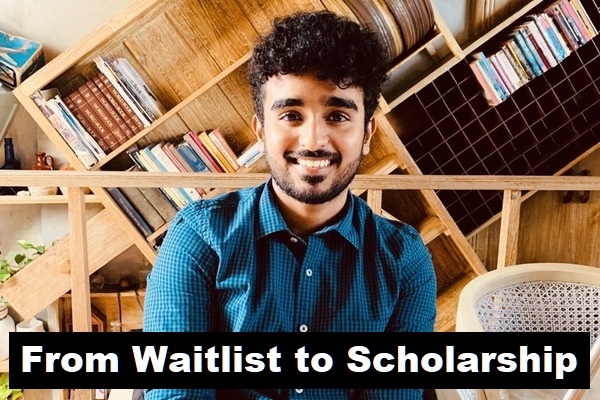
Born and raised in Mumbai, I completed my undergraduate degree in one of Asia’s oldest engineering colleges.
Massive Foodie who has a cooking YouTube Channel, Have been teaching underprivileged children since I was 15, college-level futsal player & a die-hard Chelsea FC fan! These are some things unique about myself.
Access Free Frameworks →
BUT…I am still an IIM – Indian IT Male!
I have been working at Deloitte for over 4.5 years now. Having started as Business Technology Analyst in the Technology Consulting practice, I transitioned to the Product Development practice in order to get a holistic view of “Product”, right from ideation to development to launch.
In my latest position as a Product Engineer, I got my hands dirty in the User Interface & User Experience (UI/UX) side of the product. Leveraging my artistic side to design and build intuitive interfaces for digital products was the fun part.
Acting as the mediator between the core engineering team and the business team, ensuring easy-flowing discussions and avoiding any impasse was the challenging part!
In hindsight, this is what piqued my interest around having a 30,000 feet view of the product and ensuring well-oiled workflows from conception to design to engineering.
Finally, I got the right opportunity to try this first hand!
I participated in an org-wide innovation contest in Mar-2022 focused on building a feature for Salesforce-based products. In my team, I decided to leverage my UI/UX and engineering background to take on the Product Management role.
Each team had been assigned a Product Manager mentor. Working closely with my mentor, I tailored my team’s pitch to a business audience. Incorporating the consequences and benefits of applying this technology feature in a business setting led our idea to be shortlisted among the top 16.
Following iterative development and rigorous testing, we successfully built the feature, winning a top-3 position from among 84 teams in the contest.
Discussing my aspirations with my mentor, I was convinced that a full-time MBA could accelerate my advent towards a B2B product management role.
An MBA graduate himself, he helped me understand how an MBA rounds out a CEO’s knowledgebase, filling in areas such as strategy, finance, sales and marketing. This is when I realized that an MBA is the perfect next step for me!
GMAT prep
Firstly, I took an official mock GMAT and scored 700. After creating a baseline for myself, I embarked on my GMAT prep journey.
I identify as someone who needs all the ‘mise en place’ (another food reference) before starting with anything. So, I did a thorough research around the resources and finally landed on the gold standard for GMAT prep – GMATClub.
A community of both experts and novices, GMATClub had an exhaustive spread of topics that according to me, provide a strong theoretical basis. A very helpful and engaging community helped me get my queries cleared.
Moreover, I felt inspired to answer queries posted by others as well. All of this supplemented by GMATClub’s test pack helped me get test-ready. After achieving an accuracy that I was happy with, I took the second official mock GMAT, scoring a 710.
All that prep and just a 10-point increment! Despite being confident in my skills, I was taken aback.
Riding on the “I can always take the GMAT again” insurance, I scheduled and took the test. I ended up scoring a 740 (decent score for the demographic that I belong to), which I was happy with.
I decided against re-taking the exam and worked towards understanding the B-school application process.
Which is the best MBA abroad consultancy for me?
As I researched about schools, their class profiles (also stalking students on LinkedIn), I recognized a few frailties in my profile.
A non-IIT undergraduate college, non-feeder employer, falling on the lower side of the class’ average years of experience, coming from an over-represented demographic – these jumped out at me! IIM, there we go again!
I walked into this application cycle with no yardstick to measure. I faced my first shock when I discovered the pricing for MBA Admissions consultants.
I also had an implicit bias – big admissions consulting firms would not be able to give me the personalized attention that a standalone consultant would provide.
And so, I decided to hop on to the “Let’s take the road less taken” bandwagon.
Signing up for a reputed individual consultant, who claimed to have helped many get into the top tier MBA programs, I had (very) high expectations.
Without much guidance around school selection, I was aiming too high (which I didn’t realize back then).
Out of the 10 schools that I applied across R1 and R2, I only interviewed at one – UCLA!
Ending up on an endless waitlist at UCLA was one of the most painful experiences – of course, in addition to getting a ding at the 9 others!
I was down and out.
But the waitlist experience taught me a lot. Speaking to current students and alumni, I began noticing glaring issues in my candidature – for instance, the way I crafted my post MBA goals left a lot to be desired!
I couldn’t believe it that my earlier consultant’s advice had pushed me down a road from where there was no coming back. I had no MBA waitlist strategy and getting off the waitlist seemed impossible.
I got a ding from the 10th school too!
In the process, I also learnt that there are always folks ready to help. All you need to do is ASK! I was able to identify a few GREAT mentors in current students, who were extremely forthcoming in helping me identify gaps and providing valuable feedback.
This, in addition to frank conversations with my super supportive family around the reality of my application situation helped me keep my headspace clear around one thing – I need to try again in the next application cycle wherein I need a better application strategy, better crafted goals and bring out nuanced differentiators in my profile.
That is to say, I needed a better MBA admissions consultant too!
My biggest takeaways from the previous application cycle – my mentors suggested that this time I go for experienced consultants.
Several of them had MBA Crystal Ball in their list. In hindsight, I wish I had done this earlier before burning my fingers.
This is when I decided to reach out to Manish, enquiring about the details. After getting answers to a few crisp questions around my candidature, profile and previous application cycle experience, Manish connected me to Vibhav Agarwal, my consultant (also, savior).
This is where the game changed!
My review of consultants from MBA Crystal Ball
My first conversation with Vibhav was an absolute eye-opener. From beginning the conversation by confidently throwing around generic jargons around Product Management to finally understanding (sheepishly admitting) that I only had superficial knowledge on my Product Management (my post-MBA goals), I knew that Vibhav was just the kind of guide I needed at that time.
His “Product” experience was extremely helpful. His questions forced me to rack my brains and often think outside the box. It paved the way for me to inculcate a “Product” mindset.
With a homework right after the first call, I had my task cut out. Reaching out to “actual” working PM’s to understand a “Day in their Job” helped me understand the nuances around what does it take to become a PM. (Note: no two PMs had the exact same thing to say. Every account was different)
Once I was confident that I had more clarity, I had my second call with Vibhav. This is where I learnt about MBA MAP. With so much at stake (having gone one full year without success), I wanted to walk into this application cycle with an airtight strategy. MBA MAP provided me just that!
A nuanced evaluation of my profile gave me the necessary reality check I needed in terms of my position as a candidate. Getting an exhaustive list of carefully categorized schools helped me curate a strategy around school selection and R1 vs R2.
New MBA Application strategy
After much deliberation, I decided to work on 3 schools with Vibhav for R1. I chose UCLA Anderson, Tepper and UW Foster (a healthy mix of stretch and practical schools).
Given the detailed brainstorming sessions I had with Vibhav, I knew that I would have enough content to re-purpose for several other schools. So, I also applied to Ross, Fuqua, USC on my own.
A preliminary call with discussions on how to build the skeleton out of the data from our brainstorming sessions set the ground running. After 3-4 iterations of finalizing the body for the essays, entered MCB’s Language expert – Maitabi.
In addition to vetting the essay from a grammatical standpoint, she also made sure the essay always had my metaphoric signature to it. This (completely different) perspective helped me churn out technically correct (thanks to Vibhav) essays, which were also genuinely Tejas-esque.
MBA Interview experience
Out of the 6 schools that I applied, I got interview calls from all except Fuqua.
Yes, for the schools I worked with MBA Crystal Ball, I had a 100% strike rate!
Interviews at Tepper, Foster and USC were with Adcom members. At UCLA Anderson, it was with a second-year student. And at Ross, it was with an alum.
Therefore, every interview had a different flavor to itself.
Thanks to MCB’s MBA interview prep service, I was able to calibrate my content as well as delivery to the respective interviewer’s background. An exhaustive list of standard MBA interview questions and situational questions set the ground running.
What followed were two mock interview sessions with Vibhav and MCB’s Language expert- Maitabi. An accurate simulation of interview-like conditions followed by a detailed analysis of my answers, improvement areas and potential strategies helped me gain confidence progressively.
Vibhav suggested that I keep the two calls spaced between an actual interview. This helped me gain perspective on my actual preparedness and alter my prep strategy accordingly.
From my experience, I can summarize my interview prep as:
Part one: Where you should leave less/no scope for error – standard MBA questions such as short term/long term goals, why MBA, etc. These are standard questions which are almost always asked. So, keep your content crisp and focus on delivery.
Part two: Situational questions. There is only so much you can practice for various situations. So, keep a handful of stories ready and try plugging them aptly into the situation posed. STAR/CAR format is ideal here.
I was really hopeful of converting at least one school in R1. But, as luck would have it, results didn’t start on a positive note. I got dinged at Tepper. I was then waitlisted at Ross, USC and UCLA Anderson (yes, for the second time running)!
I was already making my mind up on strategizing for R2 and was planning to call Vibhav regarding the same. And just then, I received an email regarding my acceptance at Foster!
I was elated! Relieved, more so, that my strenuous application cycle had finally borne fruit. While I discussed this with Vibhav and the MCB team, I could sense how happy they were in my success. Along with my family, they really were my personal cheering team!
MBA Waitlist strategy: Here’s what got me off the waitlist this time
During my waitlist experience, I adopted the following strategy to get off the waitlist:
– Provide NEW information about yourself, your profile, or anything that has strengthened your interest in being part of the program.
– Talk to current students or alumni to understand SPECIFIC (unique)ways in which you can add value to the school.
– Mention any additional MOOC courses (can be pre-MBA coursework or post-MBA goal specific coursework) which you have completed.
– I leveraged my admit at Foster to demonstrate my continued interest in the waitlisted program.
– Attend waitlist webinars, if any. Try asking thoughtful questions to panelists and follow up.
With the advice of my consultants at MCB, I sent two updates with a gap of 3 weeks in between.
I was confident that this time my waitlist strategy was better planned, and it rode on top of a strong application.
Final results
Currently, I have an offer from UW Foster (with a Dean’s Merit Scholarship worth $20,000) and UCLA Anderson (with a Fellowship worth $60,000).
I still cannot believe that a school that had waitlisted me twice, offered me an admit along with such a generous scholarship!
Again, current students as well as Vibhav helped me a great deal in making an informed decision while choosing between the two.
Finally, I have decided to go to UCLA Anderson. Despite the handsome scholarship amount, it is still expensive compared to UW Foster over the course of two years.
But, it was a current student who perfectly summed it up – “An MBA is an expensive vacation. Make sure you pick the right one and do it for the right reasons.”
I realized that UCLA is a much bigger brand globally, and is surely well-known in India as well.
So, I knew I could leverage the “UCLA” tag at any important juncture in my life.
Moreover, I knew I couldn’t go wrong with either school (one being in Seattle and the other with a proximity to the Bay Area) in terms of recruitment in Tech. So yea, Go Bruins!
Closing thoughts
For Indian aspirants from the tech background, my advice would be to ensure their experience and post-MBA goals follow logically (in case they are related) or provide concrete interest in a new industry post-MBA goal (in case of a pivot).
It is important to acknowledge that past experience (including education and career) isn’t in our control anymore, and move on.
As is evident from my lonnggg story, I often failed to look past the unfortunate IIM tag.
But it was only with MCB that I learnt that there are multiple facets to Tejas – as a professional, as an academic and as a person.
Using the MBA MAP (MBA application strategy tool), I learnt to introspect on a deeper level and bring out nuances which I failed to unearth in the previous application cycle.
Also, I learnt that the application story only comes about when our thoughts flow organically. One needs to have stories ready to then fit into an essay.
Force-fitting and retro-fitting are one the biggest mistakes that I made during my first application cycle with my old consultant.
And if you’re wondering about the costs, I paid more to the earlier consultant, compared to MBA Crystal Ball consulting fees. And the admission outcomes were dramatically different.
Lastly, find mentors and support systems. The application journey can be a long, lonely road. You need all the support you can get. At the same time, do not think much about consequences.
Based on my experience, MBA applications are a black box. Sometimes you get in, sometimes you don’t. Persevere, and you never know when you luck out!
Also read:
– Top blogs on MBA admission consultants
– Have you checked out our free mini MBA?
