
What does it take to get into an M7 or magnificent 7 business school? Each year our team at MBA Crystal Ball helps a select few candidates build their profile for GMAT GRE MBA programs and get into the world’s best b-schools.
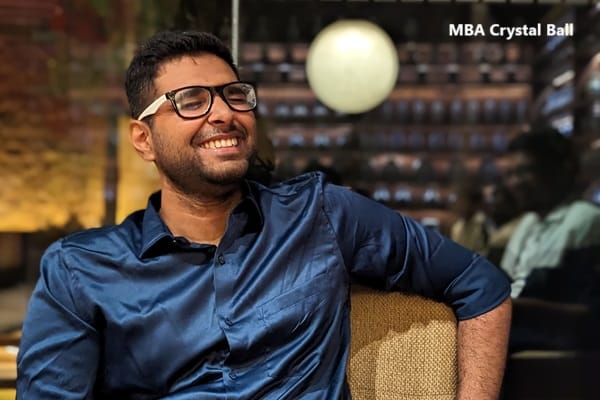
Neel Patil is going to Kellogg this fall. He shares the inspiring story of how he improved his profile and secured two elite MBA admits, including one from an M7 business school.
This is a transcript from our YouTube channel, in which Neel’s mentor and our admissions head Manish Gupta (MG) interviews him. If you prefer watching the video, here’s the link: My GMAT profile building and MBA application experience
GMAT profile building plan & MBA application strategy
This approach got me into Kellogg and NYU Stern
by Neel Patil
MG: For our readers’ benefit, give us a quick profile overview: where did you study, where did you work, how many years of experience do you have, what’s your GMAT score?
Neel: I did my engineering from IIT Madras and graduated in 2020. I started as a business analyst at Axis Bank and currently I’m a lead analyst and it’s been about 3 and half years now.
My GMAT score is 760 and my profile mainly involves working with a lot of people, mainly the operations team, sales team and various other teams to see how we can facilitate their work, based on the data we have.
MG: Let’s turn the clock back to the time when you were already done with your GMAT and you had two years of experience and you started thinking about an MBA. Why did you plan for an MBA at that point of time and what was your thought process at that stage?
Access Free Frameworks →
Neel: By that time, I had been working for almost two years. I was enjoying my work. What I enjoyed about it was it was analytical in nature; it was not purely technical – what I felt was okay.
I was already leading a small team by then but I wanted something with a bigger scope, working with a lot of different people. Because we worked with various teams, my projects varied.
But I wanted a bigger variation of what I did and something more global.
So, that’s why I felt that at that point of time, I had learned what I needed to learn in that role and I wanted to grow as well. So, I thought that an MBA made perfect sense.
MG: That’s the time, we started interacting and that’s when you took our ‘Profile Builder’ service. So, help us understand what made you think about that?
Neel: I guess like everyone, I was researching my options on the internet: about the schools, what they stand for and how they would fit into my plans.
During my search, while looking through the articles and video experiences of students and alumni, I came across MBA Crystal Ball articles that were written by you or Sameer.
At that point, I felt the need to speak to someone, so that’s how I reached out to you. I had already made up my mind that I wanted to apply that year itself – in 2022. If you remember – we had a discussion at that time regarding what my chances were and what schools I should look at.
MG: How did the Profile Builder transform the way you were thinking? Can you tell us a few specific steps you took after that? That’s the time you decided that you’ll wait for another year if not more. Talk us through about the specific steps you took after that discussion to enhance your profile.
Neel: First, I’ll get into why I took the ‘Profile Builder’ package instead of the ‘MBA MAP’ or going for a 5-school or 4-school package for essay-editing service.
During the discussion, we had an entire deep dive into my profile. We discussed about what I did during my college including all my extracurriculars post that. My experience was just two years and the average tends to be around five years for all the US B-schools and even higher for B-schools in Europe.
I remember the feedback that the chances at that point of time wouldn’t be great as the work experience itself was one and half to two years; we wouldn’t have explored as much as business schools expect us to.
Also, about the outside of the work profile, during my college, I had some decent extracurriculars and there were things I was interested in, but there wasn’t any continuity to that after I started working.
So, we decided that the best approach would be to wait for a year and work on my overall profile – not only taking up responsibilities at work but also continue what I was interested in during my college.
I had worked with Nirman – a preincubation cell involving working with startups to help them get incubated – go from idea to incubation phase. I felt these are the things I was really interested in, but I had not continued any of that.
Since business schools look for a holistic profile, I felt that it made sense waiting for 1-2 years rather than applying immediately. During this time, I thought I’ll work on improving myself.
I also remember we had this discussion: my opinion was that there was no harm in applying even if I didn’t get selected that year; I thought it would give me some experience with applications.
But you told me that if I applied and I didn’t get in, the onus of proving it to the schools that I have had significant jumps and my profile had changed significantly would be on me.
So if it was so clear that my profile needed improvement, I thought when I’ll be ready, I’ll give it my best.
In the ‘Profile Builder’ package, based on our discussions, there were specific areas of improvement needed in my work: it had to be more impactful. Either the work had to be earth-shattering or the role I was in had to be an earth-shattering one.
Another area that I had to build upon was the extracurriculars. Well, let’s not just say extracurriculars as it seems like we are just ticking them off the box.
So, I focused on taking on more work and went beyond what my job description was – talking to more people, more stakeholders and being more proactive. On the work front, I got promoted shortly after.
The other thing was on the extracurriculars side – I was exploring options like Toast Masters or something tangible. I was also considering if there was any way I could be in touch with the startup community from our school or any other startup community in general.
The Alumni Association of our IIT Madras held one of the events called Entrepreneurs Adda. I remember because they had invited a VC and I was blown away by the way he thought. I felt that they were bringing in really amazing people and I wanted to be a part of this and help people with their startups.
I talked to the committee members and mentioned about my similar experience in college. They brought me on board and since then, I have organized events that are usually attended by 50-60, at times over 200 people as well.
That was a totally fun experience and eventually I became a co-chair of the committee which was a big deal. I wanted something tangible and this happened unexpectedly and I enjoyed doing this so much. These initiatives thrive on volunteers, so most of the time, it’s just about raising your hand and saying that you’re available.
MG: You worked on this very diligently for one year, right? So, May’23 is when you decided, ‘This is when I want to apply’. Talk to us about what your thought process was. Did you still have any sort of hesitation or concerns about your candidature when you decided to take the plunge?
Neel: By May 2023, I was already in a much better position than what I was the year before. I was really happy that the odds had increased but I didn’t know if that was good enough; I was not sure about what exactly the admissions committee look for. Though there are many opinions online, nobody has a clear objective view.
That’s when I reached out to you and we had a discussion that the chances were good that year whereas waiting for a year more would improve the chances even more.
MG: It was your conviction that drove this eventually. I know you did a lot of research. Can you give us a glimpse into the top 2-3 things you think people should do for sure, that you really benefited from, in terms of the research and thinking through in this process?
Initially, when I was researching all the schools, even during my GMAT phase, which was in 2021 or at the start of 2022, M7 had a certain allure to them.
I wanted to go to an M7 school to be able to experience this, but you need to have to balance between being ambitious and being practical.
So I narrowed it down to the top 10 -12 schools with a mix of a few M7 and non M7.
I analyzed all those schools based on a few parameters including how well they fit in terms of my dream and secondly how easy it would be to get an admit based on my profile. Since I come from a banking background, basically an analytical role and I have a good GMAT score, I thought I’ll look at schools that value the GMAT score a little more.
There were other practical aspects like the school location – how far it is from the big hubs like New York or Chicago or San Francisco. Based on that, I made a cluster – the ones that are really attractive to me and that would probably would be on the easier side than those that are attractive to me but probably are on the harder side.
MG: You told me that you would document all the conversations you had with alumni and how that was useful in your essay phase. That’s a pretty intensive work that you did. So, coming to our engagement, were there any specific things that you still remember – anything vivid that you thought was maybe an ‘aha’ moment that was the highlight of our engagement when we worked together?
Neel: With MCB, you remember the first review of the essay when I put everything into writing. I had multiple schools right, then we decided which school we work on first and then go on choosing the schools later.
So, when I sent in the first draft and it was already after I had put in everything, I got a revert back from you saying that it was nearly abysmal that could use a lot of work.
You were quite frank with me but that was shocking at first.
But then, I thought that if that’s the case, the final output would be much better than where I was. For me that was an ‘aha’ moment.
MG: Can you tell our audience where you got admits from and what did you pick?
Neel: While I got admits from Kellogg and NYU Stern, I got waitlisted at Booth and Darden. For me, it was a decision about pursuing the wait list at Booth and Darden plus just before the acceptance deadline, making a choice about Kellogg. I decided to go with Kellogg.
Consulting and tech are both really attractive to me and based on the placement statistics and recruitment, Kellogg tends to do slightly better than NYU Stern in both these aspects.
So, in spite of the fact that New Yyork is the financial Hub, Kellogg outweighed that. Chicago is also quite a good place when it comes to companies, employers, so that’s why I went with Kellogg. Another important aspect was the initial desire I had about M7, so that also played in.
MG: Given the current American placement scenario, do you have any concerns? What kind of thought are you going into this with?
Neel: One of the things is: I thought, should I wait, should I defer – I had actually considered that as well. One of the reasons I wanted to do this at that point was I felt that this was the time to accelerate.
I’m young. I’m in my 20s. I’m really ready to give it my best.
Though there is a slight concern about the market, especially in the tech space because it is all heavily dependent on the parent economy itself, but I’m hopeful that Kellogg would be one of the least affected.
Secondly, Kellogg has a great emphasis on team-based culture. It has a really strong support system for that as well, so that puts me at ease.
MG: As an end note, if you were to suggest 2-3 top things every candidate coming from a banking or a tech space should do, what would they be?
Neel: I think these are the top 3 points that I have carried in within myself which have helped me through this process – this would apply to everyone through this application process – not just those in the banking space.
The entire application process would involve a lot of self-reflection as each school would have different essays. Some school may ask you about your past while another may have questions about your future plans, others may ask you where you are right now and what your values are.
I mean they cover entire landscape of what it means to be a human, so there will be a lot of self-reflection, especially if you’re applying to a lot of schools.
During the process, there’ll be those negative phases where you have self-doubt and when you tend to question yourself: despite all this, will I get through or not?
I’d say try to keep such thoughts to a minimum or try to eliminate them if possible because they don’t serve any purpose whatsoever and they can hinder you during your efforts.
The applications themselves are quite exhaustive; so you really need to be in the right state of mind so that you don’t end up making mistakes – this is one key takeaway.
The second important thing I’d say – use as many tools as possible to keep things structured; you’ll be using this a lot during the applications process, so don’t carry everything in your head.
The third one would be – speak to a lot of people. You need to reach out to a lot of people as less than half of them will respond back.
Again, since they would be in a different time zone, you’ll have to connect during odd hours like 1:00 am, 2:00 am or 3:00 am. I remember right after I spoke at 3 am with one of the alumni, I made some changes based on the feedback I received.
When you’re speaking to alumni, just make sure that you are very intentional about what you are going to ask.
If a person has served as a VP of a certain club, then ask them specific questions about that club and what your plans are for that club and if that’s feasible or not.
MG: Neel, thanks for sharing your journey with our viewers. We’ll be watching your journey to Kellogg and beyond! All the best!
Neel: Thank you, MG!
We hope you found this interview helpful.
At MBA Crystal Ball we’ve helped many applicants like Neel get into the elite business schools, often with scholarships.
Reach out if you’re looking for professional help to build your GMAT profile and with your MBA applications: info@mbacrystalball.com
Also check out the services Neel talks about in the video:
– GMAT MBA Profile Building
– MBA Application Consulting
– Second MBA at Kellogg after IIM
– Life during and after an M7 MBA: From Kellogg to McKinsey
