
In this tutorial on basic geometry concepts, we cover the types and properties of quadrilaterals: Parallelogram, rectangle, square, rhombus, trapezium.
Definition:
A quadrilateral is a simple closed figure with four sides.
Types of quadrilaterals
There are five types of quadrilaterals.
- Parallelogram
- Rectangle
- Square
- Rhombus
- Trapezium
One common property of all quadrilaterals is that the sum of all their angles equals 360°.
Let us look into the properties of different quadrilaterals.
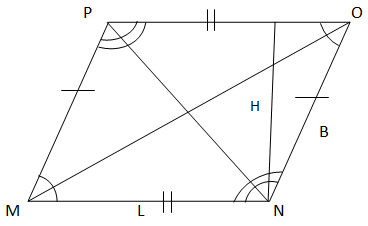
Parallelogram
Editor's Note: Rethinking your career or planning an MBA? Use these free decision frameworks to make better-informed choices.
Access Free Frameworks →
Access Free Frameworks →
Properties of a parallelogram
- Opposite sides are parallel and congruent.
- Opposite angles are congruent.
- Adjacent angles are supplementary.
- Diagonals bisect each other and each diagonal divides the parallelogram into two congruent triangles.
- If one of the angles of a parallelogram is a right angle then all other angles are right and it becomes a rectangle.
Important formulas of parallelograms
- Area = L * H
- Perimeter = 2(L+B)
Rectangles
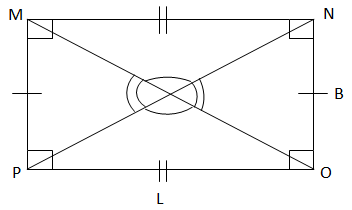
Properties of a Rectangle
- Opposite sides are parallel and congruent.
- All angles are right.
- The diagonals are congruent and bisect each other (divide each other equally).
- Opposite angles formed at the point where diagonals meet are congruent.
- A rectangle is a special type of parallelogram whose angles are right.
Important formulas for rectangles
- If the length is L and breadth is B, then
Length of the diagonal of a rectangle = √(L2 + B2)
- Area = L * B
- Perimeter = 2(L+B)
Squares
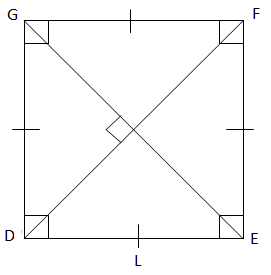
Properties of a square
- All sides and angles are congruent.
- Opposite sides are parallel to each other.
- The diagonals are congruent.
- The diagonals are perpendicular to and bisect each other.
- A square is a special type of parallelogram whose all angles and sides are equal.
- Also, a parallelogram becomes a square when the diagonals are equal and right bisectors of each other.
Important formulas for Squares
- If ‘L’ is the length of the side of a square then length of the diagonal = L √2.
- Area = L2.
- Perimeter = 4L
Rhombus
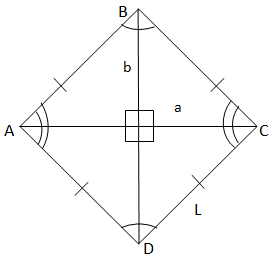
Properties of a Rhombus
- All sides are congruent.
- Opposite angles are congruent.
- The diagonals are perpendicular to and bisect each other.
- Adjacent angles are supplementary (For eg., ∠A + ∠B = 180°).
- A rhombus is a parallelogram whose diagonals are perpendicular to each other.
Important formulas for a Rhombus
If a and b are the lengths of the diagonals of a rhombus,
- Area = (a* b) / 2
- Perimeter = 4L
Trapezium
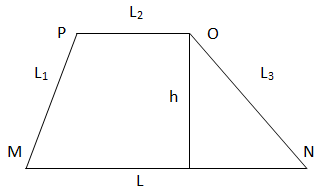
Properties of a Trapezium
- The bases of the trapezium are parallel to each other (MN ⫽ OP).
- No sides, angles and diagonals are congruent.
Important Formulas for a Trapezium
- Area = (1/2) h (L+L2)
- Perimeter = L + L1 + L2 + L3
Summary of properties
Summarizing what we have learnt so far for easy reference and remembrance:
| S.No. | Property | Parallelogram | Rectangle | Rhombus | Square |
| 1 | All sides are congruent | ✕ | ✕ | ✓ | ✓ |
| 2 | Opposite sides are parallel and congruent | ✓ | ✓ | ✓ | ✓ |
| 3 | All angles are congruent | ✕ | ✓ | ✕ | ✓ |
| 4 | Opposite angles are congruent | ✓ | ✓ | ✓ | ✓ |
| 5 | Diagonals are congruent | ✕ | ✓ | ✕ | ✓ |
| 6 | Diagonals are perpendicular | ✕ | ✕ | ✓ | ✓ |
| 7 | Diagonals bisect each other | ✓ | ✓ | ✓ | ✓ |
| 8 | Adjacent angles are supplementary | ✓ | ✓ | ✓ | ✓ |
Continue learning more about:
– Properties of Lines and Angles
– Properties and formulas of Circles
– Types of Triangles and Properties

Do opposite sides in a quadrilateral have to be equal in order for it to have diagonals that are perpendicular?
No because rectangle has opposite sides equal yet the diagonals bisect each other but they don’t perpendicularly bisect each other.