
Retired army officers looking for a career change have a tougher time than others. There are several reasons for this, with two that dominate.
- While they’ve handled more difficult challenges than their civilian counterparts, most do not have business qualifications or experience that new employers can directly use.
- After spending close to half their professional life in the military, they are older than the typical corporate guys looking for a career change. Ageism is an undeniable reality of corporate life.
Unfortunately, the corporate world is not waiting for our retired soldiers with open arms to give them a chance at re-starting new careers.
Colonel Saurabh Srivastava explains the most common options army veterans have after retiring, and why he chose to take the ambitious route of applying to business school.
MBA after retirement from Army: Career change after 40
From Retiring to Re-Attiring
by Colonel Saurabh Srivastava (Veteran)
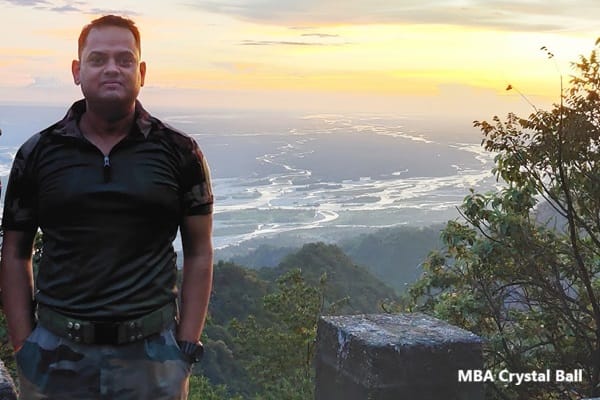
I’d be lying if I claimed that I never imagined of penning down my successful admission to a reputed B-school someday.
The thought had sprouted once I embarked on one of the most courageous journeys of my life – career transition from a successful and established army life to an unfamiliar corporate world.
In hindsight, I realize that that imagination itself betrayed a deep sense of self-belief and confidence in my own capabilities.
And I guess that’s what it eventually boils down to – belief in your abilities, courage to take decisions, perseverance, and ability to bounce back.
Access Free Frameworks →
My fascination for adventure, unconventionality and an inclination for a more ‘hands-on’ job led me to skip the traditional duality of ‘medical or engineering’ career route and opt for the UPSC entrance exam of National Defence Academy (NDA) for joining Army instead.
My four years of military training, without a shadow of doubt, anodised the iron mould of my personality with rich ingredients of discipline, ethics, integrity, and loyalty.
These abstract foundations were tested and strengthened by my kaleidoscopic work experiences in hues of different geographies, nature of duties, and teams of people.
I led teams in pure military combat missions, managed projects ranging from regional to strategic ones covering the entire country, and taught military strategy and international affairs to national and international military student-officers.
These escapades burnt the codes of adaptability, survival instincts, and risk management in the very core of my DNA.
It seems ironical but the very ethos that initially drove me to an Army career also inspired me to re-cast myself into a new avatar.
A spirit of adventure, excitement of new exploration – both of external opportunities and internal discoveries, and self-development.
The mould remains the same though!
So, after completing my mandatory 20 years of military service at a ripe young age of 43, I took the plunge.
Two routes unfolded as the decision of career transition was concretized (Service officers may take a cue for their career transition planning).
First, the competitive route – the whole nine yards. Research/consult to identify good B-schools befitting your vision, put in the requisite hours of rigorous academic regimen, get a competitive GMAT/GRE score, go through the application and interview process, complete the immersive curriculum of your selected college, and embark on the new journey armed with the new knowledge and network.
The journey is tough and that’s what that makes it intoxicating. The daily grind sprinkled with small victories here and there with a grand final purpose makes this journey extremely thrilling and satisfying.
Second is the quasi-academic route. Enrol in a six-months resettlement course semi-sponsored by Service HQs, utilise the time and brand/faculty of the college (IIMs, FMS etc) to network and land an opportunity.
Upgrade your CV with certain relevant certifications and qualifications. There’s a trap though! Don’t go overboard.
Additional certifications should be part of a planned upgradation of skills and not a desperate psychological gasp to cure the itch of impostor syndrome.
It’d be better to identify your core target industry first and then upgrade accordingly.
There’s one more route – the start-your-own-thing route.
I’m sure though that those who are or are aspiring to be on this route don’t need this blog. Entrepreneurship is an extremely exciting space and deserves a separate piece altogether.
What I’d like to highlight here is the mental spade work required to contemplate and identify one’s own niche resonating with a particular industry and/or domain. That’s the start point.
Most ex-service officers fall into the trap of describing themselves in generalities without being specific. To get to any specific description of your skills one needs to do a deep dive of self-exploration and contemplation.
This endeavour should also be enriched by professional consultancy, own research, networking and other relevant interactions. It’s a must.
Coming back, as you might guess, I adopted a mix of the two routes mentioned above. Enrolling for a six-month resettlement course (General Management Program for Defence Officers) along with the preparation of GMAT.
After five months of rigorous academic regime which included a daily 6-hr toil of formal resettlement course classes and almost 3-5 hrs of GMAT prep, I started with a score of 660 in my first mock and finished with a 730 in the fourth one before I gave my first attempt.
Guess how much I scored.
560!!!
It felt so bizarre that after the initial disbelief I just kept the entire episode aside. By the same evening I had managed to book another attempt at Chandigarh (no venues were available in Delhi) within next 15 days.
Finished the advanced GMAC guide in the meantime and cracked a 720.
A mixture of circumstantial constraints (I had to go back to my duty station to finish my retirement documentation and other formalities) and slight mismanagement of timelines saw me staring at the ISB PGP 3rd round application deadline within three weeks.
Lesson – Plan the start of your MBA application process by keeping a buffer of at least a month for GMAT re-attempt(s).
With no time to do a holistic and personal research, I consulted few friends and as a textbook case of anchoring effect hired the first consultant that came across at the lowest cost!
Despite few red flags in initial interactions and with no time to do a course correction, I gave it a full-blooded shot.
Result – Despite a good score and overall solid profile, I didn’t even get an interview call!
Reason – My application was kept pending at the application portal till the last date due to a technical inconsistency. Did I say I hired a consultant?
Lessons – Sequential planning is a disaster. Homing onto a good admissions consultant is a must.
The consultant should translate your personality and skills in the form and spirit befitting the unique requirements of a particular college.
He should add value to what you know, inform what you don’t know, and assist to discover what you don’t know that you don’t know.
Finalising 4-6 schools (home and/or international) is a must. Targeting the first or at worst second rounds (the probability of international students to get an admit in Europe or Americas dwindle exponentially with each passing application round) of the application process will give a broad timeline to schedule the entire process of your preparation.
But all this wisdom was in hindsight.
One year gone? Not yet.
Time for a strategy change. From academics to real world manoeuvers. From theoretical to experiential pursuits.
The sting of rejections became a propellant which burnt my inhibitions and mental prejudices to ashes.
Next few months saw me reaching out to people from diverse fields ranging from real estate / construction to education sector, from creative writing to NGOs et al.
It was a matter of time as the sheer volume of my forays into corporate nook and corner painted favourable probabilities of a breakthrough. Within couple of months, I joined a reputed firm at a reputed position.
The opportunity gave a breath of fresh air and the dopamine rush of new learnings.
As the euphoria of novelty faded, I discovered certain gaps in the foundations of my theoretical understandings of the business world.
Proponents of ‘learning by doing’ downplay the importance of a priori epistemology of a theoretical framework in any practical endeavour.
A sigh of nostalgia for an MBA course forced me to re-calibrate my next short term strategy.
I decided to re-apply to ISB, but to a more relevant program (PGPMAX) this time, considering my age, experience and fit.
I made sure that the decision is not driven by a sunk-cost fallacy but by realistic assessment of expected returns.
Once bitten twice shy.
Enter MBA Crystal Ball (MCB).
I had followed Sameer Kamat on social media for some time, however, the idea of actually utilising his consultation services never occurred to me earlier.
The reason still eludes me. Probably it was the lack of sufficient time which forced knee-jerk actions due to lack of advance planning.
Not this time!
I approached Manish Gupta, the Chief Consulting Officer of MCB who in turn connected me to Avinash Kaparekar – my guide for the first round application journey for ISB.
Initial two conversations with him didn’t eradicate my suspicions about this whole consultancy business. Maybe the hangover of previous association with consultancy was still lingering.
Once we got to the brass tacks though, the real value addition of a good MBA consultant started to become crystal clear.
The probing questions, the specificity of details addressing unique attributes and check boxes of the application form, the finesse and proficiency of covering all aspects yet keeping the uniqueness intact, and of course the presentation.
Avinash became a friend you wish you had in real life who could help you solve deeper existential challenges. I was shortlisted for the interview round and the entire process culminated in the form of an admission offer along with a scholarship.
In hindsight, I realise that to successfully land an admit to good colleges you have to showcase yourself in an attire that makes sense to them.
You have to sell what they want. This is perhaps the first lesson in your corporate story even before you’ve started your academic year.
In the absence of clear understanding of what-makes-sense-to-them, it’s almost inevitable to reach out to people who’ve been there, done that.
MBA Crystal Ball fits the bill perfectly.
Any amount of individual theoretical research has good chances of falling short of the mark. The risk is just too high.
It’s the right time to close the loop. To end with what I started.
No amount of consultancy and research can replace the basic tenets of clarity of purpose, focus on goals and its relentless pursuit calibrated by dynamic decision making.
This is the soul force which drives the engine of action in the real world. You’ll fail, you’ll fall, but you can’t allow that to abandon your goals.
Hero-worshipping binds us to our mental cages but real success stories of common people like us make these abstract truisms practicable. This is the sole purpose which drove me to write this piece.
– Colonel Saurabh Srivastava (Veteran)
If you’re a military veteran and planning to apply to MBA programs, reach out: info@mbacrystalball.com
Related articles:
– Career options & life after Military retirement for Army, Navy, Air Force veterans
– MBA after 40 for former military (Indian Navy) officer

Intrigued by MBA crystal ball… Would like to know more.
@Pankaj, feel free to reach out with your queries on mcb@mbacrystalball.com
Sir, if you meet the minimum education criteria and have scored competitive enough in the entrance no one can stop you from getting into any school as per the right to education act.
@Nanda, when it comes to many MBA schools, the entrance criteria is not just a single exam and there are multiple factors involved.