
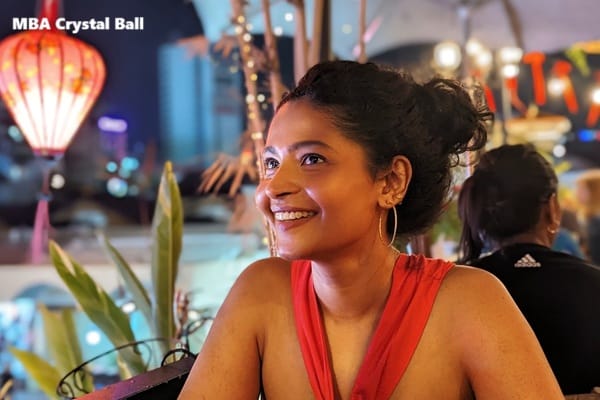
After 7 years of work experience, Bratati was at a crossroads in her career. She already had an MBA from IIT and had worked in SCM roles. The two top choices she was mulling over were a second MBA from an international business school versus a specialized masters degree.
MIT offers 2 masters degree options in SCM: Master of Applied Science in Supply Chain Management (MASc-SCM) and Master of Engineering in Supply Chain Management (MEng-SCM). The former is aimed at students who want to work in consulting or industry after the degree, while the latter is research-based and designed for PhD aspirants.
Just when Bratati had started exploring the options in more depth, she heard some bad news at work. She explains what it was and how she managed her applications that resulted in admits from two prestigious institutions in the world despite the setback.
INSEAD MBA vs MIT SCM Masters
Second MBA vs Specialized Masters
by Bratati Das
I am Bratati, from Chandannagar, West Bengal with a love for stories, people and travel. Small town kid, big city dreams, I was always that kid. I have an undergrad background in Metallurgy, few years in Deloitte and then an MBA from IIT Bombay.
I pursued an MBA for a 360 degree view of business, and it indeed opened up opportunities across multiple domains. Of these, I started developing an interest in operations and consulting. Luckily, I got a summer internship at GEP, a procurement consulting firm that worked at the intersection of the two.
In 2020, IITB gave us vouchers for courses on edX, to keep students engaged during the pandemic, and I chose sc0x – a supply chain analytics course offered by MIT on edX.
I loved the content and on initial research learnt of their full-time program for the same.
Access Free Frameworks →
It was a perfect deep dive for someone who already had some work experience in the domain, so I decided to focus on building that experience for myself.
Eventually got a PPO at GEP in 2021, and in the next two years, amidst a pandemic, war and an energy crisis, I got a first-hand taste of supply chain as a company’s core value creator. I also understood the value of resilience in large organizations and the role technology plays in building it.
With that in mind, I joined Unilever’s internal supply chain consulting team, working on cross-business network transformations and competitor intelligence. This role exposed me to a lot of ambiguity that exists in real world business problems, and taught me how to navigate them.
Cut to Dec 2023, with nearly six years of work ex, I felt it was the right time to start thinking about Fall 2025 applications.
I started looking up on consultants as I was concerned about my work experience (as a consultant I had worked across sectors and functions with relatively low core supply chain experience), as well as this being my second master’s.
I decided to seek professional help to craft my story. An alum of mine from IITB, Nilay, had talked about MCB on his LinkedIn (Read how Nilay got into MIT SCM Masters with scholarship).
On further research I made up my mind to reach out to Manish Gupta (MG).
I was sure, I would go for a consultant only if MCB agreed to take up my case, or apply independently otherwise.
But fortunately, within a day of submitting my free profile evaluation request to MG, he got back. MG was very honest about the evaluation – while he highlighted the strength of my academics and brands I’ve worked with, he pointed out that given the length and nature of my experience it would make sense to also consider a few MBA programs. But most importantly, he encouraged me to get back with a GMAT score.
I appeared for my first GMAT attempt 4th week of July, and got a 685 on the Focus edition. But, a day before my GMAT, I got some terrible news at work.
Our entire department was hit by an org wide productivity program, and we would be redundant by the end of the year.
I was heartbroken but decided to push through. The org restructuring gave me some space to introspect, which in hindsight was a huge blessing.
Following week, I reached out to MG with my score. He felt the score was already good enough, and encouraged me to start researching programs besides MIT.
What I really liked was that he gave me a broad understanding of the landscape in Europe (US MBAs were cost restrictive for me) but he insisted I do my own research and even talk to alums before I made up my mind.
The next one week, I did intensive research on schools, and finally decided to go for MIT SCM and INSEAD MBA. Avinash took up my case, and we started working on my applications.
While both MG and Avinash were honest about the pros of applying in Round 1, they agreed to go ahead with Round 2 for INSEAD, given I wasn’t comfortable chalking out my SOP in a month.
Meanwhile, I felt I could push my score a bit more, so I booked a second GMAT attempt 1st week of September.
The next month was one of reflecting on my journey so far, and fine tuning my whys. On our first call, Avinash, while expressing empathy for my situation, encouraged me to use it as an opportunity to introspect and sharpen my application further.
The initial edits and calls were to help me build a well-rounded story.
Without his help, I wouldn’t be able to bring out so much authenticity and clarity on paper.
My second GMAT score was a 725, and this was a huge boost to both my confidence and my application. I also got an internal role in Unilever around November, and slowly things were looking up.
To my delight, I was shortlisted for INSEAD’s alum interview round, and I enlisted for MCB’s help here too. Avinash was extremely patient during the mocks, and his feedback was to the point.
Eventually I heard back from INSEAD in Jan, got an admit with a 25,000 Euro scholarship!
However, earlier in December, I was waitlisted for MIT. Although this was disappointing, INSEAD was a dream program nevertheless.
Despite my admit, MG and Avinash asked me which program I personally preferred more, and when they learnt it was MIT, they encouraged me to reach out to MIT for an earlier waitlist decision closer to INSEAD’s deposit due date.
Around this time, I also had a meniscus tear in my knee, and was almost considering not going for either program.
But with Avinash’s support, I sent out an email to MIT, hoping against all hope, and heard back with an admit in 2 days!
The application process was an intense 6 months of my life and I learnt important lessons – don’t stop till your story feels real to you, and every obstacle can be an opportunity if looked at the right way.
And that is my story. From a job redundancy and an existing master’s to a 725 GMAT to admits from two dream colleges. Thank you MCB for coming along on a journey that I will not forget soon!
Connect with us for help with your MBA or Masters applications: info@mbacrystalball.com
Also read:
– Why a second MBA abroad?
