
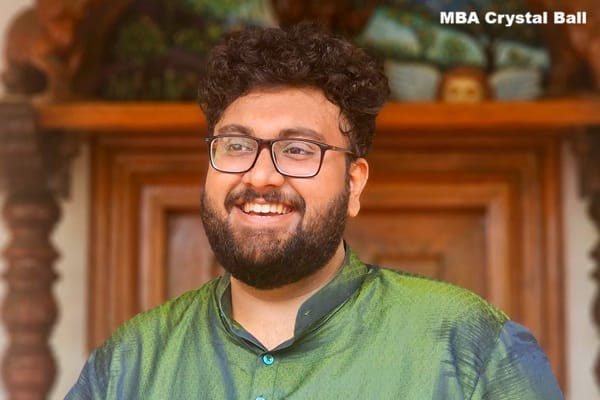
Aravindakshan’s journey, from his multiple test attempts to working with an M7 MBA admissions consultant in India, offers a real-world case study to learn how an Indian engineer from a non-feeder college built a competitive M7 MBA application and ultimately earned admission to the Columbia Business School with a $100,000 merit scholarship.
He first approached us in 2024, but his plans shifted by a year. On MBA Crystal Ball’s advice, he worked on his GMAT and then partnered with us to get into Columbia Business School. Our consulting head, Manish Gupta, spoke to Arvindakshan to find out how he did it.
How an Indian Engineer From a Non-Feeder College Got Into an M7 MBA
Working With an M7 MBA Admissions Consultant: My Experience
Q&A with Aravindakshan Sanjay
Manish Gupta: To begin with, could you share with us about yourself and your qualifications.
Aravindakshan: I’m from Chennai. I did my Bachelor’s in Electronics and Communication engineering from SSN College of Engineering and then, post SSN, I’ve been working at Citibank for the past 4.5 years in technology risk management.
I’m passionate about singing, cooking and I love to review movies and TV shows. So yes, that’s all about me.
From Citi to consulting: My MBA motivation
MG: Help us understand a little more about how you got into Citi? How was it working there?
AS: When I was in college, I didn’t envision getting into Citi. I didn’t know Citi recruited from our campus. So I distinctly remember that Citi was the first company that came to our campus and all of us were excited across departments.
Access Free Frameworks →
I think around 800 people applied, probably because of peer pressure. I also applied because I wanted to practice my interviewing skills. Finally, they selected 30 people and I was one among them.
So there was an online aptitude test, also technical coding-based questions and then there were technical and HR interviews. So that’s how I got in though I never expected it.
MG: You had a good career; you were doing well. So what prompted you to look at doing an MBA?
AS: I’ve been wanting to do an MBA right from, probably, my third year of college. I was really interested in ECE when I started but then after spending 2 years, I realized that even though I like the subject, I didn’t want to spend my career, 30–40 years working in that field.
And I knew that I want to do something related; actually, I wanted to get into strategy consulting right out of college but unfortunately SSN is not a feeder school. McKinsey, BCG, Bain and others only recruit from the top IITs and even that is very competitive.
Actually, McKinsey came to our campus but for the back-office tech roles. I couldn’t sit because I already got into Citi and there’s a college policy that you can’t sit for other companies.
But once I got into Citi, I really liked it here, that’s why I’ve been working here for the past 4.5 years. Even my role at Citi is a very unique one. I’m not a software developer.
So what I do is called technology risk management for consumer banking applications at Citi, specifically check processing applications. We don’t use checks anymore but in the US it’s still very popular.
So we have 14 applications which process checks for millions of US and Canadian customers and I manage the risks for the applications.
So it’s a very unique role, you can say. It’s a general management role within technology risk management. I’ve loved working here for the past 4.5 years.
MG: Was there anything about your experience at Citi that prompted you to move forward with your MBA plans?
AS: Like I said, I wanted to try strategy consulting at least once in my life and I wasn’t able to right out of undergrad. So I thought this would be the right point for me to pivot as an MBA offers the perfect structured pathway to consulting.
Whatever I could learn from this role, I thought that I had already extracted it. Now I was ready for a new challenge for my career to head in a new direction, that’s why an MBA felt like the right thing to do.
Six attempts, one breakthrough: My 98th percentile GMAT story
MG: Talk to us about your GMAT journey. How did you go about it? What kind of score did you manage?
AS: Oh my God, it was a roller coaster! It was a four-year journey actually. I gave the GRE thrice and the GMAT thrice. So I’m kind of a veteran at both.
The first time I gave the GRE was in 2022. I gave two attempts of the GRE and then in 2023, I gave one more attempt of the GRE. I got a 323, a quant 164, verbal 159, which is a very good score if you’re applying to MS programs or MEM programs in the US.
But it’s not a great score if you’re applying to MBA programs, especially the M7 or the top 10 programs. So, I was advised to take either the GMAT or the GRE again. I felt I would go crazy if I took the GRE again for the fourth time.
So, I took the GMAT. I thought it would be easier than the GRE but oh boy, I was wrong!
The GMAT is incredibly more difficult than the GRE because it is question-adaptive, section-adaptive and here the math and the data insights are very difficult sections.
I gave my 1st GMAT attempt in August of 2024. I got a 645 and then in my 2nd GMAT attempt in November of 2024, I got a 665.
I was hoping to apply last year in round 1, then it got postponed to round 2. I was not satisfied with the 665. I reached out to you because of that. I actually spoke with one of your mentors and they told me that I really can score better; it’s to my advantage if I wait for 1 more year and take the GMAT again.
So I gave a short break and took the GMAT again in June 2025, my third GMAT attempt. I almost cried when I looked at the screen. I got a 695, which is a 98th percentile – I got an 88 in quant, 85 in verbal and 81 in DI. So that was also very good. A high quant score is always better. So that’s about my GMAT journey.
I used a platform called e-GMAT and I definitely recommend it to whoever is watching this. They’re an amazing online prep platform, especially for Indian applicants; they really give you the value for money.
The other GMAT coaching platforms are pretty expensive and I found this perfect for me. A lot of people struggle with this, so I’m sure that will be helpful.
So it was a real struggle and it would be worth it if you persist; you have to be resilient. Some very intelligent folks may take their tests well in probably just one attempt; for some others it might take more than me but please hang in there. So that’s what I would like to say to those on a similar journey.
Why I Chose an MBA Admissions Consultant, and an MBA Over MEM
MG: So, GMAT done and dusted. Then help us understand why you decided to work with MBA Crystal Ball? What kind of services did you sign up for?
AS: So, I’ve been following MBA Crystal Ball’s YouTube channel and your blogs right from my 2nd or 3rd year of college and you guys actually introduced me to the MBA world, especially the business schools outside India.
I learned a lot from your videos and blogs, the success stories that you post and I always knew that if I wanted to apply for an international MBA, I would definitely work with you.
So that was always there because I had that trust with you guys. And then I actually spoke to Sameer at a very important point in my life.
I had previously, in 2023, applied to the MEM programs in the US, it’s called Master’s in Engineering Management. I got into one of the top three programs for MEM and I was sitting on an admit but I was kind of not satisfied.
I was yearning for an MBA. If I had to go into strategy consulting, only an MBA is the direct path. MEM is not the direct path.
So that’s when I actually messaged Sameer Kamat, who’s the founder of MBA Crystal Ball, on LinkedIn and he was kind enough to talk with me.
So we spoke for an hour. He’s actually the one who motivated me to take the chance to give the GMAT once and he really motivated me to pursue an MBA.
So yes, that’s when I decided to withdraw from the MEM program and start my MBA journey and it’s been worth it! Working with MBA Crystal Ball was a clear choice for me.
MG: That must have been a difficult decision. Which schools did you have an admit from, for MEM?
AS: I got into Duke MEM which is offered by the Pratt School of Engineering, but in that program, you also get to take courses from the Fuqua School of Business, so it’s like a tech management program. But it’s not a feeder for consulting, that’s what I learned after I got the admit.
So it’s more for people who want to go into project or product management, which I didn’t want to at that point and even now I don’t want to, so that didn’t feel like the right fit for me even though Duke is an amazing university.
I was sitting on an admit and it was my dream to go and study in the US. It was a very risky decision to withdraw from that and start afresh.
On the GMAT – I didn’t know how well I would do and it took me three attempts. So yes, it was a difficult decision but I think it was worth it.
Crafting a well-rounded M7 MBA application – The role of mentorship
MG: What kind of services did you sign up for? What was your experience like? Who did you work with at MBA Crystal Ball?
AS: I signed up for the application essay review package for three schools. I worked with Vibhav Agarwal. I had an amazing time working with Vibhav and his associate Maitabi.
They were really very straightforward with all their inputs and advice and it really helped me shape my application and put my best foot forward for all these schools.
I really needed ‘that someone else’ to bounce my thoughts around, to review and say oh this is relevant to the essay and this isn’t.
I wanted some objective opinion because a lot of the people who apply and get into these top business schools are from feeder schools like top IITs or from feeder companies like McKinsey, BCG, Bain or the big tech and I didn’t have that.
I didn’t have anyone in my network who has done this previously, so I didn’t have anyone to reach out to. It was a lonely process but at least I had Vibhav and Maitabi to keep me sane and to give me their objective opinions.
So I really value that and I also took the interview prep package after I got the interview invite.
MG: And when you think about your positioning, what do you think you did differently? How did you stand out, given the competition that you just talked about?
AS: I think more than standing out, I wanted to submit a well-rounded, strong application that’s strong in all aspects right from my undergrad GPA to a GMAT score.
People say it’s not that important but if you’re from an overrepresented pool like an Indian male engineer, every single thing matters because people have these strong hard statistics. So it becomes very important including the essays, the interview, the letters of recommendation.
In the application itself, you have to fill a lot of things; that’s underrated. So I think I put my best effort for each of them.
What really changed is – Vibhav changed my viewpoint!
I was pretty underconfident with my own profile, saying I’m not from a feeder college or a feeder company even though Citi is a big brand. But I didn’t work in finance; I worked in tech and even within tech, technology risk management is very niche.
Within tech, you don’t need an MBA to rise up the corporate ladder. I didn’t know anyone who had an MBA. People usually have just a bachelor’s degree.
Vibhav told me to double down and be confident with my experience because it was very unique, also not to try to fit into a mould or try to mimic others.
It was actually to my advantage that I honed in on my experiences – not just work experience but all the extracurriculars I had done outside of Citibank including my personal experiences, my childhood experiences, extracurriculars in college and more.
I made sure all of this was represented in some part of my application, either the essays or the optional essay. A lot of people don’t use that application component.
There’s a separate space for work experience. You can say something that gives them more context about your role, especially, if it’s unique like mine or about your career progression.
There’s the activities section where you can list up to eight extracurricular activities. So you have to use that to your advantage and that’s what I did.
I made sure all these experiences are reflected somewhere and made it a point not to force-fit everything in my essays. So overall it should be represented somewhere because all of this is looked at together.
So I think that’s how I stood out by being completely honest and proud of my unique experiences within banking, tech and also outside that. So honing in on that helped me stand out.
MG: And I think, you had a lot of things outside of work like the employee engagement work. I think you had done this internship in research.
AS: I’m part of the employee engagement committee. There’s a DEI network that I was an active part of and then there’s the voice of employee action committee, so I was part of that.
And in SSN, I was part of the music club, entrepreneurship club, my department committee, all those things. So, it adds some incremental value to your overall candidature.
It’s not just that, also the passions. I thought that should come through clearly, for example, my passion for singing, for reviewing movies, for cooking, all that influences how I will show up at Columbia or any other business school, how I contribute to the class.
So they are picking you not just for your GMAT scores or your work experience, but what kind of a person you’ll be within the community. So I think it is your advantage to show them what kind of a person you’ll be. Will you organize karaoke nights? Will you do things like cookalongs or whatever?
Refining my MBA story: How structured feedback helped
Also, I think I stood out because of my research about the school, which helped me both for the interview and for the essays.
It should not be generic. It should be very specific which I got to know because I spoke to current students, club leaders. I attended every single virtual information session for all the schools – not just attended, but also asked thoughtful questions to the AdCom.
So when it’s probably the fourth or fifth time you’re seeing them, they’ll instantly recognize you. So they can put a face to a name, whatever. So when they read your application, it signals something to them.
Okay, this guy has done his research, he’s at least interested in our school. That’s what they’ll feel. Also, you’ll get to learn a lot more about the school that you can probably even quote in your essays that you can’t get just by looking at the website.
So I think all this helped me and also for Columbia especially, what they really care about is your goals: your short-term goal, your medium-term goal, your long-term goals, your career plan after MBA, being intentional about why MBA, why now, why the school. I think that’s really very important.
Columbia’s main essay, the 500-word essay, is for this – the goals and why MBA. So I think you have to be very intentional about that.
Working with MBA Crystal Ball, with Vibhav, actually helped me frame the answers perfectly to those questions, because every time I used to say something, Vibhav would ask, Why? Why this?
And then I would give one answer and again he would ask why, again an answer, so we got to the point where he cannot ask a why, right? And that’s the thing that I used in my essays and this is very important, I think.
You have to be very specific and that’s how you stand out. Because you see a lot of applications, that really helped me and I’m really grateful to Vibhav for that.
Also, both Vibhav and Maitabi didn’t sugarcoat at all. Actually, I remember one of my essays. I thought this is the best essay I had ever written; I loved it.
We went for a review. As they reviewed it and we went line by line, word by word, it totally tore apart the essay.
So after the call, I noted down all the points and advice they had given. I had written that in my notes and still have that.
Next day, with a fresh mind, I looked at those notes and whatever they said made a lot of sense, because they want me to do really well, right? So that’s where I think this is a true difference that MBA Crystal Ball gave me.
So it was straightforward advice, but that’s what I needed, right? That really helped me present my best self and give the best answers to all the essay questions and the same I would say for the interview too.
I thought I was really good at speaking to people, but it turns out an interview is different. Even though it has to be conversational, you need to be very precise with what you’re saying. There needs to be a structure to your answers.
The two mock interview sessions with Vibhav really helped me and again I took a lot of notes. So there was an overall advice and then we went question by question.
He told me how I could answer that better and what I was doing wrong, what I was not explaining properly, if I was using any technical jargon that a layperson cannot understand or if I was overexplaining something or anything like that.
So there were so many useful pointers that I used to my advantage and yes, the two interviews went really well. So yes, very, very satisfied.
The Big Win: Columbia MBA Admit With a $100K Scholarship
MG: It’s a very cathartic process, a moment of truth, right? Where all did you interview? Where are you headed finally?
AS: I applied only to 4 schools, even though I would have liked to apply to 2-3 more. A lot of people underestimate the time it takes for the essays and I’m one of those people.
I thought once you’re done with the GMAT, you’re almost 70% done, but actually, that’s just the start. Essays do take a lot of time, especially when you’re doing research, talking to people – students and the AdComs.
Everything adds up and I wasn’t able to apply to 2 or 3 schools. But anyway, I applied to Wharton, Columbia, Fuqua and Booth. I got rejected by Wharton and Booth. The Booth rejection really was a surprise, while Wharton is like a lottery, people know that about Wharton, HBS and Stanford.
But Booth was a target school for me and I thought I had submitted my best application. But anyway, for reasons that I’ll never know, I didn’t receive an interview invite.
I was invited to Columbia and Fuqua. Columbia was my first interview invite in the first week of October. It was very early I got the interview invite for that.
So I interviewed with Columbia and Fuqua and I am waitlisted at Fuqua currently at the time of recording this video, I really don’t know what might be the reasons that led to this.
And Columbia was actually the last news I heard and I was in tears when I saw the result! I was admitted to Columbia and I got a 100k merit scholarship on top of that, which I didn’t expect!
M7 MBA Application Tips for Indian Engineers
MG: The 100k scholarship, that’s a nice cherry on top. As the application journey comes to an end, what are the 1-2 things that you would recommend people who are starting this journey?
AS: My first advice would be to start early, especially the GMAT or the GRE can take a lot of time, so please be done with that before you start the applications.
Second, you need to have someone in your network who went to business school, either from your college, your seniors, colleagues, friends or people like Vibhav.
So you need to have someone who can give you objective opinions about what you write, because even if you think you’re amazing at writing, that’s not true. You need to have people who look at your essays and all that stuff. The next I would say is to, if possible, visit the campus.
I would have visited, but unfortunately, as an international student, you can’t get a visa for that. But if you’re a domestic student and you’re able to, then go visit.
Try to register for all the virtual sessions. Make sure to ask thoughtful questions. Don’t ask something that would get generic answers that can be found on the website.
The kind of question that you frame should elicit a very unique answer or an experience or a short anecdote that you can probably quote in your essays, but don’t go with that intention. Rather you need to learn more about the program.
Talk to students and alumni if possible, you need to talk to at least 3-4 students . A lot of these schools have separate groups of students whom you can directly reach out to who have volunteered for this.
Talk to club leaders. Find 2–3 clubs, no more than that, where, drawing from your personal experiences, passions, work experience and extracurricular activities, you believe your contribution would be the best.
Identify those clubs, talk to the club leaders or representatives if possible, ask what kinds of events they organize and what resources they offer, find out any pain points they’re facing this year and try to include that into your essays.
Try to explain how your contribution would be different and how it would benefit the community as a whole. Also, don’t focus only on your essays or the GMAT, pay attention to the entire application, which takes a lot of time. I really underestimated that.
The process is time-consuming and each school has its own word and character limits within the application. Start as early as possible and try to present different aspects of yourself across different parts of the application.
Avoid repeating what’s already in your resume, in your application or essays. Each part should add something new and complement the others so that you present a well-rounded profile.
Be proud of the work you’ve done or whatever you’re currently doing and approach everything with confidence. That’s something Vibhav really helped me with.
I realized I had been putting myself down. He told me that you need to be proud of yourself and confident, or you won’t be able to submit your best application. So be confident and leverage all those experiences, even your personal experiences right from childhood.
All these schools have an optional essay where you can present additional information. So wherever you think there are weak points in your profile – or even if they aren’t really weak points but just need more context – go ahead and mention that, so that the AdComs have a complete picture and we do not leave anything ambiguous.
This is for your benefit, because that’s how the AdComs will advocate for you to the other committee members, to include you in the class, to admit you. So use all this wisely and show your care for the school.
Send gratitude notes to admissions committee members you spoke with who helped you. I actually sent them during Thanksgiving. Also send thank-you notes to current students you spoke to.
Just be a good individual in all these calls you attend. Like I said before, try to ask thoughtful questions. Be cheerful. Be the person that you are. Don’t be someone else. Also make sure you represent that in your application.
If you’re a funny person, make sure in your essays you have that comedic tone. So be authentic and true to yourself. Be incredibly honest in your application and your interviews and you’ll do well.
MG: Excellent! That’s a pretty comprehensive list. Thanks so much for doing this.
AS: Yes, one more thing to say. For people coming from tech, I have one small advice for them. Especially if you’re a software developer, the thing is you cannot directly see the impact that you’ve made in most cases, like people working in consulting or finance or sales marketing.
So what you can do then is talk to your project managers or your manager or your skip-level manager. If there’s something that you implemented, maybe a big project, ask them about the impact or at least try to estimate it.
Ask them how it affected the customers. Did it save time? Did it save money? How much did it save? How many dollars?
This will be useful for you because you can use that in your application – in your resume, interviews and essays. That impact matters a lot more than what you did; in technology, your impact matters more than the work itself. That’s very important, and that’s the biggest tip I’ll give for people working in tech.
And also, don’t use any technical heavy jargon, so you should be able to explain it to someone who has not worked in tech or doesn’t have a background in engineering or tech. They should be able to understand what you’re trying to say.
So make sure everything is in simple, readable language so that the AdComs also understand what exactly you’ve done. That’s my advice.
MG: Thanks so much for sharing all this with us. All the best and we’ll very closely watch your career progression here onward.
AS: Thank you so much, Manish. I’m really thankful and grateful that I’ve known MBA Crystal Ball. Thanks to you, Vibhav, Maitabi, Sameer – all of you. You’re doing amazing work!
Interested in working with an experienced M7 MBA admissions consultant in India? Get in touch with the MBA Crystal Ball team: info@mbacrystalball.com
