
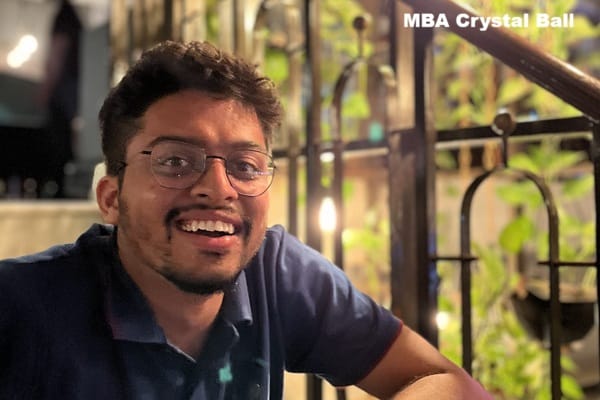
Coming from the highly competitive Indian male software engineer demographic, getting a top U.S. business school admit, with substantial funding, takes much more than excellent credentials.
In this Q&A, Shubham Singhal shares how he secured top MBA admits with scholarships. He discusses how strategic career decisions, nonprofit leadership, effective application positioning, and persistent networking helped him stand out in a crowded applicant pool.
From his GMAT preparation and interview experiences to securing a pre-MBA product management internship, Shubham offers practical insights for anyone planning their own MBA journey.
He is finally headed to UCLA Anderson with a hefty scholarship of $70,000. Let’s find out his magic mantra.
How I Secured a $130,000 Scholarship & Multiple Top-School Admits
How to stand out as an overrepresented MBA applicant
MG: To begin with, could you give us a quick introduction about yourself, your background and qualifications?
Shubham: My name is Shubham Singhal. I grew up in Ahmedabad, Gujarat, and did most of my schooling there. After that, I went to BITS Goa for my undergraduate studies, where I pursued a dual degree in Chemistry and Electronics.
Post graduation, I’ve been working in the software industry for over four and a half years. I was previously with PayPal, and currently, I’m doing a pre-MBA internship at a startup called Aspo.
Access Free Frameworks →
MG: Very interesting. Can you expand on your experience at PayPal – what kind of work you did and how the journey was?
Shubham: I started at PayPal with a six-month internship, which later converted into a full-time role. My time there coincided with PayPal’s transition to the cloud. Over the four-and-a-half years, I worked across three major areas.
First, I worked on building applications and pipelines to migrate internal data and SQL workflows to the cloud. Second, I helped enable cloud services for data analysts, data scientists, and software engineers to connect their applications to various cloud services. Third, and most recently, I worked on building an end-to-end FinOps product to manage over $250 million in annual cloud expenses.
These experiences gave me a holistic view of the cloud ecosystem and how large organizations transition from on-premise systems to the cloud. It was a very fulfilling journey.
MG: That’s very well explained. You also balanced this with a nonprofit experience. Tell us more about that.
Shubham: During college, I felt I focused too much on academics and not enough on extracurriculars. Later, in 2023, a former Senior Vice President at PayPal left to start a nonprofit donation platform called Kind Cart.
I had interacted with him earlier, so I followed his work. When he posted about looking for volunteer software engineers with Golang experience, I reached out and joined as a volunteer.
I built some core features, for example, a proof-of-delivery email system. When a donor places an order and it’s delivered to an NGO, they receive confirmation, which builds trust. I worked on several such features, and it was a great learning experience both technically and personally.
Why Pursue an MBA: My Decision-Making Process
MG: That’s fantastic. So you were in big tech and also working on a passion project; what prompted you to pursue an MBA?
Shubham: Over my four-and-a-half years at PayPal, I realized I was more interested in product development and business decision-making than pure execution. I felt I didn’t want to spend the next 5–10 years only on implementation. I wanted to move toward the business side, and that’s where an MBA came in.
MG: Tell us about your GMAT journey.
Shubham: I prepared for about one and a half months, but I had already spent six months preparing for CAT, which gave me a strong foundation. I took only one GMAT attempt and scored 695 on the GMAT Focus Edition.
I mainly used official GMAT OG books and focused heavily on mocks. I believe GMAT is largely a time-management test, and mocks helped me build that rhythm. I only took official mocks since they best reflect the actual exam pattern.
Evaluating MBA Admissions Consultants: Why MBA Crystal Ball Stood Out
MG: How did you decide to work with a consultant, and how did MBA Crystal Ball come into the picture?
Shubham: A college friend recommended MBA Crystal Ball. When I first spoke with you, MG, what stood out was your honesty; you clearly outlined my strengths and gaps and gave a structured plan for target schools.
Even before I signed up, you suggested that I re-engage with Kind Cart in a more strategic role, like working closely with the CEO. That helped strengthen my story significantly and added depth to my application.
MG: As you went through the application process, what were your concerns?
Shubham: I came from an overrepresented pool – Indian male software engineer, so differentiation was a big concern. That’s where consulting helped in framing my story better.
For example, my work with Kind Cart and my involvement in a sports club at BITS Goa were shaped into compelling narratives. I also stayed updated with trends like GenAI and agentic AI, led a team in a PayPal AI hackathon, and secured second place. That became a strong talking point.
MG: Great insight. How was your interview experience?
Shubham: I applied to nine schools and received interview calls from five: Kellogg, Ross, McCombs, UCLA Anderson, and ISB.
Initially, I was nervous, but the interviews were more conversational than grilling. US schools take a holistic approach; they genuinely want to know you.
At Anderson, for instance, the interviewer was very interested in my AI work and also shared insights about their own projects. It felt like a two-way conversation.
UCLA Anderson vs. ISB: Why I Chose a 2-Year MBA (with $70K Scholarship)
MG: That’s great to hear. So, where did you get in, and what scholarships did you receive?
Shubham: I was admitted to three schools: UCLA Anderson with a $70,000 scholarship (where I’m heading), ISB, and UT Austin McCombs with a $60,000 scholarship. I was also waitlisted at NYU Stern and Cornell.
MG: How did you decide on Anderson?
Shubham: The decision between ISB and UCLA was tough. This was my second time applying to ISB, and I really valued the admit. However, I always preferred a two-year MBA over a one-year program, as it allows more time for networking, academics, and recruiting.
I also wanted a different experience from my undergrad at BITS. Despite uncertainties in the US, I felt UCLA Anderson would be better in the long run.
MG: You’re currently doing a pre-MBA internship. Tell us about that.
Shubham: Yes, I wanted hands-on product management experience before my MBA. Since big companies move slowly, I chose a startup environment.
I landed my internship at Quipo (a B2B platform working on ONDC) through cold emailing. The founder is a BITS and UCLA Anderson alum. After a few informal interviews, I got the role.
It wasn’t easy; I had to send multiple follow-ups to get responses. But persistence paid off.
MG: Impressive. You’re already leveraging your network well. Any closing advice for future applicants?
Shubham: Planning is crucial. The application process is long – 4–5 months. So you need a clear timeline for essays and submissions.
Also, while hiring a consultant may seem expensive initially, it really helps in shaping your story effectively and pays off in the long run.
MG: Thank you so much, Shubham, and all the best for your UCLA journey!
Shubham: Thank you, MG. I couldn’t have done it without your guidance.
At MBA Crystal Ball, our team has helped thousands of candidates secure admissions to top business schools around the world, often with scholarships. Drop us a line at info@mbacrystalball.com if you need our help.
