
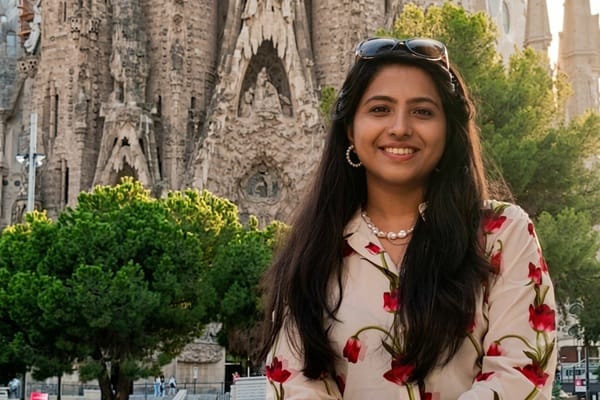
Smruti Sarita Swain’s journey to India’s top 1-year MBA programs is anything but ordinary. From studying at NIT Rourkela and IIT Bombay to working with global aerospace giants like Airbus and Collins Aerospace, she built a strong technical career—only to realize she wanted more.
What followed was a high-stakes balancing act: navigating multiple rejections after working with another consultant, preparing for the GMAT all over again, and even taking the test while 9 months pregnant.
In her second attempt, Smruti turned things around spectacularly, securing admits from IIM Ahmedabad, IIM Bangalore, IIM Calcutta, and ISB. In this candid interview, she shares her GMAT strategy, application mistakes, interview insights, and powerful lessons for MBA aspirants aiming for top B-schools.
Application strategy that got me into IIM A/B/C & ISB
Reapplicant success story
Q&A with Smruti Sarita Swain
MG: To begin with, can you share something about yourself and your qualifications?
Smruti: Absolutely. I am basically from Odisha. My schooling happened there across multiple districts because we had to change places frequently due to my father’s transferable job in the Forest Department.
After 12th, I pursued my BTech in Electronics and Instrumentation from NIT Rourkela. My NIT life was really cool.
I met many smart people and apart from the rigorous academics, it was the environment that pushed me to think differently.
Editor's Note: Rethinking your career or planning an MBA? Use these free decision frameworks to make better-informed choices.
Access Free Frameworks →
I was also passionate about lifestyle clubs, robotics, and of course, academics. I have also done my MTech from IIT Bombay in aerospace controls specialization.
MG: Got it. So, help us understand, what prompted you to pursue a master’s after doing your undergrad from a top school as well.
Smruti: After my BTech, during the campus placement drive itself, I was recruited by Publicis Sapient, a technology company based out of Bangalore. There we were a team of 20, all freshers coming from different institutes and my role started out as an Interactive Developer Level One.
It focused majorly on front-end API development. It was using various frameworks and coding.
But within two months of joining, I quickly realized that this is not what I actually wanted.
I wanted to get more into research, more into a different industry, maybe automotive. I was not clear back then.
So along with the job, I started preparing for the GATE exam and after a year of preparation, I attempted it and scored an All-India Rank of 145 in the Instrumentation discipline. After that, I was interviewed at a couple of institutes and finally I got a seat in IIT Bombay Aerospace.
So that was more about going for the research aspect – understanding what is happening in cutting-edge technologies and aerospace was a really cool area because I was very intrigued by it, but before that I had not got a chance to explore it. So it was fascinating at that time.
From IIT to Airbus: Taking off in the aerospace industry
MG: After completing your master’s, help us understand what kind of career journey you had. You have worked with some pretty big aerospace companies – what was that experience like?
Smruti: Yes, absolutely. Everyone expects life at IIT Bombay as an MTech student to be all about research, thesis, and classes. Definitely that was there, but again, it’s a very happening campus with a lot of things going on. Along with my studies, I had also gone for a Himalayan trek.
At IIT Bombay, you can expect holistic development.
After that, there was also a campus placement drive for all the MTech students and during Day Zero itself, I was recruited by Airbus. I still remember the day – it was 4:00 a.m., I was in my formals when I got the selection news. Thereafter, at Airbus – which is one of the top OEMs in the aerospace industry, I was posted back to Bangalore.
Working with Airbus actually gave me very wide exposure to the aerospace industry – about what is going on, also you get to know the journeys of the legacy airlines of the world. I started out as an associate engineer working on flight simulators – a mix of the complex hardware of aircrafts and the intelligent software.
I was sitting there as an integrator, working on cockpit display systems and slowly I transitioned into a Product Owner role for the ECAM display and flight warning systems. So it was a very, very sharpening experience, I would say.
Also, my visit to Toulouse, which is the headquarters of Airbus, added a really wide-eyed experience because there you get to see the actual infrastructure of one of the top OEMs in the world. That was a very humbling experience for me.
MG: Absolutely, sounds very, very cool. And so you did move companies. How did that come about? What was that experience like?
Smruti: Correct. After Airbus, it was Collins Aerospace. Working at Airbus, an OEM was great. But then you see how the building blocks of the aircraft are developed: the sensors, the systems that are innovated and then assembled.
Collins Aerospace is a top-tier supplier to these OEMs, and it was also offering me a role in applied research, which I actually wanted at the time. So both the supplier ecosystem and a research group – that was a good combo and that’s what made me switch to Collins Aerospace.
Right now, I have been working for three and a half years at Collins.
And I am working on digital transformation in operations and manufacturing of all the components of the aircrafts.
From technical expertise to strategic thinking: The motivation behind my MBA
MG: That’s a very wide kind of experience and you were doing what you liked. What prompted you to pursue or think about an MBA?
Smruti: Well, an MBA was actually not initially planned. It was a growing realization that surfaced through my work experiences. My work at Airbus and Collins was deeply technical, which I definitely loved.
But whatever component I was developing, whatever technology I was working on – that was the ‘what’ of the story. Then what about the ‘why’? How is it done? How is it financed? How is the marketing done? For example, how is the Airbus A350 financed, pitched, and taken to global airlines?
I never had a chance to see or experience those backstories. I felt like I was looking through a keyhole in a technical, siloed structure.
I wanted to have a more holistic understanding of things. That was the professional part.
While working and networking with colleagues, ex-colleagues, friends, and even my husband, who is an IIM Indore alumnus, I understood firsthand the learnings from an MBA – that exposure, that knowledge – how it gives you all-round development. That helped me decide that I wanted to pursue an MBA, and it would definitely help me understand the bigger picture.
Delivering under pressure: The GMAT journey
MG: Then came the GMAT. Talk to us about your GMAT journey.
Smruti: The GMAT journey was a real roller-coaster for me. It started back in 2023. I was working in Collins at the time. Obviously, you get very little time after work.
And it took me 3 takes, actually, for the final score. The 1st one, I was very underprepared, but still I went through the attempt. It was 670 in the GMAT Classic, which is not sufficient. Back then in my mind I thought I will apply to global schools as well as Indian B-schools.
So 670 is not a good starting point. I thought I’ll take a 2nd chance and I prepared again for 3-4 months. It was 2024, I remember, but for whatever reason, my score plummeted down even lower than the first one, so I had to cancel that score.
And then I just paused for a while because at that time, on the personal front, I was already 3 months pregnant. So the real question considering what was lying ahead of me was – How can I make the switch? How can I make the next attempt?
At the same time, GMAT changed its pattern as it shifted from GMAT Classic to GMAT Focus. The Data Insights section was introduced, which was my Achilles heel because I had to prepare again from scratch for that section. My Quant was really good, verbal was okay and I knew I could improve that, but Data Insights was really the challenging part.
I was 3 months pregnant and in another 5 months, I would have a baby and then I wouldn’t have time at all. It was a now-or-never situation, right? So I gave it my all. I prepared again for 3-4 months and in June, it was my 3rd attempt.
And I remember that day because I was already 9 months, almost due, and I knew it could be any day.
On that day, I could have anxiety, pains, anything could happen. I thought, okay, now I have to give it my best.
Fortunately, that day went fine and my score was 655. I was relieved because it translates to a 710 on the GMAT Classic. It is a really good score, if not the best, but at least a decent one to go with. And that was it. I was done with it in June.
In my journey, the resources I referred to – one was EJ because it has very detailed concepts, quizzes, Sigma mocks – all are very good. What mainly helped me were the sectional tests because you can know where your improvements are, where you are lacking.
Then GMAT Club, which is like the Bible for all GMAT applicants – their mocks and quizzes were top-notch. I also used another prep course, but I didn’t benefit much. So these two were the major ones that helped.
And after that, obviously, I did not get much time. So, the GMAT story was closed for me and I worked on my application.
A second shot at success: How the right guidance helped
MG: That’s a very impressive story! So the GMAT was done when you had a baby coming. How did you go about your applications? How did you discover MBA Crystal Ball? Why did you choose to work with us?
Smruti: Yes, that was quite a thing because in June 2024, my GMAT was done. In July, I delivered a baby boy and I was on maternity leave for the next 6 months. I took a break of 1-2 months for all the baby duties as the schedule was very hectic for me.
But then I thought – ‘let’s try with the application‘ because you never know what’s going to come next year.
I was following MBA Crystal Ball for a while, but for some reason, I took the help of another consultant in 2024.
But then it was already late because for Indian B-schools – IIMA, IIMB, IIMC – this was Round 3. I knew there was risk because the chances of selection somewhat reduce. And for ISB, it was Round 2. I also applied to 2 global B-schools in Round 2. After all the work, I knew I had little time, but I gave it my best.
I was lucky to get interview invites from all the colleges that I applied to except one. I applied only to IIM-A, IIM-B and ISB and to these global schools and interview invites came in. I was somehow able to prepare, but it was not full preparation for interviews.
I did not convert anything – 4 interviews but no admits.
So that left me clueless. It was early 2025, all the results were done. But since I got interview invites, I understood my profile has strengths. But again, I had no idea what was lacking – whether it was the application, the essays or the interview.
At that time, my personal situation was also very demanding with a 7-month-old baby. So I was exploring ‘How do I go forward? And if I am going forward, am I getting another attempt’?
I decided I would give my 2nd attempt at the application and that would be the last one.
I was following MBA Crystal Ball. I remember Sameer Kamat had posted a 10-minute casual chat on LinkedIn. I signed up for that and after talking to him, he connected me with you.
Over mail, we exchanged conversations. We had discussions about my background, my stories. And you also took a look at my profile and my essays and then you made me realize what was lacking, what the deficiencies were. And then after a good email exchange, I signed up for your service. Avinash was my mentor; you connected me with him. So that’s how I got the chance to work with you.
Then on, Avinash also took a look at all my previous work, and he was very clear on it. A few stories were already prepared for my previous application, but the clarity was missing. That depth, that conviction that should come out clearly was not present at the moment. Then I worked dedicatedly for the next 3-4 months and we applied.
Preparation pays off: Mastering both essays and interviews
MG: Right, so you applied with more confidence. How did the interviews go this time? And how do you compare – previous year versus this year? What do you think was different?
Smruti: Definitely it was different, very different in fact.
What I was very impressed with while working with Avinash was – while you’ll put stories in your application, but how to throw light on the crucial aspects is what a mentor should do and Avinash did a perfect job there.
A story from one of my professional experiences, which I had actually omitted from my application, he was the one to point it out to me – ‘This is one of the reasons that motivated you for an MBA. Why are you not including it? You should do it for sure’. So that was one major thing I included in my essays this time.
The depth that the AdCom should see was not coming out clearly in my previous attempts. Avinash was very good at putting it in a very structured way and also at the aesthetic appeal of the stories. I was also very happy to see one of the opening lines of my essays and one of my personal stories that got very beautifully pitched there.
The second thing is the positioning of the story – what is the blend of professional and personal story that should come in. That was also a very nice aspect that Avinash showed me.
Third thing, I also signed up for the interview package. Avinash took 2 mocks for me. But again, I will say that apart from the questions and the mocks, it was the one-on-one discussions he had with me. Being an IIMA alumnus himself, he gave me practical tips like what actually comes in the interview, how you should polish your communication style; all those things helped me a lot.
So this time what we did was polishing our stories, polishing our essays in a very solid and punchy way and preparing really well for the interview. Be prepared even for the interview, not just the application – that will be my mantra for everyone.
That worked for me because this was my second attempt. As a reapplicant, I was very skeptical about everything, but it turned out very well because of all the hard work put into it.
Confidence through preparation: Cracking India’s top B-school interviews
MG: Where did you interview? Where did you get an admit? Where are you headed?
Smruti: I applied to IIMA, IIMB, IIMC and ISB and I was incredibly fortunate to have received invites from all of them this time also.
That was my first success, I will say, because as a reapplicant I was worried about what will happen. But I got interview invites again.
For each of the interviews, it was a bit different. IIMA consists of an extempore first and then a conventional interview. The panel is all professors. I got a two-member panel and my extempore was on startups and their unicorn status.
What I learned was you should have an opinion-based learning approach for these kinds of topics. The interview was a good mix of your work experience, your industry, your career goals, all those things. It was a very nice interview, I will say, it was not grilling. It left me in a good mood after the interview.
Then it was the ISB interview. There were four alums in my panel. It was a very engaging interview. They deep-dived into my work. I currently drive factory simulation projects, so they asked me to the extent of describing the process of assembling.
They were not afraid of using any technical jargon because they all came from technical backgrounds, as they told me. So we had a very good conversation for 30 minutes and it covered extracurriculars and career goals as well.
Fortunately, on the same day, the IIMB interview was also scheduled in the afternoon. I had to rush from ISB to the IIMB campus. I reported there at 2, but my interview happened at 5:00 p.m., almost 4 hours later. I was the last one to go into the room, obviously exhausted. There was no one in the corridor. I was the last candidate. But the panel of professors were really cool, full of energy.
It started with a very jolly note, but this interview was a little bit different from IIMA and ISB because many fact-related questions were asked about my industry, like aerospace, about Airbus, about Boeing, about Collins – like what were their past programs, why did they stop, why did they prosper, what are the current initiatives, what are the future technologies.
There were a few fact-based questions which I was not able to recollect. I wasn’t really looking forward to how it would turn out. But overall, it wasn’t a bad experience either. I just thought, okay, two interviews went well and this one was neutral.
And then finally the last one was IIMC. This one lasted for 15 minutes – super fast, I would say. I just went in, there was a casual exchange with 2-3 questions on work experience and a personal question and then we wrapped up. This one went fine.
This time, I had prepared very well for all the interviews. I did not leave any stone unturned, starting from my work in very detail, my company, my industry, my career goals, how they align with my work experience, how they align with my future vision – everything was very well prepared, which was lacking in my previous approach.
And that actually builds confidence, shows up in your communication style, in your speech and that I think worked really well for me this time.
Choosing the right fit: The journey to IIMA
MG: From where did you get admits? Where are you headed? How did you decide between the multiple admits?
Smruti: I got admits from all the four schools that I applied to: IIMA, IIMB, IIMC and ISB. But the first one to come was IIMA and I still remember it was October 30th and their website said it is due on October 31st.
Just the day before, I was getting super anxious because this was my 2nd time. I was not going to apply any further and I was worried that if I’m not getting in, then there would again be that anxious waiting period for the further results.
Then boom, it happened! IIMA dropped the email that the results are announced. We needed to check into our account and see the results.
I had already decided that I’m not going to see the results this time. I asked my husband to check and let me know the results. I gave him the credentials. He was in office.
I was working from home and in a meeting. I had told him to text me. But then after 10 minutes, my parents were there and my mom rushed in to ask why I was not picking up her calls. She informed me, ‘You are already in IIMA!’
I was super happy. Now I did not have to worry about any other result. I could just make up my mind even if I was not getting any other admits.
And I remember my toddler who was just 1 year 2 months just rushed in. I hugged him, ‘we are going to IIMA, baby! It was an amazing feeling! And we celebrated with a good dinner.
Then afterwards in the next 15–20 days, the other results started pouring in. First to come was IIMB. Although the interview experience went neutral for me, I got in. I was waiting for any scholarships but I did not get any.
Now comparing between IIMA and IIMB became a little easier because had I received any scholarship, I would have given it a thought, but now it was more about where I fit better.
IIMB was convenient for me because I’m already living in Bangalore. I do not have to uproot my entire ecosystem to go there. But I finally chose IIMA because of the fit and also the cohort and that felt right for me.
Then ISB came in third. This time, the comparison felt a bit more personal because the entire MBA journey started with my thought of ISB, so comparing IIMA and ISB became a huge task.
I checked with dozens of alums, current students, even my would-be batchmates at ISB and IIMA, and it increasingly became clear that currently my age, my work – it all fits more with IIMA. It’s not just about which brand is good, but also about how I fit into it. So that made me choose IIMA.
And in between, I received IIMC results and I had gotten in there as well. But then I had already made up my mind after a lot of due diligence, so finally I selected IIMA. That was really a very, very interesting and happening journey, I would say.
Lessons from the journey: Tips for future applicants
MG: As a closing thought, what tips or suggestions would you share for future applicants, particularly those coming from technical or slightly underrepresented industries?
Smruti: To be honest in my second application, I was skeptical. But during this process, my mentor and people surrounding me, also my previous experience made me realize the strengths of my profile. I come from a high-tech aerospace background.
I also have shop floor and operations experience. The current trend is on digital transformation and I’ve also worked on that.
These were very compatible things – a cutting-edge combo – also the biggest strength of my profile that gives you that unique advantage over other candidates.
If you are from an underrepresented industry, it counts how you make use of this. Highlight it properly in your essays and your stories and to your maximum benefit.
Secondly, in the preparation journey, you have to brainstorm your stories very meticulously. So that’s why you take the GMAT prep out of the picture as early as possible because you never know, it might take a single take or multiple takes. So if that is out, your mind is free for brainstorming. So give enough time for that.
And lastly, the interview preparation should be solid! There is this thing going on whether or not you should be yourself in the interview. But I would say you should not be completely yourself. You should be what you are planning to become – an improved version of yourself – the one you want to see yourself as 5-10 years down the line.
So be prepared, bring that conviction and confidence. The panel always wants to see prepared candidates. So preparation would help for all the stages. That would be my tip.
MG: Perfect. Thanks so much for sharing this, Smruti and all the best with your journey at IIMA!
Smruti: Sure. Thank you so much, Manish!
At MBA Crystal Ball, our experienced consultants have helped thousands of aspirants get into the top MBA programs, often with scholarships. Drop us a line at info@mbacrystalball.com if you need our help.
