
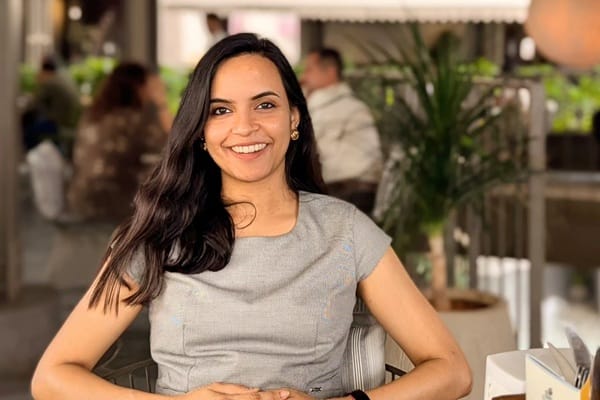
Applying to an MBA without GMAT or GRE scores requires careful planning, thoughtful school selection and a compelling career narrative.
In this interview, Mandovi shares how she secured admits from six top MBA programs, successfully cracked tech-focused interviews, earned multiple scholarships and ultimately chose the school that was the right fit.
Today we have with us Mandovi Bortharkar, a multi-admit, multi-scholarship winning candidate. She pulled this off despite what many might perceive as profile handicaps. Let’s see how she did it.
Mandovi’s Score Card
| MBA Application Strategy | MBA without GMAT (Using Test-Optional / Waivers) |
| Business School Selection | Elite US Business Schools (Tech & Traditional) |
| Total Applications / Interviews / Admits | 6 / 6 / 6 |
| Total Scholarships Awarded | $405,000 (USD) Total Breakdown: • Boston University (Questrom): $125k • Georgia Tech (Scheller): ~$90k (Full Tuition) • University of Washington (Foster): $80k • Indiana University (Kelley): $60k • Cornell Tech: $50k • NYU Stern Tech: Admitted (No Scholarship) |
Is it Possible to Get a Top MBA Without GMAT?
6 Top Admits and $405K Scholarship Offer
Manish Gupta: Thank you for coming on board. To begin with, could you tell our viewers a little about yourself, your qualifications, and your professional background?
Mandovi: Sure. I did my undergrad in Electronics and Communication Engineering from an NIT. Right out of college, I joined a boutique consulting firm called Affine Analytics as a data engineer. I spent about three years there, largely helping Expedia support their global marketing campaigns.
After that, I joined PwC. I am currently a Product Manager at PwC within the Customer Analytics sphere of our Commercial Technology & Innovation (CT&I) practice, working on agentifying key business use cases.
Access Free Frameworks →
Data engineering to product management: My career pivot journey
MG: Could you dive a bit deeper into how you managed that transition from boutique data engineering into product management? What worked for you, and what tips can you share?
Mandovi: It was a very interesting phase. While I thoroughly enjoyed the engineering and implementation side of data engineering, I realized I wanted a bigger-picture view. I wanted end-to-end ownership of the implementation process.
Because I had worked closely with product managers at Expedia, I knew that the PM role sits perfectly at the intersection of technology and business.
Fortunately, while I was at PwC, the company went through a reorganization under a platform called ‘Products and Technology.’
I used that perfect opportunity to work with leadership and formalize an internal pivot into product management.
A lot of people use an MBA to make this switch, but it worked out for me as an internal transition. It gave me that crucial business exposure while allowing me to keep my tech roots.
The need for an MBA: What drove my decision
MG: That brings us to my next question. Since you had already successfully managed this career transition internally and had substantial years of experience, when and why did you start thinking about pursuing an MBA?
Mandovi: The ‘Why MBA’ journey has been a long one for me; it wasn’t a recent calling. It actually goes back to late 2019, before COVID. At that stage – about 2-3 years into my career – you see your peers either pursuing an MS or looking at business degrees. I wasn’t interested in an MS or an MTech, so that left an MBA.
Initially, I looked at Indian business schools like ISB and SPJIMR that accept the GMAT, as well as global schools. But back then, with barely three years of experience, I felt a bit early in the cohort and my profile hadn’t shaped up concretely yet.
Then COVID hit and I paused. I didn’t want an online MBA experience; I wanted the true value of peer learning and meeting people from diverse backgrounds in person.
During that pause, my ‘Why MBA’ evolved. Because I had already achieved the domain shift to product management internally, I wasn’t entirely convinced I needed a traditional full-time MBA anymore.
However, a couple of years ago, I witnessed a corporate restructuring very closely. I watched technically brilliant products get completely sunsetted simply because they lacked a sound product-market fit or commercial sustainability.
That was my epiphany. The products that survived and stayed relevant were the ones driven by commercial viability.
I recognized the gaps in my own product management skillset on the business and commercial sides, and I realized there was no better way to augment those gaps than through a formal, premier business education.
By the time I join my program, I will have nine years of experience.
MG: Talk to us about your GMAT journey. How did that evolve?
Mandovi: I have had a definitive love-hate relationship with the GMAT; it was not a smooth experience. I took my first attempt in 2019 on my own. Because I was targeting international B-schools, I was aiming for a 700+ score, but I didn’t hit it.
For my second attempt, I took prep support from e-GMAT. The material was objectively good, but I struggled to replicate my performance and execute under the high-pressure, timed environment of the actual exam.
It reached a point where I didn’t even show up for a test I booked in 2020. Having always been a strong student academically, this mental block affected my confidence and peace of mind. I pushed through to a third attempt, but I still couldn’t cross that 700 mark.
That was when I had to make a graceful exit call. I told myself that the GMAT is not the end goal itself, it is simply a means to an end. If one path wasn’t working, I needed to explore alternative avenues.
Ultimately, when I applied in this round, I leveraged the test waiver and test-optional policies offered by several top schools.
Finding the right MBA Admissions Consultant: Why I chose MBA Crystal Ball (MCB)
MG: Once you made that decision, how did you discover MBA Crystal Ball, and why did you choose to work with us on your applications?
Mandovi: I had actually known about MBA Crystal Ball since 2019. Back then, a friend of mine who was applying for an MS told me, “If you ever apply for an MBA, consider MBA Crystal Ball. They are premium and typically work with high-GMAT scorers, but their conversion rates and success metrics are stellar.”
When I decided to apply in Round 2 without a GMAT score, I remembered MCB. I followed your LinkedIn posts closely and saw success stories of non-traditional candidates with higher work experience getting into elite programs without test scores. Those stories gave me confidence.
When I first reached out to your team for a profile evaluation, the email response contained incredibly tough, meaningful, and upfront questions. Your team flagged the risks in my profile immediately.
I deeply appreciated that honesty.
Being fully aware of your profile’s weaknesses from day one completely changes how you strategically approach the application journey.
MBA admissions insights: What top schools look for
MG: Tell us about your application strategy. Where did you apply, where did you interview, and what stood out to you during the process?
Mandovi: My choice of schools was driven by specific geographic locations and a desire for tech-oriented programs. I also had to be highly strategic because not every top school offers a test-optional policy, which naturally filtered my list.
I applied to six schools in total:
- Two one-year specialized programs: Cornell Tech MBA and NYU Stern Tech MBA.
- Four traditional programs: University of Washington (Foster), Indiana University (Kelley), Georgia Tech (Scheller), and Boston University (Questrom).
Remarkably, I received interview invites and subsequent admits from all six schools.
Across the board, the interviews were highly conversational. The admissions committees genuinely wanted to understand my unique profile, post-MBA goals, and what I would contribute to their community.
The format varied – some were blind resume interviews, while others were fully aware of my background and explicitly mentioned they had thoroughly read my essays.
For the Cornell Tech and NYU Stern interviews, they went incredibly deep into my day-to-day tech background. They wanted to verify my implementation skills and understand how I stay updated on tech trends to ensure I was a seamless fit for a tech-specialized MBA rather than a traditional one.
How to Apply for an MBA Without GMAT: Waiver & Test-Optional Strategy
MG: Taking a step back – for applicants looking to pursue an MBA without GMAT scores by using a test-optional policy or waiver, what are your tips on proving quantitative readiness?
Mandovi: The GMAT score is primarily a validation for the admissions committee that you can handle the quantitative rigors of the core first-semester curriculum.
If you waive the test, you must demonstrate that quantitative readiness through alternative proof points in your optional essay.
In my optional essays, I used a three-pronged approach:
- Undergrad Academics: Since I had an engineering background from an NIT, I called out specific, highly quantitative courses I took like Probability, Statistics, and Advanced Calculus, and highlighted my strong grades in them.
- Professional Responsibilities: As a Product Manager in an analytics practice, my day-to-day role involves heavy number-crunching, translating complex data into business insights, and managing financial statements or project budgets. I mapped out these responsibilities clearly.
- Prior Standardized Metrics: Where relevant, I also called out strong historical benchmarks, such as my Joint Entrance Examination (JEE) percentiles.
MBA success story: Six admits and major scholarship awards
MG: Now for the drumroll moment! Which schools did you get into, what did the scholarship numbers look like, and where are you officially headed?
Mandovi: Thanks to the phenomenal support from the MBA Crystal Ball team, I was admitted to all six universities. Furthermore, I received substantial funding from five of them:
- Boston University (Questrom): $125,000 scholarship over two years.
- University of Washington (Foster): $80,000 scholarship over two years.
- Indiana University (Kelley): $60,000 scholarship over two years.
- Cornell Tech: $50,000 scholarship.
- Georgia Tech (Scheller): A full-tuition Graduate Assistantship (GA) stipend, which covers the entire tuition value of roughly $90,000.
I am thrilled to share that I am officially headed to Georgia Tech Scheller.
MBA application advice: Choosing the right school and preparing for Interviews
MG: Incredible achievements! Do you have any closing thoughts or words of advice for applicants who might find themselves in a similar situation?
Mandovi: I would emphasize two main things: starting your school research early, and thoroughly understanding your interviewers.
First, finding the right business school is as intense as finding a life partner; you must do deep due diligence. I eliminated a few schools early on because I couldn’t establish a genuine connection with their alumni or find clear data regarding their pedagogy.
In contrast, Georgia Tech Scheller was completely transparent. They have an incredible “Intersection” podcast and a wealth of YouTube content that laid everything out clearly. This deep research allowed me to write highly specific, authentic essays and speak passionately during interviews.
Second, for the interviews, always know your audience. When you receive an interview invite, check if you are speaking to an AdCom member, an alumnus, or a second-year student. Tailor the stories you choose to highlight to match their perspective.
Additionally, remember that the interview is a golden opportunity to introduce compelling professional stories that you had to cut from your main essays due to tight word limits. Use that space meaningfully.
MG: Wonderful insights. Thank you so much for sharing your inspiring journey with us, Mandovi, and we wish you the absolute best of luck with your MBA at Scheller and your career ahead!
Mandovi: Thank you so much, Manish. This outcome truly would not have been possible without the immense dedication, hard work, and relentless support from Avinash at MBA Crystal Ball.
Frequently Asked Questions About Pursuing an MBA Without GMAT
1. Can I get into a top business school without a GMAT score?
Yes, but with some caveats. Many top-tier business schools in the US and globally offer test-optional policies or formal GMAT/GRE waiver processes.
If your professional track record, undergraduate GPA, and technical background demonstrate strong quantitative and academic readiness, you can secure admission to elite MBA programs without a standardized test score.
2. Do business schools offer scholarships to candidates applying without GMAT?
Absolutely. Merit-based scholarships and Graduate Assistantships (GAs) are awarded based on the overall strength of your application profile, and not just a test score.
As Mandovi’s success story shows, candidates applying with GMAT waivers can secure substantial funding, including full-tuition awards totaling hundreds of thousands of dollars.
3. How do you prove quantitative readiness if you waive the GMAT?
When applying for an MBA without a GMAT or GRE score, you must use your optional essay to prove you can handle the academic rigor.
You can build a strong case by highlighting:
- Undergrad STEM coursework: High grades in university-level math, statistics, or calculus.
- Data-driven Work: Daily responsibilities involving financial modeling, data analytics, programming, or budget management.
- Alternative standardized benchmarks: Strong placements in competitive national exams (like the IIT-JEE) or professional certifications (such as CFA or CPA).
4. Does applying with a GMAT waiver hurt my chances of admission?
Not if you have a robust profile. Admissions committees review applications holistically.
If the rest of your application (essays, professional achievements, recommendations, and interview performance) clearly demonstrates leadership and analytical capability, a waiver will not penalize you.
At MBA Crystal Ball, we’ve helped thousands of candidates like Mandovi get into the top business schools, often with scholarships. Drop us a line at info@mbacrystalball.com if you need help with your application.
