
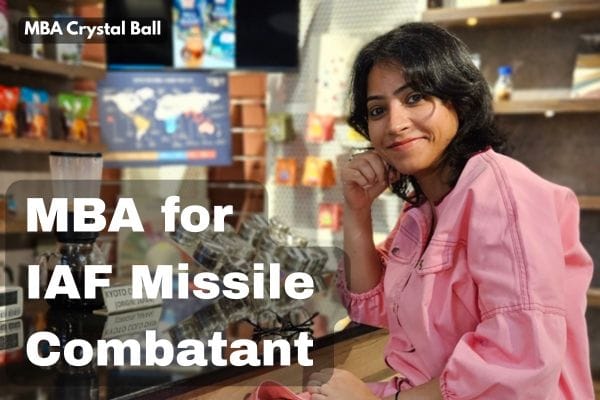
Today we have with us, Anamika Jha, an ISB Executive MBA (PGPMAX) admit with an interesting mix of armed forces and corporate experience. Let’s hear her story.
Executive MBA from ISB (PGPMAX) after Air Force
Tips for military veterans for corporate transition
by Anamika Jha
MG: Welcome, Anamika. Can you share a little about yourself? What prompted you to join the Indian Air Force?
Anamika: To begin with, I was born and brought up in the steel city of India, Jamshedpur and I did my Bachelor of Engineering in Electronics and Communication from BIT Mesra. I joined Vodafone as my first job, entered the corporate world and worked very briefly there.
With the kind of motivation that I got from my mother, the idea of doing something different from the mainframe and definitely destiny, I would say, I joined the Indian Air Force after six months of working with Vodafone.
I worked with IAF for 10 years, a decade, as a missile combatant.
After 10 years of service, I hung up my uniform and again re-entered the corporate world, worked with Amazon for 2 years as an operations manager. Currently, for the last 2.5 years, I’m heading one of the plants of Hindustan Zinc Limited.
MG: That’s quite interesting. So, if it’s not a national security concern, could you help us understand what a missile technologist does or what you did?
Access Free Frameworks →
Anamika: Sure. So I was into the complete end-to-end operations, maintenance and administration of a particular unit, wherein we would move from one place to another depending on the instructions that we would get.
With the team, we would be deployed at a particular location. There are 3 layers of defence. So, one of the layers – the last layer of defence, is what we provided to the Indian airspace through surface-to-air missiles, which was my system, with a limited range of operations. So that is what I can share.
It has been quite an interesting journey, moving across the country at different locations and getting to know the people of the country, the different cultures that we have.
So, it was quite a journey.
From uniform to boardroom: My journey into the corporate world
MG: Thanks for your service to the country! Actually, this is something that many people struggle with – the transition from the armed forces to the corporate world. So how did you manage this? Just talk us through that.
Anamika: So, in the previous year, I had a few conversations already. A few of my seniors were already in the corporate world, so conversations with them definitely helped. Without any question, these are two different worlds, I would say.
I could see the culture, the way you communicate and the structure – all the three are majorly different in the corporate world and in the armed forces.
However, one thing that was very, very common was the kind of leadership.
So the concept of leadership remains the same at both places and that was my anchor point.
When I joined Amazon, it had a very defined way of leadership principles – that’s what they call it and they live by those leadership principles. So when I joined, that was something that I hooked on to and led my team.
At that time, I had a team of around 100 folks reporting, directly and indirectly, to me. So, there was both learning and unlearning – unlearning was a bigger part of what was there in the past, and then learning became secondary nature.
That is what has helped me sail through this journey – accept, or rather, be a part of what the system requires initially and then try to bring a change from the previous experience that I’ve had. So that is how I have operated.
MG: Do you have any suggestions or tips on how to actually approach it right? How do you start applying? What matters – is it the resume, is it the networking – what clicked for you in your view?
Anamika: For me, when I had moved out of the defence forces, that was the time – in 2021 – when the world was struggling to breathe, there was this challenge of finding a place for yourself in the corporate world. So networking is the most important thing to begin with.
We were a group of officers who had hung up their uniforms together and we formed a group. We reached out to a few of our seniors who were already working at different businesses. We pitched ourselves – what our skill sets are, and how we can help or bring value to the table? From there, the journey started.
A few very well-known organizations like Amazon, JP Morgan, Wells Fargo and Morgan Stanley are very open and have a very set process for hiring veterans, so that helped us.
In my case, one senior referred me.
Through that referral, I had probably 6 different interviews across different organizations, of which I zeroed down on Amazon, considering the culture and the kind of interview experience that I had.
So all in all, I would say it’s networking plus presenting a skill set that the corporate world understands. It is very important to translate our skills into the language the corporate world understands because many times I feel and see that people cannot relate it much, as the jargon and the way we communicate is different. So these are the two important points.
The ‘Why MBA’ moment: Clarity on goals and impact
MG: Now, you’ve already achieved a certain level – you mentioned that you’re a Plant Director. When and how did you start feeling the need for a business education?
Anamika: So, this current role of mine was the initiator. First of all, I would say an MBA was already in my mind back in 2020 when I was still serving, but there wasn’t much clarity. However, it was more focused on appearing for the GMAT and getting a good score.
The answer to “Why MBA?” became clear when I joined Hindustan Zinc Limited.
The kind of discussions, the proximity to the business, understanding the metrics – what impacts operations, how operations impact other gamuts of the business, and how all of that impacts revenue, the top line, and the bottom line – I became familiar with all those terminologies here.
That is where “Why MBA?” became clearer to me. I had a clear picture in my mind of what I was looking for after my MBA; also when I am communicating or discussing certain points with the cohort. What is it that I want to draw? What is it that I can give to the cohort?
So with that perspective, I thought this was the right time to further enhance my knowledge of business so that I can also take on an elevated role going forward, whichever business I join. Also, if I decide to start something of my own, the clearer picture and the networking that I can build will definitely be of huge advantage to me.
MG: Absolutely. And also talk to us about how you went about identifying the schools. Because I think you had a very clear process in how you arrived at the schools you wanted to apply to.
Anamika: One thing was very clear in my mind – I wanted to go ahead with ISB. I did not do a lot of research with respect to other schools outside India, though a few were in my mind. INSEAD and HEC were also on my list.
I have a few friends and family members who are alumni of ISB, and I have seen their learning and growth journey. So I was very clear.
Also, from the conversations I had with many alumni, considering how the entire program is built, it is meant for understanding business in a better way, which I think was my requirement. I felt I was fitting into that zone, and that’s where I zeroed down and was very clear that I needed to go to ISB.
What shaped my MBA story: How mentorship made the difference
MG: Can you share with us how it was working with MBA Crystal Ball (MCB) for your applications?
Anamika: Sure. That is an interesting story because when I started preparing back in 2020, I used to solve questions from GMAT Club, and that’s where I saw inputs from MCB and started reading.
I happened to land on the homepage and went through a lot of stories from different people. From that time, I have actually bookmarked the site. So on and off, I would go back and read some of the stories, which also acted as a motivator for me.
Around the month of July, when I had to finally decide, I made up my mind to go ahead with the PGP MAX. After doing all the research, that was my first choice. When I reached out to you requesting guidance on how to go about the process, the initial honest inputs that you gave were also an addition. I was not actually biased, but this was where I needed to go.
To clear any fog that was there in my head, I also reached out to a few other consultants to check what would suit me best. And definitely, this did.
You connected me to Avinash, who happened to be a very good support throughout this entire journey because of the kind of probing questions he asked while we were writing the essays.
He explained the ‘why’ behind everything – why we should write certain points, even those that were not initially at the top of my list.
But the way he suggested we could put it forward in a stronger way and how it could frame my story in a more presentable manner, was truly a game changer.
I also learned that it was not just for the MBA, but going forward as well. Probably, in my head, I might not be thinking that a particular story is important, but having an outside view and reflection is very important.
Throughout this journey, he has really helped me in understanding that last point. He was very immaculate with the framing of how it should be. So it was great working with him. Absolutely! I think the art of storytelling, as we call it, is awesome.
What ISB looks for: My interview experience and key takeaways
MG: So, also talk to us about how the interview experience was with ISB PGP MAX.
Anamika: The interview information is given 3-4 days in advance. However, I had missed that mail until somebody from ISB called to inform me that I had not accepted the interview invite. So I had 2 ½ days, to be precise.
I thought, okay, and again reached out to the alums I had been speaking to, took their suggestions on how the interview had been for them and what pointers I should keep in mind.
Something that worked for me was, again, being myself. The clarity of why this MBA and how I will contribute to the cohort is something very important.
The second thing that is also important is understanding the business that I am in, because there were questions related to that – what is the bigger picture, the macroeconomics of the business.
The third and the most important thing is being myself – not trying to do something different on the interview day or trying to portray something that I have not done in the past. So being true to the interviewers is something very, very important.
MG: And, the result – we know you got the admit. As a kind of concluding thought, any sort of tips or suggestions now that you have gone through this entire journey?
Anamika: I feel that one thing any applicant needs to keep in mind is the ‘why’ of it, because ultimately this is not just another educational qualification to be added to the list.
This is going to be a journey of understanding what I want from it – having that clarity is something very important.
The second thing I would say is when we are communicating or being with the cohort, we should learn as much as possible from the rich mix of people that we have there.
In my case, I was not very clear about the exact field of work I should be doing. When we communicate, we receive a lot of inputs that help us realize, “Okay, this is interesting – let me read more about it,” say, for example, mergers and acquisitions. If I get to know about a particular topic, it will be through the people. So utilizing the networking is the second thing that I would say is important.
MG: Absolutely. Thanks so much for sharing your journey, Anamika, and all the best! We will be closely watching your career progress from here onwards.
We hope you found this interview helpful. At MBA Crystal Ball, we’ve helped many applicants get into the elite business schools, often with scholarships. Reach out to us at info@mbacrystalball.com if you’re looking for professional help with your applications. Good luck!
MBA Crystal Ball has extensive experience in helping military veterans from the Indian army, navy and air force get into the top MBA programs for many years. Connect with us at: info@mbacrystalball.com
