
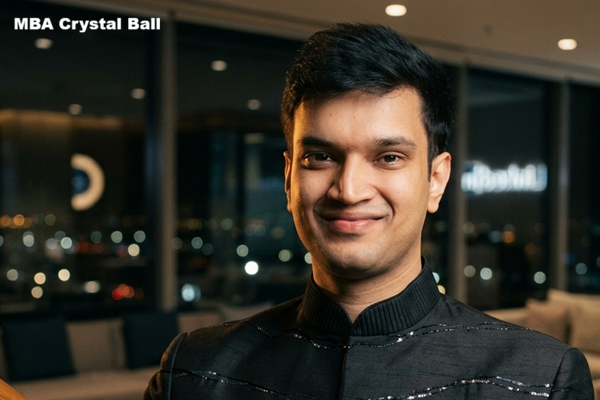
Anshuman first approached us in 2024 but his plans shifted by a year. After a long GMAT journey, he finally crafted his Oxford winning strategy with us and is headed there. Let’s find out how he did that.
This is the transcript of our video Q&A with Anshuman. Watch the original video here: How I got into Oxford and ESADE MBA as a reapplicant
Chartered Accountant Gets into the Oxford & ESADE MBA As Reapplicant
MBA Reapplicant with 655 GMAT and 4 Rejections
by Anshuman Saraogi
MG: So to begin with, why don’t you share about your qualifications – what kind of background do you come from?
Anshuman: So, I pursued my Chartered Accountancy alongside my BCom from 2015 onwards, and I completed the same along with a couple of levels of the CFA. My interest in this field was rooted in my early involvement with my family in daily budgeting activities.
That is why I found finance to be a very intriguing aspect, as it could help me make difficult decisions not only from a personal perspective but also from a professional one.
So I pursued CA and completed my three-year articleship at EY. Post-qualification as a Chartered Accountant, I joined the PwC Acceleration Center in the debt valuation practice. After that, in order to move into a more client-focused role, I shifted to EY India’s financial due diligence practice.
Other than my qualifications, I also love watching and playing sports. I have been an active member of Lions Clubs International for climate initiatives for the past one year. I also love traveling and taking up opportunities in different kinds of adventure sports such as scuba diving and skydiving, whenever I can get an opportunity to do the same.
Access Free Frameworks →
MG: Awesome, sounds great! So, talk to us about your decision to pursue the CFA – why you felt the need for it and how it helped you in your job.
Anshuman: During my articleship, I was surrounded by a lot of CA rank holders and on the basis of discussions with them, I felt that the CFA could give me more global exposure. After working in audit for a year or two during my articleship, I found the investment banking and private equity space very interesting.
Based on discussions with my colleagues and people in my target firms, I found that the CFA would provide me with a more enhanced exposure towards attaining my goals, while also giving me a more global exposure to finance.
That is why I started pursuing the CFA during my articleship.
CA vs CFA: Which one is tougher?
MG: So you started early. And I know this isn’t a fair, apples-to-apples comparison, but a lot of people tend to think about CA and CFA in a similar way. How would you compare the two in terms of preparation effort and overall intensity?
Anshuman: In terms of effort, I would say that CA requires a notch higher preparation compared to CFA. In CA, there is a subject called Strategic Financial Management, which covers many aspects of the CFA Level 1 curriculum, except for certain elements such as the US GAAP perspective.
However, from a Level 2 and Level 3 perspective, the CFA program provides a more in-depth understanding of areas like derivatives, hedge funds, which are typically not covered in depth in the CA curriculum.
On the other hand, CA focuses on a much more holistic framework; it is not restricted only to strategic financial management but also covers areas including costing, accounting, auditing, law, and taxation.
So, while CA offers a broad-based business and finance foundation, CFA is more finance-focused and provides a more detailed perspective as you progress through the levels.
MG: In terms of preparation and overall toughness level, how would you compare one with the other?
Anshuman: So, CA was a long ride for me. I spent a significant amount of time preparing for CA. For CFA, I used to spend approximately 1-2 hours a day. I started early – about six months before the exam – and studied a couple of hours each day, while managing it alongside my articleship job.
With respect to CA, I received a 5-6 month leave before my CA Final exams, and during that time, my preparation was more focused. I would spend at least 10-12 hours every day going through concepts, developing a good understanding, and practicing the kind of problems expected in the exam.
So, to summarize, I would say that CA is a notch tougher compared to CFA and requires additional time investment from an individual to successfully crack the exam.
MG: Understood. Very interesting insights. So you were doing well in your career. What prompted the decision to pursue an MBA?
Anshuman: So, one of my inspirations for doing an MBA was my own brother, who had completed his MBA from IIM Bangalore.
I had seen him develop from a pre-MBA person to a post-MBA person – I noticed changes in the way he communicated, the kind of insights he had and how he focused from a more dynamic viewpoint rather than a purely microscopic one after completing his MBA.
As I mentioned earlier, I was interested in investment banking and private equity. So, I also spoke to people working in those domains to understand the kind of skill sets they look for.
Additionally, while I was working, my brother joined McKinsey, and through him, I also got to know the skill-sets that management consulting firms look for in candidates.
Therefore, to develop a more holistic perspective beyond finance, and to build on my communication skills and strategic thinking abilities, I found an MBA to be the right path forward.
MG: Right. Tell us about your GMAT prep journey. How did that go?
Anshuman: I started my GMAT preparation in February 2023, but I had to manage it alongside my EY due diligence role, having just switched from the PwC practice. So, I also had to learn things from a professional perspective while also focusing on GMAT preparation and it took longer than I had expected.
I was ready to take my first attempt in the GMAT Classic in December 2023, where I scored a 680. Since the Classic version was being discontinued from January 2024, I decided to give it one more shot. I already had a decent score, and I felt I could improve on the same, but it didn’t work out that way.
So, I started studying for the newer GMAT Focus Edition. Around that time, I had some serious health issues, so I had to postpone my takes for the focused edition. Eventually, I scored a 655 in my 3rd attempt around November 2024.
At that point, I applied to ISB, Oxford, LBS, and NUS.
I had applied to these 4 schools the previous year as well, but I didn’t get through.
I felt there was still scope for improvement in my GMAT score, so I took another attempt in July 2025, but I didn’t get a better score.
At that stage, I realized that one of the major reasons for not being shortlisted could have been not applying early. So, I shifted my focus toward applying to all my target schools in Round 1 itself.
Why the right MBA consultant can be a game changer
MG: Help us understand how you discovered MBA Crystal Ball? Why did you decide to work with us? What kind of services did you sign up for?
Anshuman: I had initially read about MBA Crystal Ball – there was a post by Prerna Arora. One of my friends knows her from the undergraduate days, so I spoke to Prerna in 2024 about MBA Crystal Ball.
She was very happy with how things were proceeding. By then, she had already joined LBS, and she explained to me how MBA Crystal Ball had supported her.
However, at that point, I felt that taking up another consultant might be more beneficial, since I believed, I would have to invest a lot of money for MBA Crystal Ball services.
Also, at that time, I did not fully realize the importance that essays and interviews hold during the school’s shortlisting process.
After having a below-average experience with my previous consultant, I reconnected with MBA Crystal Ball and attempted the GMAT again.
Based on that experience and the reviews I had received and read online, I felt confident that moving forward with MBA Crystal Ball would provide me the right space to enhance my essays and gain the necessary exposure to help me get selected into one of my target schools.
So initially, I remember that I had taken up the MBA MAP as well as the essays package for 4 schools. The MBA MAP process was really helpful because I was working with Vibhav and we both got on frequent calls.
It was basically about understanding the
So once I started working on the MBA MAP as well as the essays, there were a couple of instances like the brainstorming sessions with both Vibhav and Maitabi that were very insightful. I remember they were pushing me to an extent where even I did not have the answers to the questions they were asking.
I specifically remember them pushing me on the why CA question, and I did not have an answer to that. That day, I went up to my parents and asked them why I pursued CA – what was the trigger point during my childhood, or when my interest started developing.
It was my parents who told me about the kind of interests I had started developing since my early teenage years that enabled me and ensured that I take up the CA curriculum.
These brainstorming sessions – another instance was how I came out of asthma and started working on adventure sports. These kinds of stories came out when I spoke to Vibhav and Maitabi on a very frequent basis.
We usually used to get on at least 2-3 calls in a week and that, I feel, was a game changer for me.
Post these experiences, I was pretty sure about taking up the interview package as well with MBA Crystal Ball. When I was shortlisted for the Oxford interview, I took up the interview package as well.
What top B-schools really look for in MBA interviews
MG: Talk to us about the interview experience – anything that stands out, that you still remember from the interview itself, also what kind of results did you get eventually?
Anshuman: I got shortlisted for 3 colleges – one was Oxford, the 2nd was IESE, and the 3rd was ISB. And I remember that one of the key differentiators that I had was that I visited the Oxford campus; Vibhav had really encouraged me to go to the campus and speak to the adcoms.
So it provided me with a lot of insights into what they look for in a candidate and how I can place myself to differentiate amongst others while I am applying. I had already written and submitted my essays at the point of time when I met the admissions committee, but I utilized these inputs during my interview.
I also went to a networking event of Oxford, which was organized by the business school itself in Delhi, and based on these experiences and the kind of examples I was gathering, I spoke to Vibhav and framed my answers – or the key points – that could be utilized in the interview.
I remember the interview was on a Tuesday. One day before the interview, Maitabi took a mock interview on Monday night at around 8:00 or 9:00.
They gave me the input that my answers were overly rehearsed at that point of time and that would not work in key schools like Oxford, ISB or any of the top business schools.
So their focus was on relaxing me at that moment and not getting overprepared, so that I could convey my messages more clearly and also ensure that the person taking the interview remembers what I am trying to say.
That was a very important point they had figured out – that even in Oxford, the interviewer takes down detailed notes during and after the interview. They are expected to write a short assessment of the candidate.
It is very important for any person to make a strong impression and communicate very clearly, so that the interviewer has got the right points and conveys the right kind of message that the candidate is trying to deliver.
So they played a simple exercise during the call, where Maitabi told me that this is no longer an interview environment and that we should just talk as friends.
When I was trying to communicate with them as a friend, I felt that there was a distinctive impact and storytelling style through which I was conveying my messages.
I followed a similar approach while interviewing with Oxford. The questions were a bit tricky, none of them were straightforward. They focused on limitations, but not in a direct what do you feel is your weakness? way. Instead, they picked specific words from my essays and pinpointed them.
Secondly, I interviewed with ESADE after I had already received my Oxford results. The interview was very short – I guess it was a 15-minute interview – and within the first five minutes, they had already started showing positive signals about my prospects of being shortlisted.
The third was ISB. The ISB interview was a bit different, as there was more cross-questioning, which I felt was different compared to the foreign business school interviews that I had experienced till then. But, I think all three interviews went really good.
I had also communicated the same to Vibhav, that all the inputs that he had given me, I was able to communicate those positively to the interviewer. Lastly, I would feel that one of the key differentiators that I utilized in the interview is that business schools look for specific things in a candidate.
For example, Oxford would look for a candidate who has more global experience. So me and Vibhav both figured out what the key things are that a college looks for, and during the interview, while I was trying to say all those things, I was trying to cover them.
There were instances where the appropriate question was not being asked, so I was not able to deliver that point to the committee. So I made sure that I covered those points through the questions that I asked.
For example, continuous learning. I told them how I had a focus on continuous learning and how Oxford can help me continuously learn even after the MBA. So this was a strategy that also helped me convey all the points during the interview.
MG: Right. That’s very, very interesting and very smart as a strategy. So, where did you get in? Where are you headed?
Anshuman: I got into Oxford and ESADE and I am going to Oxford. The decision is primarily based on utilizing the broader university network and utilizing the prestige of the college, as I would want to come back to India in the long term and build on my career from that.
MBA reapplicants: What you must do differently to succeed
MG: As you reflect on the journey, any tips, especially in terms of the change that you may have seen or done in terms of strategy, because as a reapplicant, things can feel a little harder than before – anything that you’d like to share?
Anshuman: So, based on all my discussions with everyone – the admission committee, Vibhav, Maitabi, I feel that it is very important for a person to not only see the GMAT score. Till an extent, it obviously helps, but after the GMAT score, it is very important to identify how you could differentiate yourself as compared to others.
There are a lot of people who are scoring a 685, 695, 705, but they are not being able to make the cut as well.
These are instances that people are facing because they are not being able to differentiate themselves as compared to other candidates when it comes to either the essays or the interview process.
So I would say that it is very important to identify the key differentiators while you are working on your essay as well as while you are doing your interview. And the second thing I would say is that you should pre-plan your journey in a way that you can apply as early as possible – in the earlier rounds.
I know that a lot of people say that it does not matter if you apply in round 1, round 2, or round 3, but specifically as an Indian candidate, we represent an overly competitive pool — there are a lot of people who apply from India. So there is a lesser chance of being selected as compared to being an applicant from a foreign country.
When the seats are available, try and apply at a stage where there are ample seats available so that you get a better chance of getting in.
MG: Excellent insights! Thanks so much for sharing your journey with us. All the best!
Anshuman: Thank you so much Manish. I would also want to thank Vibhav and Maitabi for their valuable inputs in my journey and helping me crack the Oxford interview as well.
MG: Absolutely. All right. Thank you.
At MBA Crystal Ball, we’ve helped thousands of applicants get into the top business schools, often with scholarships. Reach out to us at info@mbacrystalball.com if you’re looking for professional help with your applications. Good luck!
