
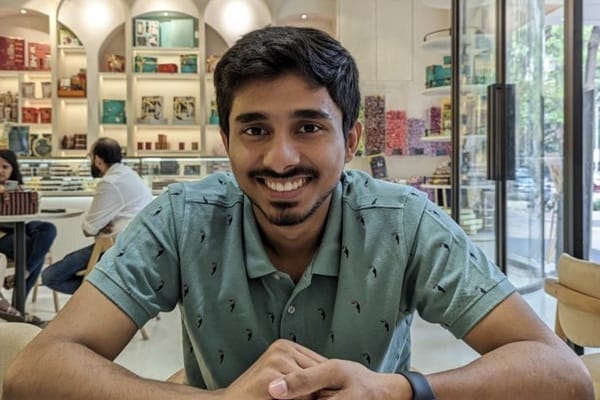
Siddharth Panikath has had a unique application journey. He saw many rejections before smartly achieving success. During our initial profile evaluation discussions itself, we had discussed the risk of going ahead with his MBA plans and had suggested an alternative too.
Acknowledging these, he chose to give MBA applications a shot and worked with us. Rejections followed but he bounced back and considered a change of plan. We had suggested a different degree and another set of applications that worked. Let’s hear the details directly from him.
This is the transcript of our our video Q&A with Siddharth. Watch the original video here: MBA in USA with scholarship vs MFin in UK
MBA in USA with scholarship vs MFin in UK
How I got into London Business School
by Siddharth Panikath
MG: Welcome Siddharth. Can you tell our viewers about yourself a bit?
Siddharth: I’m a Malayali, born in Ahmedabad and brought up in Mumbai. I did all of my schooling in Mumbai. I grew up with an interest in math and science and that led me to pursue engineering, also seconded by the fact that my brother had pursued engineering. So that inspired me as well.
I completed my engineering degree from SVNIT Surat in electronics and communication back in 2020. Apart from that, I’m hugely passionate about sports, especially football.
Access Free Frameworks →
I have followed the sport and played it for all of my life. It’s a big part of who I am and has helped build my personality and my character as well. So that’s a bit about me.
MG: Excellent. So where did you work after graduation and what was your work like?
Siddharth: Over the course of my four years at SVNIT, I knew that a core engineering role is not for me and that’s what led me to eventually joining ‘Futures First’.
So ‘Futures First’ is a proprietary trading firm that deals in financial derivatives and specifically financial futures. I joined there as an energy markets analyst.
As part of my work as an analyst, I was given my own account to trade in one of the most competitive futures markets in the world.
I primarily traded in products ranging from different types of crude oil and products like gasoline, diesel, natural gas and it was quite an interesting experience. I learned a lot about markets.
I also ended up learning a lot about trading in energy markets during a time period such as 2022, when the Russia war happened and markets went through a cycle that probably has not been seen for a long time. It was definitely a once-in-a-lifetime experience and something I’ll always keep with me and remember.
MG: Yeah. This is very interesting. It feels very intimidating, right, as an engineer getting into this world of trading. So how did you prepare? Any tips you have for people who are thinking of a similar career?
Siddharth: I think the first thing is you have to go in with an open mindset. I knew when I went into the interview itself that I was going in with a blank slate because I didn’t clearly know what the job entailed, but I had to back my own ability.
So you have to stay a bit humble, knowing that you’re going to learn along the way. You’ll make mistakes, but at the same time you’ve to be confident that you’ll be able to overcome that.
I think trading in general, as a profession, is highly EQ-dependent.
So you always need to stay confident yet stay humble, I would say. That would be the best advice.
MG: Right. And from a hard-skills perspective, on the financial aspects and the actual financial products aspect, did you use any sort of resources that you would recommend people look at?
Siddharth: So, Futures First as a firm is actually now quite mature in terms of learning. There are a lot of modules within the firm itself that help guide you and teach you all of the basics about what futures are, what financial derivatives are, and how you can use them – how companies use them, and how actual physical players are also using them.
They give you quite a lot of information on that. As such, a lot of the exchanges also have material – they have learning resources which we also relied on. Now everything is available on YouTube, and even something as simple as a ChatGPT search helps you so much.
You can just go ahead and start picking up the basics and learning a bit, then sort of piece together things. At the end of the day, I think it’s a lot of experiential learning – you learn as you do it.
We spent about 4-5 months just preparing before we actually went into live markets.
And the actual learning started after that, because there is a big difference between theory and execution.
MG: So after having this career for a few years, when and how did you start thinking of an MBA? And as you did that, also comment on your GMAT journey. How did that go?
Siddharth: So I think the MBA plan was always sort of there. As I mentioned, I realized engineering wasn’t really where I’d spend my career, or most of my career.
I was looking at other options and trying to think in terms of the skill set I would want to use, and I always enjoyed the managerial aspect – mostly the people aspect that’s involved. So I always felt that might be for me.
Apart from that, even though I had a strong inclination toward math and science, I think finance and economics were subjects that I felt I wanted to dive into, but I just held off. So I knew that maybe somewhere along the line, that’s something I was going to do, either in the form of a CFA or an MBA.
I gave CAT every year since my graduation, mostly to stay in touch, because in the year I would want to eventually pursue an MBA, I wouldn’t have to struggle as much with the exam.
Secondly, I also enjoyed the process of giving the exam as I learned a lot through it.
Having done all that, after about 3.5-4 years, I decided that it was time. I felt I had gone through every market cycle, or at least a lot of market cycles, working in the energy markets.
So I felt that I had a good sense of the experience and what it’s like. So now I could actually go ahead and pursue further studies, and that’s when I decided that I would pursue an MBA.
Now, when it came to deciding whether to do it in India or outside of India, that was more a case of the fact that I had four years of experience and was already bordering on the average class experience in India.
I also spoke to a lot of my peers who had actually done their MBA in India, and what I learned is that essentially the MBA is whatever you want to make of it. You have your set of goals that you want from the MBA. The way I thought of it was that my Master’s had to be something that gave me exposure.
Since I had already worked and had already been at a national institute at SVNIT, I felt that now I wanted more global exposure as well as building a global network. I felt that’s the next path for me. That’s how I eventually decided I would look for an international MBA and then I went ahead with the GMAT.
MG: Yeah. It’ll be interesting to hear your GMAT preparation strategy. What score did you get? How did that journey go?
Siddharth: So I gave the GMAT for the first time in 2023 and as I had mentioned, I had given the CAT a couple of times earlier. So I did not feel like, conceptually, I had to adapt as much. I gave myself a few months, and I gave the official GMAT, which was the old GMAT at that time.
I got a score of 710, which is a respectable score, but given my background, I would say that it wouldn’t help me target the top schools. So I just felt that I still had further to improve on.
I gave myself more time, and then a year later, in 2024, is when I applied and again gave the GMAT. I gave the GMAT Focus this time.
I felt the Focus would actually help me a bit more because it was more analytical and logical – the component was more focused on that.
I spent another 2-3 months during which I was constantly on and off, but I would say it was a good 2 months of practice where I was using all the official resources. I was using GMAT Club. I was also using whichever YouTube channels I could find – GMAT Ninja was one of them that really helped me.
Using all of that, I eventually got a score of 735 on the GMAT Focus. And once I got that score, I was pretty certain that that’s all I could do on that front. And I thought that now I could move on to the applications.
MG: Absolutely. That was a fantastic score that you got. But despite the score, tell us what were your concerns as you went deeper into the process?
Siddharth: So, what I had always heard and later felt firsthand was that the entire application process is more than just a few sets of numbers. I knew that on the score front I was okay.
But it’s a fact that ‘Futures First’ is the space I’m working in; it does not primarily require an MBA for you to excel in that field.
So for me to explain why I wanted to do an MBA was going to be a challenge. And there weren’t a lot of employees from ‘Futures First’ who went on to do their MBA except a very few, a handful. So I knew it was a tough thing to explain. That was the first challenge I felt I had.
Secondly, ever since after my 10th or 12th grade, it was all about academics, and I had to decide how much time I could allot to everything else. So I just decided I’d give everything else to football.
Now, obviously, as a person, it helped me a lot – I learned a lot. But if you think about it in terms of CV points, it doesn’t add as much volume. And I felt the effect of that when I was going through the applications.
I could only speak about my experience with football. I did not have that many varied activities that I could select from or show. And I felt that’s very important in this process.
In the form of extracurriculars or in the form of volunteering, I needed something more. That was where I was lacking, and I had to try and bridge that or try to shape it in a better way.
MG: Got it. So you went into it with a positive mindset but the first set of applications did not work out right. Tell us what your emotions were? How did you take the rejections? What kind of pivot did you make?
Siddharth: Yeah, initially I gave about 7 applications in the first round. I got 2 waitlists, and I converted one college. I knew, in terms of selection of the college also, I kept myself restricted to only the top 25 in the US.
I said I won’t go beyond that because I like my job, I like what I’m doing. So I would only choose something else that’s really worth the opportunity – something that I couldn’t pass up on.
After going through the first round and once the results came in, the rejections were tough to take.
Some of them I probably expected a better result from, but that’s just how it is. And I think, in that sense, my work has helped me take those hits a couple of times.
So I just took it in my stride and then thought, okay, what’s next? Since I had one convert, I could still keep that as a backup and move on to whatever was next and improve on those aspects.
And that’s when one of the recommendations I got from you yourself was to look at ‘Master’s in Finance’ programs as well – something which initially I was hesitant about because I just felt I wanted a more complete or holistic experience that an MBA provides.
But again, going back to the same point of what you want from your MBA or in this case what you want from a Master’s, a school like London Business School was still providing me that, but in the form of a ‘Master’s in Finance’. And yet it was teaching me everything that I needed to be taught.
And I knew that, given that I’ve worked 4 years in the financial services industry, most likely I’m recruiting for finance – even if I’m in an MBA program, that’s where I’m going to be recruiting.
So I felt that it doesn’t make a big difference if I pursue a ‘Master’s in Finance’ as it still gets me to where I want to be.
And since the Master’s in Finance at London Business School offers electives that can give me a flavor of what an MBA feels like, I felt that it was a good program to apply for. So I went ahead and applied for that and I’m glad I did.
MG: Yeah, I know. And during this process, how did you feel working with MBA Crystal Ball (MCB)? what is it about the process that you may have liked?
Siddharth: I actually started working with MCB back in 2023. I had done a profile evaluation – that’s how I initially started. That’s how I got in contact with you as well.
I felt the reviews of MCB were very honest and constructive and I think I needed that.
So after doing a bit of research, I decided I’ll go ahead with the MBA Mock Application Process (MBA MAP) that MCB provides.
And the MBA MAP is quite extensive, quite detailed. Once I went through that – getting that list of colleges and putting them into buckets – that helped me create a structure, a map of how I’m going to go about my applications, which are the programs I can target, which are tougher for me to get into.
And then, eventually moving on to the essays – I think that was something I wouldn’t have thought of myself, writing such a detailed or such a coherent essay, but it came there after a couple of reviews and a couple of discussions.
Also in terms of certain stories, for instance, I wasn’t initially going to bring up my dad’s career in the banking industry as something that helped me decide on my MBA.
Initially, my ‘Why MBA’ was just a bit of different fragmented parts and then it helped come together when I used that as an anchor, and that suggestion was given to me by you.
So those little clues – a little bit to keep the mind churning – ideas to think of what else I can add – that was very useful. I put everything on paper and then start forming that skeleton. So I think overall, even in terms of timing, it helped me.
I did not know how much time it would take for each application – how long it takes for going through 4-5 essays, going through 4-5 edits of the same essay. So that whole thing was also quite a process that I learned and enjoyed.
MG: Excellent. And so you interviewed both with MBA schools and the ‘Master’s in Finance’ – any similarities or differences that you’d like to share.
Siddharth: I think they’re quite similar, at least the international MBAs. I’ve given a lot of MBA interviews, even in India, but the international MBAs are quite similar in the sense that they’re very conversational. So you just have to be yourself.
And I think what helped me was that I treated the interviews as a process of not just them evaluating me, but me evaluating them. So I asked them questions. I want to know about them.
And I think that helps a lot – showing that genuine interest of why I want to be in that program, why that is the program for me and overall, just being yourself, because they’re conversational interviews.
It really helps being clear on your idea of what you want in the future. I think that’s fundamental.
You have to have that for any interview. You have to be as relaxed as you can be and just be ready to answer things on the fly.
MG: You got an admit from a US business school with a scholarship. Tell us what the name was, and then also LBS ‘Master’s in Finance’. How did you decide between the two as well?
Siddharth: I got into the University of North Carolina, Kenan-Flagler Business School, with a scholarship and in my second round, I got into London Business School for their ‘Master’s in Finance’.
I think for the most part, I was certain I wanted to go to the US, but then, you also have to consider the political aspect and how everything is changing on that front.
Also the fact that brand value is quite important going ahead in the world, I knew that I needed one that’s more global – one that I can use even if I have to come back to India, because that’s a very realistic possibility now for international students, that you may have to come back.
I spoke to a lot of students from both schools. And then for me, you also had the added factor that they’re quite different programs – one is a one-year program, the other is two years – so even in that sense it was quite different.
That’s how eventually I felt, London Business School was a better fit for me, and that’s how I decided to go ahead with that.
MG: So now that you’re headed there, any kind of closing remarks or tips you might have for future applicants – what you should have done, what you wanted to do, how it went?
Siddharth: I think firstly, when you’re going for any application, this is one thing I learned from you – that you have to speak to a lot of students from those schools to really know what the culture is. That’s how you can then frame the answers that suit you and them.
That’s very important and it helps you. I’ve connected with some very good people. Even though I connected with them just for an application, I’ll stay in touch with them and that’ll be a network that I can tap into maybe in the future. So that’s one thing I think everyone should do.
Secondly, I have no regrets. I knew that this was the only set of applications I was sending. So I did apply to really ambitious schools like Harvard, Stanford because I knew that at the end of the day, I don’t have to have any regrets.
I’m going through this cycle once in my life and I’ll do it. You’ll have a few rejections, but you have to get used to that in the world. You just have to take it in your stride.
If I had to go further back, maybe I would have done a few more activities that could have added CV points which I never really valued that much. I just thought of what interested me and went ahead with that.
That is another factor that I could have considered long ago. But overall, it’s fine. I am who I am because of all of that.
MG: Thanks so much Siddharth and all the best with your superstar career in the world of finance in coming years! Take care.
Get in touch with MBA Crystal Ball if you are aiming for the top business schools: info@mbacrystalball.com
