
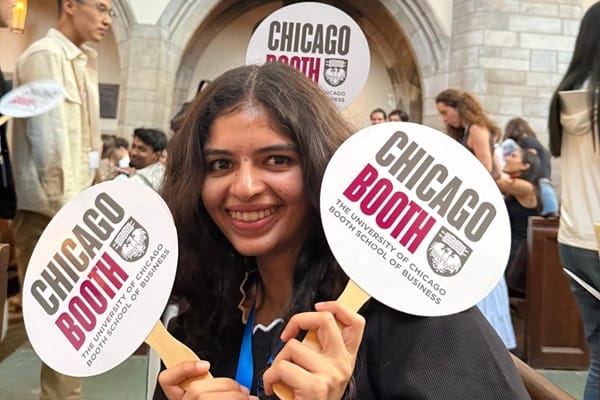
After being written off by a reputed ‘M7 specialist’ admissions consultant, a VIT engineer ignored the demotivating advice, worked with MBA Crystal Ball and earned admits from Chicago Booth and UVA Darden with a $70,000 scholarship.
Sumedha Updhyay approached us while preparing for her GMAT. The computer engineering graduate from Vellore Institute of Technology (VIT) started her application journey without a GMAT score at hand. While this is usually risky, she was confident and that showed up in a stellar score and some eye-popping admits with scholarship. Here’s her story.
This is the transcript of our our video Q&A with Sumedha. Watch the original video here: How I got into Chicago Booth & UVA Darden MBA with scholarship
How I got into Chicago Booth & Darden with $70K
From VIT Vellore to M7 MBA with scholarship
by Sumedha Upadhyay
MG: Welcome Sumedha! As a starting point, could you tell us a little bit about yourself and your qualifications?
Sumedha: Sure. I was born and brought up in a town near Agra in India and I did my schooling there itself. I then went for my under graduation to VIT Vellore, where I majored in Computer Science. After that, I joined Schneider Electric as a Graduate Engineer Trainee.
I am also a founding member of a nonprofit, Zaroorat Care Foundation, which is an integrated platform for patients with rare forms of cancer.
I am also a trained classical Kathak dancer, which I have been practicing since I was four or five years old. I also love anything fitness-related. I love running and have completed a few half marathons over the past few years.
Access Free Frameworks →
So yes, that is a little bit about me.
MG: That’s great! Tell us a little about this nonprofit that you established. When did you start? What was the motivation and where is it currently?
Sumedha: Well, it was started by the co-founder of the NGO, Priyanka. She and I are friends and she started it in memory of her late mother, who passed away due to a rare cancer, gallbladder cancer in December 2023. She was thinking of starting it in late 2023.
Then in December, she approached me because we had already discussed the NGO, and she and I both really liked the cause. I really believed in it – that we should help patients, especially in India, who do not know how to navigate cancer.
Especially when a doctor tells you that you have cancer, it’s really scary for both the patient and for the family and caregivers. So I really wanted to join this initiative, and hence I joined it in December 2023, and I’ve been working with the NGO ever since. And yeah, that’s how it is.
My professional journey so far
MG: Give us a glimpse of your work at Schneider? What kind of profile did you have?
Right. So I joined Schneider right after VIT through campus placements. I initially interned with Schneider for six months during my last semester at VIT and then joined full-time as a Graduate Engineer Trainee.
My work with Schneider started from a technical background, beginning with basic coding tasks. As I grew from GET to Analyst and now to Senior Analyst, my role went on from owning certain deliverables to leading digital transformation projects.
That has been my journey so far. Over the past 4.5 years with Schneider, I have led several digital transformation projects involving Schneider’s European as well as American businesses, digitizing a lot of the factories Schneider has in these regions. That is a little bit about my work.
MG: Right. So where did the MBA come in? When and why did you start thinking about it?
Sumedha: Well, the seed for an MBA was planted quite early during my undergrad days. I used to see a lot of my seniors preparing for the CAT – not international MBAs per se, but mostly CAT – and I also saw a lot of my peers going for an MS as well.
There were three major reasons why I wanted to pursue an international MBA and not an Indian one. Firstly, I wanted to work for some time after undergraduate studies so that I could gain some amount of exposure to the practical side of things, which I could not get at VIT. That was one reason.
Secondly, I value the kind of diversity an international MBA classroom offers, and thirdly, the global network that comes with it.
I’ll also share another observation. I recently met my current B-school batchmates in India, and out of around 20-30 people who are going from India to the B-school, other than one person, I did not find anyone else with a similar technical background.
That was really interesting and quite surprising to me. When we were meeting in Bangalore, seeing almost nobody with a technical background stood out. So yes, that reflects the kind of thought put into choosing the people – I love that.
What made my GMAT journey so eventful
MG: Help us understand how you prepared for your GMAT and why you decided to start the applications in parallel to the prep?
Sumedha: My GMAT has been quite a journey. So many doubts and I had a lot of retakes. I initially started my GMAT once I was confident that I wanted to go for an international MBA, which was in late 2021 – that is generally the first step when you are planning for an MBA abroad.
I joined a few classes, but they didn’t work out well. Initially, I got a 690 and was stuck at that. Then it went up to a 720 – I was in the Classic GMAT and was just stuck there.
But in 2024, I felt I really wanted to go to school that year because I felt I had gained enough experience and wanted to jump the ladder. I knew what parts were missing from my GMAT preparation from the previous year. I knew I had issues with the timing aspect, so I had to do a lot of timing practice.
For example, I got a 100 percentile in Quant when I got my final score, and my basics are pretty clear, especially for Quant. I owe that to my Quant mentor, Saurabh – he really helped me with everything Quant-related.
Once I identified that timing was the problem and focused on it, I got my score. Funnily enough, I got my current 705 about two weeks after I had already submitted my applications to the two B-schools I applied to in Round 1.
I still remember getting my score on 15th October, which was the day of Booth’s interview – a Wednesday. Booth’s interview results came out that Friday.
I remember telling my consultant at MBA Crystal Ball, that I had got my score. He asked, “Did you tell the B-schools? You didn’t inform them?”
I said, “No, I’m waiting for GMAC to send the final scorecard.”
He said, “No, no, no! You send them right away, and later you send the scorecard again.”
That worked out pretty well. Absolutely, I think timing is very critical in these things.
Behind the scenes: The support that made the difference
MG: Why did you decide to work with a consultant and how did you discover MBA Crystal Ball (MCB)?
Sumedha: Yeah. I did talk to other consultants as well, along with MCB. What I really appreciate about MCB was that, initially, when I was discussing with you over email, I really liked the questions that you asked in the initial form that we had to fill. When you replied, you underscored what things could be used for my essays, which I really liked.
I also loved the fact that right after I wanted to talk about my applications, you directly connected me with the consultant. He was very supportive. He took an entire half an hour to understand what I wanted, which schools I wanted to go to, where I was at the moment, commented on my scores, what I should do, etc.
He really took a lot of time to understand my story and then shared his perspective, even before I made my first payment. So I really felt that the person was genuinely invested in my success. So those are the things I really liked.
I did go to other consultants as well. One consultant – I wouldn’t name them – was very different. I did not even talk to the consultant; I just talked to a representative from that firm. The person was like – you don’t have the score, you have a non-traditional background, etc., you should not consider applying.
MG: What were your concerns and what strategy did you adopt to stand out amongst the over represented pool that you came from?
Sumedha: Yeah. Initially, I was very scared with respect to a few things – one was obviously the score, but the other was that I’m an Indian and Indians are quite overrepresented. Then secondly, it was my technical background because I felt that people do not come from a technical background for an MBA. That was my thinking.
I didn’t know whether they did or not; I just assumed that they do not go for an MBA, and even if they do, it’s difficult. This was because I did not see a lot of people from my company, as well as from the teams I had interacted with, going for an international MBA. So that was a real concern.
I did put this across to the MCB consultant as well, and he really pushed me to just be myself and write who I am and what I am. I wrote about my achievements at Schneider and the STEM background I come from. He was very clear that I should just own it, because it’s a great background to come from.
Even minor things – for example, my PCOS journey – I did not think that would be something relevant to put in an MBA application.
But my consultant said that it is a journey, it shows who you are and the journey you have lived and the things you have done in the past. It is a part of who you are, so you should put it up. That’s how the consultant made me realise these small things were relevant.
What surprised me most during my MBA interview
MG: With this approach, you notched up quite a few interviews invites. Tell us where did you interview and anything that sticks out right from the interview experience that you’d like to share?
Sumedha: I got Kellogg and Darden interview invites. Booth and Darden were Round 1; Kellogg was Round 2. One thing that stuck out with Darden was that the interviewer I was told would be interviewing me was not the one who actually interviewed me. They changed my interviewer, and when I went to the venue, I was looking at a completely different person.
So all the research I had done about my interviewer just went for a toss. They also did not have anything – no resume, no application – nothing. It was just an open interview. So that was my experience with Darden, but it turned out well.
With Booth, it was the best interview out of all three. We talked for over an hour, even though the slot was for about 45 minutes. Toward the end, it was just normal, random conversation. The interviewer was also Indian and from the Delhi region, which I am as well.
We were just talking casually about those things and about how things are in Chicago, etc. It was a breeze, and she really made an effort to make me comfortable. The interview didn’t even start with ‘introduce yourself.’ Her first question was, “So what fun things did you do this year?” It was pretty great!
At Booth, they had my resume but not my application. Kellogg was also similar to Booth. It was about 45 minutes, stuck to time, and it was good. Both had similar questions – introduction about me, why MBA, and behavioral questions. So those were my interview experiences.
Admits, scholarship, lessons from the MBA journey
MG: Now, the drum roll – where did you get admits, what scholarships did you get and where are you headed?
Sumedha: I got admits from Booth and Darden, and I received a scholarship of US$ 70,000 at Darden. And I’m headed to Booth.
MG: Now that this journey is kind of done and you’re headed to one of your dream colleges, any advice for future applicants that you’d like to share including how you made the decision between these two choices?
Sumedha: Personally, I would say try to apply in Round 1, but definitely not at the cost of the application. But if possible, try because by Round 2, I’d admit I felt pretty lazy and exhausted, because I was doing the GMAT and applications together.
That might just be me, but I felt that by Round 2, the class they’re thinking of is already made, and they might be looking at where you fit in the class rather than taking risks, which I feel they do more in Round 1 – at least from my personal experience.
Unlike me, prepare well in advance and have your GMAT score ready. It worked out for me, but it is exhausting when you try to do everything together. Avoid those nervous, nick-of-time moments that I managed somehow. Those are the two main things I would say. The rest worked out well.
MG: Got it. Thanks so much for sharing those words of wisdom, Sumedha. All the best!
Get in touch with MBA Crystal Ball if you are aiming for the top business schools: info@mbacrystalball.com
