
What’s a good GMAT score for M7, ivy league MBA, Top10 programs?
The average GMAT score for M7 MBA programs is around 730. That’s just the global average. If you do a little demographic drilling (for countries, industries & roles), this average varies. Underrepresented candidates can get away with low GMAT scores.
For Indian applicants, you can assume the average GMAT score for M7 and ivy league programs to be 20-40 points higher than the class average.
There’s another trend that’s common among GMAT test takers from India. In a majority of the cases, the sectional scores of Indians tend to be unbalanced. e.g. high quantitative and low verbal.
This generally gets attributed to the fact that most Indian test-takers are engineers – so quantitative seems easier than verbal.
But sometimes the GMAT sectional scores flip, leaving the test taker confused and concerned.
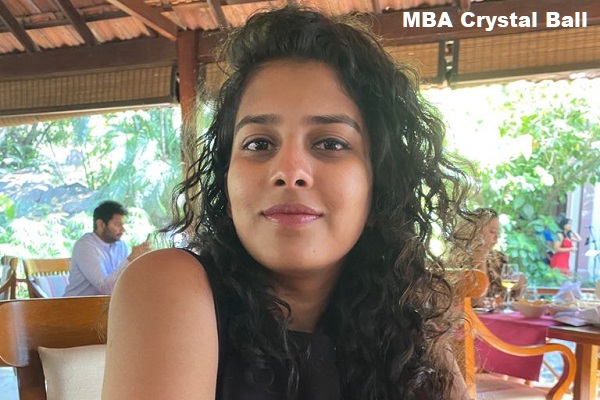
Consider Trisha Reddy’s story. The NIT engineer got stressed after she got a low quantitative and high verbal GMAT score, though the overall score was pretty good.
Access Free Frameworks →
How I overcame an unbalanced GMAT score and got an M7 (Kellogg) admit
Applying with a low quantitative, high verbal GMAT score
by Trisha Reddy
I flip flopped about my decision to go for higher studies a LOT over the last five years. Looking back, it’s been such a long time coming and it feels surreal that I finally have an admit!
My mom, due to various circumstances, had to give up on her dreams of higher education and so it was her biggest goal for her two daughters to be very educated. I grew up with the expectation that I’ll do my Masters. Post my Undergrad at NIT Trichy there was an easy exit to this path.
However, I was confused whether I wanted to pursue a Masters in Industrial Engineering or Management so I decided to get some real world experience before committing time and money towards a specialization.
I joined ExxonMobil Lubricants as a Demand Planner. This role provided me exposure to the Sales and Operations functions and it was a steep learning experience working in Supply Chain through Covid and the Ever Given blockade.
However, two years in, I was sure I did not want to specialize in Operations and so Masters in Industrial Engineering was off my list.
Back in college I was the editor of my college magazine and I really enjoyed writing. Particularly, political analysis pieces like an alternate history where Indira Gandhi was not assassinated.
The lack of a social life during Covid allowed me to reconnect with this hobby and while exploring different career options in this space, I came across the Schwarzman Scholarship.
It’s a one year fully funded Masters in Global Affairs at Tsinghua University. With the growing relevance of China in the world, this really seized my imagination with all the different career paths this would open up.
But since I had zero experience in the field, I reached out to MBA Crystal Ball for help with the application process.
Despite getting a reject, the experience of working with Manish gave me an understanding of what admission committees evaluate in candidates.
I took this rejection pretty close to heart and decided to not let my career be constrained by a degree.
However, the harsh reality was that it was impossible to switch into a new industry without relevant experience unless I was willing to take a significant pay cut.
The only exception to this rule was startups. After a lot of prospecting, networking and interviewing, I decided to join the Strategy and New Initiatives team at Dunzo.
It was a very exciting opportunity as I got to work on moonshot projects and scale them. What I loved the most about it was that it was a pure generalist role that would allow me to work across different verticals.
Within the startup ecosystem there is a bias against MBA because there’s an emphasis on learning by doing.
However, given the rate at which technology is evolving, I was of the opinion that taking time off work to study and be close to where the innovation is happening would be a good bet.
And honestly, with the ongoing layoffs in tech, I could not have timed it better.
I started preparing for my GMAT in Jan’22 with my test scheduled for Feb end. My preparation strategy was straightforward – Official Guides for practise and eGMAT for clearing up concepts.
Although I was around my target score of 750 leading up to my exam, I ended up scoring only 710.
I was sure I was not applying with that score but I procrastinated on retaking the exam for as long as I could, only giving it in July end.
This time around, I focussed on the sections and question types where I scored low based on the GMAT Enhanced Score Report of my previous attempt.
This allowed me to improve my score to 740.
But I was in a uniquely difficult position for an Indian where I was in the 99th percentile in verbal and 53rd percentile in Quant.
Given Round 1 deadlines were 45 days away, I decided to just apply with this score.
My goal was to get into an M7 college so that made choosing colleges to apply to very easy. Out of HSW, I planned to apply to Stanford because they were more eclectic in their selection which to me translated to better odds.
Having spent four years in a tier 3 city, proximity to a big city was a very important criteria for me.
Also, given my low quant score, I wanted to avoid colleges which had a focus on quantitative aptitude – MIT and Chicago Booth.
So I applied to Columbia and Kellogg. Outside of M7, I decided to apply to Duke because all my alumni conversations were great and it felt like a good fit for me because of the emphasis on sports.
Since I already had experience with applications and I had mentors to guide me, I decided to apply on my own.
However, with less than a month to go for deadlines, I realized that my essays were not compelling enough and feedback from multiple people was contradictory and left me very confused.
So I decided to reach out to Manish and given our long standing relationship. And knowing that MBA Crystal Ball has a long track record and the best admission consultants for M7 and ivy league MBA programs.
He agreed to help me out on short notice.
My approach to the essays was to focus primarily on professional achievements. However, almost everyone applying to these top colleges would have the same accomplishments if not better – early promotions, cross functional projects, managing teams and the likes.
Conversations with Manish helped me be honest with myself that my ambition looked different and that could be how I stand out.
In the long term, I want to work at the intersection of writing and technology and I have proof of work to back up this unconventional goal. I have a personal blog where I review non fiction books.
One of the illustrations I made reached Harvard Professor Dan Levy and became marketing material for his book and we began collaborating on his next book on Decision Analytics.
Although this is not typical, I decided to take the risk and structure my essays around this goal.
When I got dinged by Stanford and Columbia without an interview, I began questioning my approach.
Although I interviewed with Kellogg, almost everyone who submits an application does. So it was not really reassuring.
I had hopes on Duke because from the start, I considered it a safe college and my interview was perfect.
My Kellogg interview was with an alum who graduated in 2020 and my Duke interview was with a second year student. For both, my strategy was to prepare the questions posted on the GMAT club forum and do mock interviews with friends and mentors.
Getting Waitlisted by a college you considered safe is a special kind of disappointment.
After the Duke Waitlist, I spoke to Manish, who helped me prepare an R2 strategy and reminded me of the hope-giving six magical words every applicant needs to hear repeatedly –
“It’s not over till it’s over!”
And he was so right about that! When I got the email from Kellogg on D-Day, that one yes outweighed all the rejects so far.
Given how close I was to giving up on the 2023 application cycle, I feel weird giving any sort of advice. But here’s a list of a few things I attribute my success to or things I would have done differently. Knowing my story, you’ll know which is which.
- Before you even start the application process, have a support system in place. This can be friends, family or SO (significant other). But let them know that you are going to be a self doubting mess for a couple of months.
- Know that failure is a part of the journey but also know that it’s not absolute. Just make sure you have enough time to retake GMAT.
- Don’t skip steps. Even if you initially think you don’t want to work with a consultant, no harm in having conversations with them. That way if you change your mind mid-way, it’ll be much easier vs vetting them from scratch with a looming deadline.
- Even in essays that the college is asking about you, it’s actually about the college. For example, Kellogg’s essay on values is indirectly asking how those values serve the college.
- Last one but most important one – IT’S NOT OVER TILL IT’S OVER!
– Trisha Reddy
Are you planning to apply to the top MBA programs with unbalanced GMAT sectional scores (like low quant high verbal, or vice versa) deviating from what admission officers are used to?
Send across an email and we’ll figure out the right business schools to target and then build a strong application to overcome the hurdles:
info [at] mbacrystalball [dot] com
Check out our video channel for the top MBA and career videos.
Also read,
– GMAT experience at Online vs Offline test centers
– Second MBA at Kellogg after IIM
