
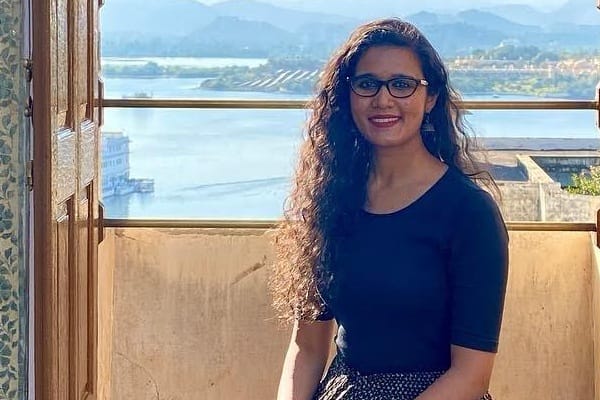
Nihitha’s professional journey has taken her places – from Netherlands to Italy to India and more – but her MBA journey was not without its hiccups. She trumped them all to achieve impressive results. She got into 2 IIMs after a Bachelors in Arts degree in Journalism and Mass Communication.
This is the transcript of our our video Q&A with Nihitha. Watch the original video here: I got into IIM Ahmedabad PGPX & IIM Bangalore EPGP with scholarships
MBA after B.A. in Journalism & Mass Communications
IIM One-year MBA in India with scholarships
by Nihitha Alicherry
MG: Welcome Nihitha. So as a starting point, could you give us a little introduction about yourself and your qualifications?
Nihitha: Sure. So, I’m originally from Kerala. I’ve moved around quite a bit – about every 3-4 years across my life. I did part of my schooling in the Middle East and the rest in Kerala, and then I moved to Manipal for my undergraduate degree in Mass Communication.
During that time, I was also selected for an exchange program to Erasmus, for which I missed placements, but I knew the international experience would help.
So I spent my last semester at Erasmus. After that, I was in Bombay and Bangalore for work – that’s been my journey so far.
MG: So, your undergraduate as well as the exchange – are pretty interesting, especially the exchange. Can you tell us how that works, why you went for it, and what the experience was like?
Access Free Frameworks →
Nihitha: To walk you through my undergraduate degree, it was basically Journalism and Mass Communication, so it’s a very practical course where, every semester, we pick up a few things, we have a lot of assignments, projects, etc.
With Manipal University, there are a lot of different universities affiliated with them for exchange programs, internships, things like that. So my school was affiliated with a couple of universities in Europe and Australia for a semester exchange program.
So I had applied for Erasmus because Erasmus was a research university.
I was very intrigued by how different that would be compared to my practical degree and how it would differ from the Indian education system.
Three of us got selected from the whole school, and we were on our way to Erasmus.
MG: Right. Any memorable experience from that time that you’d like to share?
Nihitha: There were quite a few shocks, I would say. Definitely I didn’t expect the academic rigor that’s there in a research university in Europe. So the entire education system is very different. We barely had classes but there was a lot of work that we had to do before our classes.
There were a lot of pre-reads and studying done before the classes and then in classes, it was just discussion and teaching through discussions. So that was a major shock for me because I was coming from an arts degree where I didn’t even have textbooks and we were encouraged to focus on practical skills.
So going from that to directly reading research papers every day, I think it took me some time to get used to it.
And obviously, there was a lot of cultural shock as well because it’s an international university.
So we had exchange students from across the world, and even the students studying there were from around the world.
So, interacting with all of them, learning about their culture, learning about their education systems back home – I think it was a very rich experience for me, very eye-opening as well.
MG: But you said you missed out on placements. So how did you find work? Walk us through your career journey.
Nihitha: Sure. So I come from an engineering family, so it was very much expected of me to also join an engineering college and go down that path. But I wanted to do something different. I wanted to be in the creative space.
I was not sure exactly what it was that I wanted to go into, but public relations was one industry that really caught my eye. Manipal’s course was focused on public relations, so I had chosen that for my undergrad. We actually have a lot of alums in different industries – be it advertising, public relations, movies, etc.
Since I missed out on placements, I had to rely on alum networks to figure out what jobs were out there – doing cold calling, emailing, all of those things.
I finally got through into my dream PR company, Edelman in their Bangalore office. One of my alums was already working there, so I had reached out to her for a reference. That’s how I got my foot in the door and started my career in public relations.
I was at Edelman for a year. I quickly realized that what you study and what you do are very different from each other and public relations was not the right industry for me. I felt I wanted to do something more. I wanted to explore more things.
Again, I was not sure what, but I was willing to take the risk and quit that very cushy MNC job to explore something else. I was sure that I wanted to move into an early-stage startup so that I could learn and explore. I think my idea has always been to just keep learning and keep growing no matter which stage you’re in.
So, at that stage, I joined Nua. It was an early-stage startup, and I was the fourth employee there. That was the perfect opportunity for me to grow with the company. Given my background, they hired me in social media and content, but I wanted to do more.
So I took up everything under marketing, and in the first two years, I literally did every role under marketing – learned about it, started learning about business.
It gave me an opportunity to understand what my strengths and weaknesses are and where my passion lies.
I realized that I was really good at project management and cross-functional teams. I was very passionate about the industry and the business. So from PR, I shifted to marketing through Nua, and at Nua, from marketing, I moved to category management and started taking up cross-functional roles.
I was working directly with the co-founders to build the business out. I spent 5 years at Nua doing all of these things – literally everything under the sun to build out the business. It’s really close to my heart as well because I joined at a very early stage and was there for 5 years.
After 5 years, I wanted to broaden my horizon a bit. For those who don’t know, Nua is a D2C brand in the menstrual wellness space. I felt I had become an expert in that particular industry/niche, but I wanted to learn more and push myself to see if whatever I’d learned, I’d be able to apply and do well in a much larger industry.
So after 5 years at Nua, I shifted to 82°E. It’s a celebrity self-care skincare brand. There, I got the opportunity to again work directly with the founders in the CEO’s and co-founders’ office. I continued to work in cross-functional project management roles – that’s been my journey so far, very dynamic.
MG: So when and how did you feel the need for an MBA? Because at least on paper, you had a pretty dream career of sorts. When did that thought come and how did you start your GMAT journey?
Nihitha: I think my MBA journey started way back. I’ve been thinking about an MBA for a really long time. It started with thinking, oh, should I go for an MIM degree, and then it shifted to an MBA.
It took me this long to apply for an MBA because I was always comparing an MBA to what I was doing.
So I was constantly asking myself, will I learn more in an MBA degree or will I learn more in my current role?
And I think over the years, work always won because, since I was in a very dynamic startup, it gave me the opportunity to learn and keep growing. But after a point, I realized that I was also carving a niche for myself.
I have been in the startup space. While I was becoming an expert in my role, it also made my view quite myopic. If you ask me tomorrow to join a very large organization and build a company at a scale of a thousand crores, I might not know how to do it, but if you ask me to build a company from scratch, I know exactly what to do.
So I quickly realized that gap of mine.
While I was getting comfortable in my role and in the startup ecosystem, I knew that it was going to limit me – if not now, then definitely a couple of years down the line. That’s when I realized that I really needed an MBA degree.
I was also working with MBA graduates in these roles, and one of the biggest gaps I saw was in theoretical knowledge. Whatever I know and have learned is by working – by hustling, by reading up, and then doing it on the job.
But I realized that I don’t really know the basics of building a business, or Marketing 101, or Business 101. And I really want to go back to school to learn that – to strengthen my foundation and learn the theory behind the work that I’m doing.
So that is what led me to really consider an MBA seriously – because I knew that if it’s not limiting me now, it will definitely limit me later because of these gaps that I have. So finally, I decided to take the leap and apply.
MG: So, in step zero – typically the GMAT – how did you go about it?
Nihitha: Since MBA was in my mind, GMAT was also in my mind for a really long time. And GMAT was definitely scary, especially coming from a non-engineering background. I was very scared of how going back to studying would affect me.
There were times over the years when I started preparing for the GMAT, and then I would stop after a few days or a few weeks or some work project would come in and I would completely stop. Finally, I put a deadline that I wanted to achieve.
So in 2023, I thought now I have to give my GMAT. So I figured that I would take about 3-4 months, preparing everyday for the GMAT, and then give the exam. During this time, I was also working.
So I would work through the day, stop my work around 7-7:30 pm and then start my GMAT prep. I did that for about 3-4 months and then gave my first attempt. I was not scoring really high in my mock exam but I felt maybe I should just give it and see how that experience is and I can always try again.
So I did go ahead with my exam and I got a very modest score of 650 which is in line with what I was also getting at my mocks.
I did expect it to be slightly higher though. But in my mind I thought I can always try again.
But that studying and applying again didn’t actually happen as work came in the way and I thought okay I’ll keep this score aside and focus on my work. And then next year, when I was applying to colleges, I felt, let me first apply with this GMAT score. So, I only ended up taking the GMAT once, with a very modest score.
MG: Right, when you started applying, tell us about your process? How did you decide on the schools, also the geography? I mean, India or abroad – how did you go about doing that?
Nihitha: That was something I pondered upon for a long time, especially the geography. Because you wonder – should I go for the best in the world or look at India alone? So there were two factors I took into account: one was my long-term vision, and the second was ROI. For me, long-term, I did want to settle in India.
I’m very passionate about the space I’ve worked in so far. I wanted to continue in the same industry in India. I also felt that India is currently the right place to be in because the industry is growing, the roles are expanding, and there’s a lot of exciting work and scope. So I was sure that I wanted to work in India in the long term.
Then the second aspect that came to mind was the ROI – If I’m going to be in India, does it really make sense to do an MBA from a school outside India? I was very clear that I didn’t want to take up a role just to repay the educational bill instead of doing something I truly wanted. From that aspect, the ROI didn’t make sense for international schools.
And after going through Indian MBA programs, I found them stellar – they’re really up there with the top international schools. If you look at the FT rankings or the course structure, everything is top-notch.
Also, when I looked at my target schools like IIMA, IIMB, and ISB, they are all global MBAs with a lot of international exposure and exposure to international alumni.
So I felt I was not going to miss out on anything. The ROI was great. It was very well aligned with my personal future goals and hence I decided to narrow it down to only the top schools in India.
MG: You come from this journalism, mass communication background. So why did you not decide to work by yourself? Why did you decide to look for a consultant? What was that process like?
Nihitha: So for me, I have this philosophy that if you’re doing something, you give it all or nothing. If I’m going to do something, I want to do it right. And even if it’s a 5% or 10% improvement, I definitely want that as well.
And given that I had a modest GMAT, I didn’t want to take my chances. I felt that as much as I know my story, an external view of my story is a lot more powerful than what I would think my story is.
So that’s why I thought I’d definitely reach out to consultants and see who the right person could be to amplify my story and help me with my gaps in the application, etc. And that’s why I was like let me go ahead and get help.
MG: How did you zero in on MBA Crystal Ball, and what was the experience like? Anything that sticks out from the entire journey that you’d like to share?
Nihitha: So my MBA journey, and even my journey with consultants, spanned across years. You know that I reached out to you in 2018 first. I really wanted to understand where I stand – how my profile looks. So I did that with other consultants as well.
And for me, I think one of the things that I saw was that I do have a unique profile, which means I also need a unique consultant because the standard cookie-cutter approach does not work for me.
Like my GMAT score is not in my favour, my undergrad is not really in my favour. So I needed someone who can understand these nuances about my journey and what I bring to the table and what my gaps are.
And I think through my interactions, I did not find a lot of consultants who could understand that, whereas my conversation with you in 2018 gave me a lot of confidence. And then I have been following MCB for a really long time, over the years.
I’ve been seeing the kind of profiles that you were working with. So when I decided to apply, I was clear that I felt a very strong fit between my profile and how you viewed it.
Rather than just telling me, ‘Okay, this is all that you have to do,‘ that personal touch, the understanding that I come from a different background and have certain nuances, the way you helped me identify my gaps and strengths, gave me a lot of confidence in MCB. That’s why I decided to go ahead with you guys.
MG: Awesome. Can you tell us two things – which consultant did you work with in our team, and which schools did you apply to? What kind of interviews did you have?
Nihitha: I worked with Avinash. He’s also an IIMA PGPX alum, so I was very happy to be connected with him. I worked with him on three of my applications, and I applied to only three schools — IIM Ahmedabad, IIM Bangalore, and ISB.
I think my experience with Avinash was, like I said, absolutely great because he was able to help me understand what to put forth and what not to write about. Because I’ve been in this industry, I couldn’t look at a few things as my achievements, whereas he would say, ‘Oh, you working with the CEOs is something you should touch upon.’
He also gave me the insight that social impact is something that’s very close to my heart because I’ve been working on social impact initiatives since childhood and in areas like women’s wellness, etc. I didn’t realize there was a connection, that I’m so passionate about social impact, but I had been doing it without realising this.
He really pushed me to do a lot of self-reflection to understand my journey from a very different perspective and helped me bring that out in my essays. I think that entire experience with Avinash was really great.
He helped me structure my thoughts, bring clarity to my journey and fill in the blanks that even I couldn’t figure out by myself.
So that was there, and I worked with him on all three of my applications, which led to getting two interviews. I got interview calls from IIM Ahmedabad and Bangalore and was able to successfully convert both of them as well.
MG: Right now before we go into the results, anything that sticks out from the interview that you’d like to share – something that people should be aware of?
Nihitha: So, I’ve seen people who have not prepared for their interviews. I am not one of them. I have over-prepared for my interview. I’ve spent hours and days looking at every aspect of my application, looking at news, looking at industries, learning about my industry.
I’ve spent a lot of time, and I can say that no matter how much you prepare, it will still be something completely unexpected.
I had tried to evaluate how the interviews would be, and then the interviews were very different from all my preparation.
So that’s one thing I would definitely give as a tip – you should definitely prepare, but keep in mind that no matter how much you prepare, there are high chances that it might be something completely different because you can’t really prepare for everything.
I would also strongly recommend learning about your industry, your organization, going into the details of the work you’ve done. In my Bangalore interview, for example, when I walked in, it started with them saying, ‘You don’t need an MBA,’. Then I took about 10 minutes to help them understand why I really need an MBA and why an MBA from IIM Bangalore.
Towards the end of the interview, they started asking me questions about my industry that were recently in the news. Because I had gone through it, I was able to explain, but someone who hadn’t probably gone through the news articles – like what Piyush Goyal had said or what ONGC was doing – would have found it very difficult to answer those questions during the interview.
In my IIM Ahmedabad interview, it was quite the opposite, where it started with an extempore. I got a very easy topic, but because it was easy, while I gave my defence, they also asked me to speak against it. So they told me, ‘Okay, what if there was another person talking against this topic?’
MG: So, what was the topic?
Nihitha: It was about whether there should be reservations for women specifically in corporate setups. And me being passionate about it, I said obviously yes, there are a lot of things you need to keep in mind.
Then we got into the reservations topic, and they asked me ‘Okay, what do you think is the thought process of people who are against reservations? Where are they coming from?’ So I had to think about it that way and give a very different perspective from what I was already giving.
So my next tip would be to take your time. It’s very important to understand all aspects and perspectives for a certain topic, especially ones like these where there are very strong stances on either sides.
MG: It sounds pretty interesting and quite an eventful interview experience. So tell us, where did you get in, what kind of financial aid did you get and where are you headed?
Nihitha: I got interview calls from IIM Ahmedabad and IIM Bangalore, and I’ve converted both of them. And I’ve decided to go ahead with IIM Ahmedabad. It was more in alignment with my profile and what I wanted to do, and I also got scholarships from both the schools.
I got a merit scholarship from IIM Bangalore and an entry scholarship from IIM Ahmedabad, which was not something I expected at all. That was kind of phenomenal.
MG: Tell us, what does that amount to?
Nihitha: So the Bangalore merit scholarship gave me a flat fee reduction of around INR 600,000 in my tuition fee, and the IIM Ahmedabad entry scholarship gave me a 25% reduction in my tuition fee.
MG: Wow, that’s phenomenal, and I’m sure that would have tilted the scales in favour of IIM Ahmedabad as well.
Nihitha: Yes, absolutely! Amount-wise, IIM Ahmedabad is slightly higher. But for me, that was not really the criteria. The criteria was the school and what it could offer me after my MBA.
MG: Okay, that’s great. Any parting thoughts that you have? Just as you’ve shared interview tips – any other tips that you’d like to share, especially for people who struggle with GMAT a lot? Anything around that that you’d like to share with our viewers?
Nihitha: One thing I’d really like to share and also tell everyone is that the MBA and GMAT is not a 4-5 month journey though The GMAT might be, because you can give the GMAT in 4-5 months.
When I look at my journey, I would say it’s been 10 years in the making because I’ve taken a lot of risks. I’ve really pushed myself to take up things, take the unconventional path. All of that helped me in favor of my applications.
So despite having a modest GMAT, the experiences and the work I had done speak volumes as compared to my GMAT score.
Like I remember in one of my interviews, I even asked the professor, ‘See, I come from a Bachelor of Arts degree – are there any courses that I should do before my MBA?’ And they flatly said no, because you’ve already done all this work in your role.
So even though I couldn’t establish myself in the GMAT, they saw that, okay, she has done this work, so that means she might be able to keep up with the MBA rigor. So I would definitely tell people, ‘if you want an MBA, start as early as possible.’
Having more time in your hands helps in carving out that path – and every path is very different, right? Because I get a lot of queries from people saying, ‘Oh, should I do this, this?’
And everyone’s journey is very different, so try to be unique, try to be true to yourself. Don’t do anything for the MBA. I didn’t do any of these things for the MBA – I just did it because I was passionate about it and I wanted to take those risks.
So spend more time on your journey than worrying about your GMAT score or the schools, etc. Because if you’re passionate about what you’ve done, if you’ve done phenomenal things, that will stand out in your application.
And the admission community is very smart. I think going in, I was not confident, but I had hoped that they would see my profile as a whole rather than the individual aspects – and they really did.
So I would say, you should also give them credit that they see thousands of applications every couple of months. So just work on your own journey and try to be different and stand apart.
MG: Thanks so much for sharing that, Nihitha. All the best with your journey!
At MBA Crystal Ball, we’ve helped many applicants get into the elite business schools often with scholarships for full-time and executive MBA. Reach out to us at info@mbacrystalball.com if you’re looking for professional help with your applications. Good luck!
