
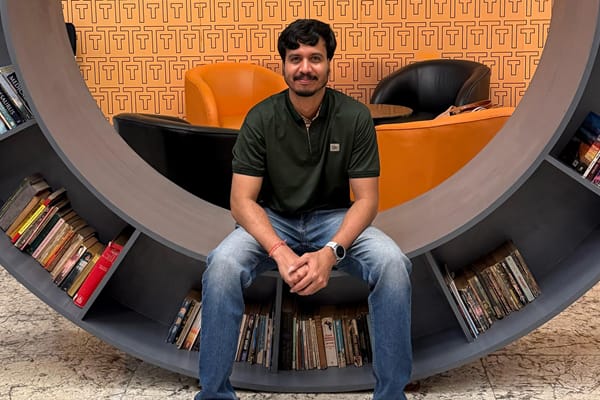
Today we have with us Deep Patel who is no stranger to challenges. He’s overcome them all and gotten multiple admits from top schools this cycle.
In this Q&A with MBA Crystal Ball, Deep shares how he overcame these personal and professional obstacles, managed six GMAT attempts, refined his MBA application strategy after 9 rejections and leveraged his experiences to create awareness and drive social impact.
His story offers valuable lessons for MBA applicants on perseverance, leadership, and pursuing goals with purpose.
Top School Admits After 9 Rejections for a Reapplicant
How I got into Ivy League and Oxbridge MBA programs
Q&A with Deep Patel
MG: To begin with, can you share a little about your life and the challenges you faced?
Deep: Sure. So, I’m a hard-of-hearing individual. I was born without both ears as well as without ear canals, and I also had a big hole in my palate.
So, when I was born, life was not at all pretty much straightened out for me. So, yeah, lots of challenges from the start.
I went through multiple surgeries to reconstruct my ears as well as my ear canals. Unfortunately, at that point in time, we did not have advanced medical science. So, none of the surgeries worked out for me, and that meant I had to rely on self-learning.
Access Free Frameworks →
I used to be the first bencher always in my classes, but then at home, my parents would help me with my studies. So, until schooling, I pursued education in my native medium, which is Gujarati.
I was able to manage, and after some point in time, I also became the valedictorian of my class in 10th as well as 12th.
But then things became very complicated when I started engineering because, overnight, the medium of instruction became English.
Again, the classes were very big compared to my school. So, I could not hear anything at all, even though I was a first-bencher. That was the first time in my life I started exploring multiple hearing aids.
Unfortunately, because of my unique ears, none of the over-the-counter hearing aids worked out for me, and that meant I was not able to participate effectively during engineering.
That also meant I was disqualified from core engineering roles during the placements in my college. So, all in all, there were pretty much many challenges.
But I think as long as you are able to navigate out of them and try to focus more on solving your problems, maybe some things can happen for you.
Career Challenges That Inspired an MBA
MG: When I first heard your story, it was really challenging but also inspirational, the way you navigated it. Tell us more about how you overcame this potential challenge, and why did you decide to pursue your first MBA immediately after undergrad?
Deep: Absolutely. So, as I mentioned, despite having tried three or four multiple hearing aids – they were very expensive solutions – none of them worked out.
That also led to my disqualification from core engineering roles. So, I did not have any solid career prospects in front of me right after graduating from engineering.
I was very frustrated and annoyed as well.
But I also had some dreams in my mind that I want to do something out of my life. So, I started researching a lot about potential solutions.
After doing a lot of research, I finally came up with one solution, which was an implant-based hearing aid, and I did tremendous research on that. I did lots of question-and-answer sessions with my whole team of audiologists as well as my surgeon.
The comforting factor for me was that they were all with me throughout the journey. Whatever questions I had, they just answered them all, and because of that, I went for the surgery.
In parallel, as a backup, I started preparing for exams like the CAT so that I could do a Masters right after my engineering, so that I could do something about my career. It was still not lost.
So, yeah, the reason why I decided to pursue an MBA was to turn around my life. I thought, if not core engineering roles, maybe a desk-based job may work out for me. And given the potential of this new hearing aid, I was pretty much comfortable that these other kinds of job roles might work out.
MG: I think you told me that you were India’s second or third recipient of this, and your state’s first recipient of this hearing aid.
Deep: Yeah, absolutely. So, adding on to that, Manish, I was very scared as well because none of my past surgeries worked out. They were all experimental, and this one was as well for my surgeon, also the first in my state.
There were other two patients who had gone through the surgery but I could not connect with them prior to my surgery. So, it was pretty much a black box for me.
Still, I was so desperate that I was like, what worse can happen? The upsides were unlimited, while the downside was still limited. So, I still decided to go ahead with it.
Choosing the Right MBA Specialization: Why Operations Over Finance
MG: Tell us about the MBA experience because your specialization was in operations, but you decided to make a pivot. What did you do during and after the MBA?
Deep: Absolutely. So, when I did my MBA from Symbiosis, the first year is very generalized. You get to learn all the disciplines. In the second year, you have to select your specialization.
I actually got a summer internship with JP Morgan within the first year itself, and I went ahead with it. I was almost 99% sure that I would be able to convert this opportunity into a full-time role.
At that time, I also realized that most of the roles over here at JP Morgan in India are finance plus operational – we call it F&O.
I felt finance as a specialization was very theoretical. I did not like it.
So, in the second year, since I knew that I would anyway get into JP Morgan, I thought, why not operations? Over there, people were more experienced in my cohort.
Secondly, the kind of subjects were very practical, and they had some very good faculty as well, who were helping us create a mindset with framework-like thinking. Those kinds of things are transferable whether you go into marketing, operations, or anything else.
Based on all of this, I thought, anyway, I don’t want to be focusing only on studies, so, why not operations?
Again, in JP Morgan, I realized that a lot of the tools that we were using, like project management, program management, product ownership, and all; 90% of that was again people management, stakeholder management, and mostly it was covered by operations and not by finance management. So, I thought, why not operations?
Career Growth at JP Morgan Before Applying for a Global MBA
MG: How many years have you worked with JP Morgan? What has the experience been like?
Deep: So, I have been over here at JP Morgan for almost 8 years. I joined JP Morgan as part of one rotational program, which is called the Corporate Analyst Development Program.
As part of that, I went through the disciplines of process improvement, project management, and analytics. Each discipline was of eight months, and we got to work with very different departments altogether.
Finally, I decided to continue with project management. I worked as a project manager on one global reconciliation project. We made some pretty cool software applications that are used by thousands of JP Mites all across the globe.
Then I got bored with project management, so I decided to upgrade myself.
So, I joined my current team as a product owner. Over here, I got to work as a product owner and got to design a product roadmap, and also talk to various stakeholders across the globe in different capacities. So, it gave me a flavor of so many things.
So, yeah, all in all, at JP Morgan, I have enjoyed it a lot because people are very dynamic, and there are so many opportunities that you can just internally move to different departments and different roles, as long as you are capable and think you will manage it. So, the journey is pretty much exciting.
Demonstrating Leadership Beyond Work: Accessibility and Social Impact
MG: Yeah, pretty rich career, and pretty demanding as well! But you had an interesting list of activities outside of work. So, talk to us about that.
Deep: Absolutely. So, after I went through this hearing-aid-based implant, I was able to communicate with people in person only. But when I had to talk to others on virtual forums like Zoom calls and all, I had to rely on my natural hearing.
The problem was that even though I was using pretty high-spec headphones, the volume was getting too loud for my colleagues who were sitting next to me. So, I was not able to make it loud enough for me.
As a result, I was not able to participate in the calls effectively. That impacted my career progression as well.
Over there, I started exploring multiple solutions with the HR, the technology support team, etc. Luckily, I found that JP Morgan is very much into supporting people, especially people like me. I found some pretty solid solutions.
As part of my journey, I realized that from India, the representation of the DHH (The Deaf and Hard of Hearing) community was also not that good. So, what I did was, whatever directors I came in contact with as part of my roles, I started talking to them about my journey and also about my experience exploring different solutions.
With their help, I started spreading awareness locally within India, and finally at a global scale. I was so fortunate that when JP Morgan was building its new headquarters at Park Avenue North.
I was part of one of the forums where people like me were suggesting ideas on what kind of technological solutions could be implemented within this facility so that people like me could effectively participate in group meetings, in person as well as on virtual forums.
Things like transcription work on your screen, but not when you are in a meeting room. So, those kinds of solutions, and then there are hearing-loop solutions if you are using advanced hearing aids. Those kinds of things are already there in the Park Avenue North headquarters.
Then, outside of JP Morgan, I also did some pretty exciting work in my own community. In India, awareness about the DHH community and the different solutions available is pretty much dormant. Nowadays, people are talking about it because of AI, social media, and everything.
What I did was, based on my personal experience, I started motivating and interacting with other people like me who came in touch with me because of my audiologists. I shared my journey with them.
I also told them how my life was before the surgery and what changed after the surgery. I explained how I was able to participate more effectively.
Because they could see that I had been through this journey and experienced it myself, they started trusting me. Many success stories also came out as part of this. So, I’m very happy that things started falling into place for me as well as for my community.
Why Pursue a Second MBA? My motivation and purpose
MG: I think it’s very inspirational, the way you’ve helped hundreds, even thousands of people through this. So, everything was going well. When and how did you start thinking about a second MBA?
Deep: So, the first MBA which I pursued, I was kind of forced to do it. My original plan was that I would get some experience before doing an MBA. It did not materialize.
So that time, when I joined Symbiosis, I had made a promise to myself that I’m not done yet. I definitely do want to be part of some global-level Tier 1 MBA experience. So the dream was there.
Then, when I started working here at JP Morgan, one of my colleagues, who is my best friend as well, started preparing for the CAT. He got multiple admits from FMS and all. Then he reached out to me, “Should I pursue this MBA over here in India?”
I told him that if he did not have any experience, maybe I would have suggested it, but since he had experience, maybe he could start exploring abroad MBAs as well.
That time, he started working for the GMAT. He forwent all of the admits from India. He got multiple admits from T10 B-schools, T15 as well, and right now he’s at Duke.
The kind of things he’s telling me – how the crowd is very diverse with people from multiple nationalities, my whole dream started coming to light.
I thought, ‘This guy was working with me. Whatever things I was doing, he was also doing the same. The only thing is, he’s more aggressive and more clear about what he wanted to do‘.
In the meantime, through my experience of mentoring the DHH community here in India and in JP Morgan as well, I realized that people like me are not able to do many things. I have still been privileged that I was able to go through this very expensive hearing aid solution.
So I thought, is there any MBA program which can help me realize my mission of providing affordable hearing aid solutions to marginalized communities, especially people from India.
That time, I came across some solid programs, and I thought, ‘okay, I definitely have to do something about it‘. The very first step was that I gave some GMAT attempts.
I was able to crack it, and finally, once I had a decent enough score, I started applying to these schools. So this is the whole reasoning why I wanted to pursue a second MBA.
GMAT Preparation Strategy That Led to a 695 Score
MG: Give us a little more sort of color on your GMAT journey. How many attempts did you make? What was your final score? Any resources that you would recommend?
Deep: I had joined one coaching class. They had provided all the well-planned materials. It had everything. I did not have to do anything outside of it.
The problem was, they had given a structured plan.
I kind of became oversmart, and I thought, ‘Okay, this kind of plan, I don’t like. It’s for everyone, so let me not follow it’. And in that whole mindset, I wasted 5 attempts.
Finally, for the sixth attempt, I realized that, ‘Okay, I’m not doing it well at all‘. So I started following their plan. I started focusing only on the very challenging problems, like we say, the 700+ level problems because, in my 5 attempts, I was stuck at the 85th to 90th percentile.
I was not able to go beyond that, and I realized that I was making the last-mile one or two mistakes, and that was impacting my overall score. So I just unlearned everything. I rigorously followed their plan.
What I did was only start focusing on very difficult problems. They were like, they will give you a nightmare, those kinds of problems.
If I talk about RC, literature is the weakest area for me. I did not like it at all. So I started focusing on RCs only for literature.
I liked science a lot, so I thought, ‘I don’t have to focus extra on this. I will anyway be able to manage it’.
So those kinds of little things I improved a lot on – my weak areas all across the board, Verbal, Quant, and DI as well.
Luckily, what happened was, my five attempts were in the older pattern. Over there, the DI section was not mandatory. It did not count toward the overall score. In the new pattern, DI was also there, and I thought it was my strength.
So what I did was I started preparing a lot for very long RCs, very complicated as well. That whole preparation helped me with DI indirectly because, in DI, you don’t have enough time to read everything.
You just have to skim through, and you have to quickly do the calculations – mental calculations. You have to come up with an answer also. You don’t have enough time to revise or review your answer.
So, I focused on my weak areas, that’s how I was able to get a decent score in the final attempt, which was the sixth one.
MG: So what was your score? Share with us.
Deep: In the final attempt, the score was 695. Verbal was still tough for me. I was able to score only 81, which is like the 67th percentile. But since DI was so good, I was able to crack a decent overall score.
MG: So, armed with the score, you applied but did not go through. Talk to us about that experience. How many schools did you apply to, and how did you feel after not getting through?
Deep: So, last year I had attempted eight or nine schools after getting this kind of good score, and I thought that, ‘Okay, my story is also pretty unique. So, I was a bit overconfident in terms of my application drafting‘.
The thing is, my story was there, but what was required was to put it across in the application, and I did not do good justice at all.
I was not able to make a cohesive story of me, like my experience with the DHH community, my experience at JP Morgan, along with my short-term and long-term goals.
My post-MBA goals were pretty generic. ‘I want to become a product manager in big tech‘. Those kinds of goals I came up with. So, it was like here and there, and that’s why I think I was not able to get it right.
Why I Chose MBA Crystal Ball for My MBA Reapplication
MG: Earlier you applied with another consultant, and then the next time around, how did you discover MCB? What was your experience like?
Deep: So, last year, when I was applying to multiple schools, I had a friend from my own team. He was also applying to T20 schools. He got into two or three schools.
That time, when I did not get in, he told me that maybe the frequency was not matching with the earlier consultant I was working with. I needed some more hand-holding in terms of the whole planning.
So, at that time, he suggested three consultants, and one of them was you as well.
I immediately went to the Reddit forum. Now, Reddit is very brutal in terms of providing feedback.
Over there, I was able to find only one con, which was that MCB is a bit expensive. But apart from that, people were like, they will be able to help you with discovering your plans and all. They will give you more than enough time. There were no other negatives.
Now I was like, okay, you are the guys I have to reach out to. I also explored your website. It is pretty well planned, very well structured as well. I got my answers as well.
Finally, I had a mock interview, or rather, I would say I had some connect with you before even going ahead with you. Over there, I found your approach very blunt and very honest as well, and that was the kind of thing I was looking for.
Why? Because I already had rejections from 9 schools on my plate. This time, I was looking for some honest feedback so that I could actually improve myself and convert some of the schools.
So, because of that, I decided to go ahead with it.
From Nine MBA Rejections to Yale, Oxford and Cambridge Admits
MG: So this time around, how many schools did you apply to? Where did you interview? Anything that stands out from any of the interviews you’d like to share?
Deep: I had applied to many schools in Round 1 as well as in Round 2. In Round 1, I had applied to four USA schools and two UK schools. In the UK, I applied to Cambridge and Oxford. In the USA, I applied to Yale, Tuck, NYU Stern, Kellogg for the full-time two-year program.
I got interview invitations from five of them except for NYU Stern.
I was waitlisted without an interview for NYU. So, working with you, the experience was pretty good. And I was able to convert multiple schools, including Yale.
At that time, after talking to MBA Crystal Ball, I thought, why not take another chance and apply to M7 again in Round 2? I decided to apply to Columbia. Unfortunately, I was not able to convert it.
MG: Anything that stands out from all these interviews that you would like to share with us?
Deep: So, as long as the interview is from USA schools, it is pretty much a ‘catch-up’ kind of thing. They just want to learn from you who you are, as a person and whether you will fit into their community. So, the interview will be quite chilled.
But if you talk about interviews from Oxford and Cambridge, they are more structured. They want to know you as a person, but they also want to know what you have done as part of your extracurriculars, your professional commitments, and sometimes your academics.
So, I was a bit intimidated by this kind of structure because I started with the US, then the interviews were from the UK. But still, I think if you have worked a lot on your application in a structured manner, especially with a team like yours, you are there.
You have done all the things that you have mentioned in your application. You just have to articulate them accordingly.
So that was my overall experience.
MG: So now, with a drum roll, tell us where did you make it, and where are you headed?
Deep: So, I made it to Oxford and Cambridge, and in the US, I made it to Yale.
Now, the Oxford and Cambridge programs are only one year. They are pretty fast-paced, and I am rather in a phase to rediscover myself again. So, I needed some more time. That’s why I have decided on Yale.
Yale also, because of its Ivy League, its integration with the wider university, the School of Environment, the School of Policy, and everything. Also, Yale has a pretty tight pipeline for consulting and banking as well.
My MBA Admissions Advice for Applicants
MG: Excellent! That’s amazing. Great things ahead. Anything that you’d like to share, like your top one or two learnings from your entire journey for future applicants?
Deep: Absolutely! So, GMAT is just the first step. But it is the most important step. Why? Because we Indians are from an overrepresented community. So, if we have to even knock on the door of these schools, we do need a good score.
Secondly, in terms of your applications, you have to be very clear about what you want to achieve. So, you have to narrate it in a way that it connects with your prior experience, like your academics, your extracurriculars, and your professional experience as well.
This is like a whole journey. It is very slow and very boring, but as long as you are able to give some disciplined action, like every day you have to work on it for two to three hours even if you are a working person, you can’t say, ‘Okay, today I’m not in the mood, I don’t want to work‘.
You just have to give it time; over a period of time and over a period of iteration, your story will start coming out. Once it starts coming out, then you feel that something is going in the right direction.
But before that, you have to reach there, right? And for that, you just have to take some time, be patient with yourself, and I think it will just happen.
MG: Excellent. Thanks so much for sharing your journey with us, and all the best with your career ahead.
Thanks a lot, Manish.
At MBA Crystal Ball, our experts have helped thousands of MBA aspirants get into the top business schools, often with scholarships. Drop us a line at info@mbacrystalball.com if you need our help.
